
Skip to content
The Encyclopedia of Horology

Tool · Flemish astronomical ring dial

Astronomical Ring Dial by Gualterus Arsenius

Partially verified

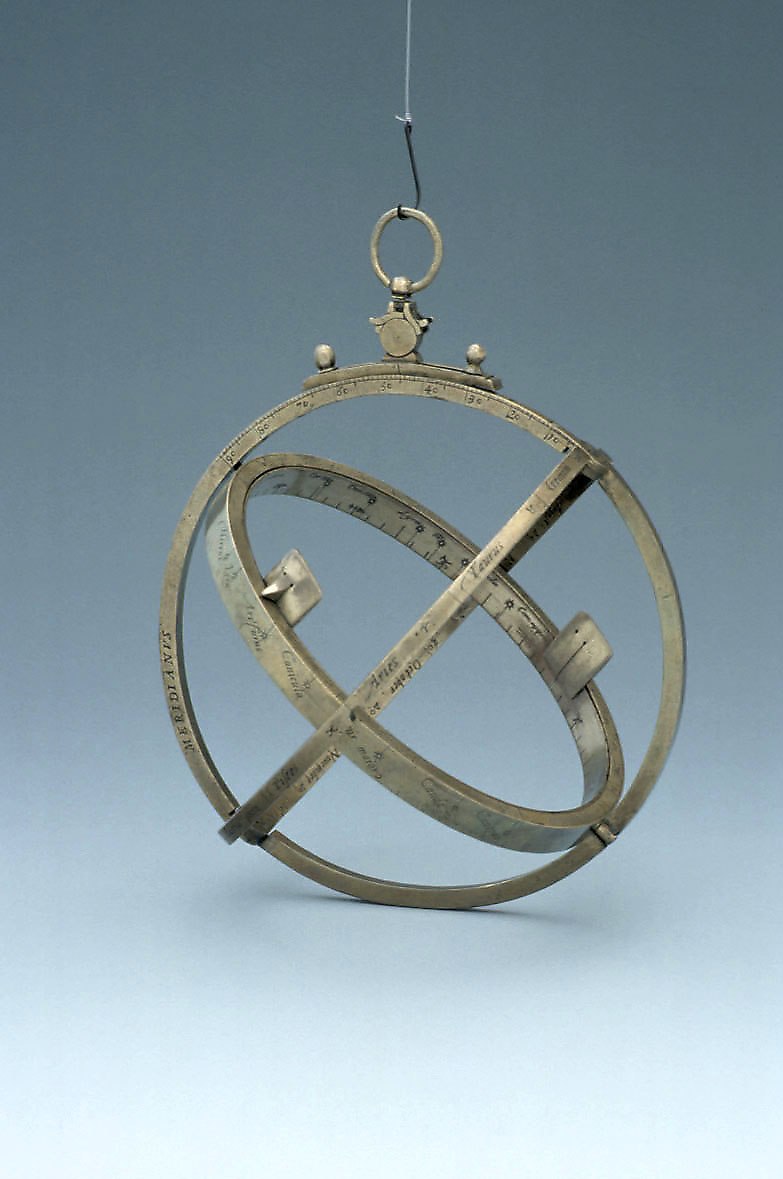
This astronomical ring dial is a brass instrument measuring 111 mm in diameter. It is signed by Gualterus Arsenius and dated 1567 at Louvain. The construction follows the format described by Gemma Frisius, featuring folding rings for the meridian, equator, and declination, along with a sliding ring for the sights. The meridian ring includes a latitude scale, while the equatorial ring displays hours, a shadow square, and a zodiacal calendar. The declination ring features a zodiac scale, a declination scale, and star markings. A sliding ring, which acts as a later replacement, provides two sights with pinholes and additional astronomical scales. The instrument is held by the Museum of the History of Science, Oxford, and possesses a provenance involving the Michel and Billmeir collections.

Astronomical ring dial, signed by Gualterus Arsenius, 1567.
Astronomical ring dial, signed by Gualterus Arsenius, 1567. — Museum of the History of Science, Oxford. Rights pending — permission not yet requested. Original source

Catalogue identity

Source
www.mhs.ox.ac.uk
Category
Tool · Flemish astronomical ring dial
Maker / attribution
Gualterus Arsenius
Reference
Not recorded
Catalogue / lot identifier
48126
Source-reported date
1567
Source-reported place
Belgium

Source-reported attribution and specifications are not independent authentication. A listing does not establish present ownership, current display, availability or permission to reproduce.

Object description

Construction and Design

The instrument is constructed from brass and measures 111 mm in diameter. It follows the format established by Gemma Frisius, utilizing a series of folding rings to perform astronomical calculations. The frame consists of a meridian ring, an equatorial ring, and a declination ring.

The meridian ring incorporates a latitude scale marked from 0 to 90 degrees. The suspension mechanism allows for adjustments in latitude via slots provided in the suspension plate. The outer rim includes markings for the arctic and antarctic poles and provisions for mounting the suspension hardware.

Evidence for this section
  • “The instrument is in the form described by Gemma Frisius”
  • “The meridian ring has a scale of latitude 0 to 90, divided to 10, 5 and 1, and numbered by 10.”

Astronomical Scales

The equatorial ring provides multiple functions on its two faces, including a semicircle of hours divided into 20-minute and 4-minute intervals, and a shadow square labeled 'VMBRA RECTA' and 'VMBRA VERSA'. It also supports a zodiacal calendar located on the inner rim, while the zodiac signs are engraved on the outer rim.

The declination ring carries scales for declination and a further circular scale of hours. The outer rim of this ring marks the declination of 14 specific stars, which is also reflected on the innermost sliding ring. This ring, used for sighting, contains two pinhole sights.

Evidence for this section
  • “The equatorial ring is twice titled on one face 'AEquator' and carries a semicircle of hours 0 to 12 numbered by 1”
  • “The outer rim of the declination ring names and marks the declination of 14 stars.”

Signatures and History

The instrument is signed by Gualterus Arsenius, who identifies himself as the nephew of Gemma Frisius. The signature and date are engraved on the meridian ring, confirming its origin in Louvain in 1567.

The instrument has been held in at least two notable collections: the Michel Collection and the Billmeir collection, before entering the holdings of the Museum of the History of Science in Oxford. The source notes that the inner sliding ring is a later addition based on its distinct engraving style.

Evidence for this section
  • “It was therefore especially appropriate for the instrument maker Gualterus Arsenius to sign this instrument as 'Nepos Gemmae Frisij Louanij fecit 1567'”
  • “From the engraving style, this inner ring is a later replacement.”

Open research questions

  • What specific stars are represented by the 14 marks on the declination ring?
  • Does the current replacement sliding ring affect the accuracy of the solar time conversion?

Source evidence

Recorded claims and source quotations for Astronomical Ring Dial by Gualterus Arsenius
FieldSource-reported valueSource quotation
MakerGualterus Arsenius“Signed by Gualterus Arsenius”
Date1567“Dated 1567; Louvain”
MaterialBrass“Brass; 111 mm in diameter”
ProvenanceMichel and Billmeir collections“Provenance: Michel Collection; Billmeir collection (57-84/24).”
Inventory Number48126“Inventory number: 48126”
InscriptionNepos Gemmae Frisij Louanij fecit 1567“'Nepos Gemmae Frisij Louanij fecit 1567'”

Visible details

  • Meridian ring features a latitude scale numbered by 10
  • Equatorial ring includes both a shadow square and a zodiacal calendar
  • Sliding ring carries two sights with pinholes

Research qualifications

  • The innermost sliding ring is identified as a later replacement based on engraving style
  • The exact nature of the zodiac divisions on the sliding ring is queried by a question mark in the source

Photograph identity and source facts were screened before import; rights clearance remains pending.

Consulted source

Astronomical Ring Dial

Reviewed 2026-10-26 · Record 6ecbc40f27

Terms in this record

Glossary explanations for terms named in this object’s record.