
Skip to content
The Encyclopedia of Horology

Tool · Augsburg astronomical compendium

Astronomical Compendium

Partially verified

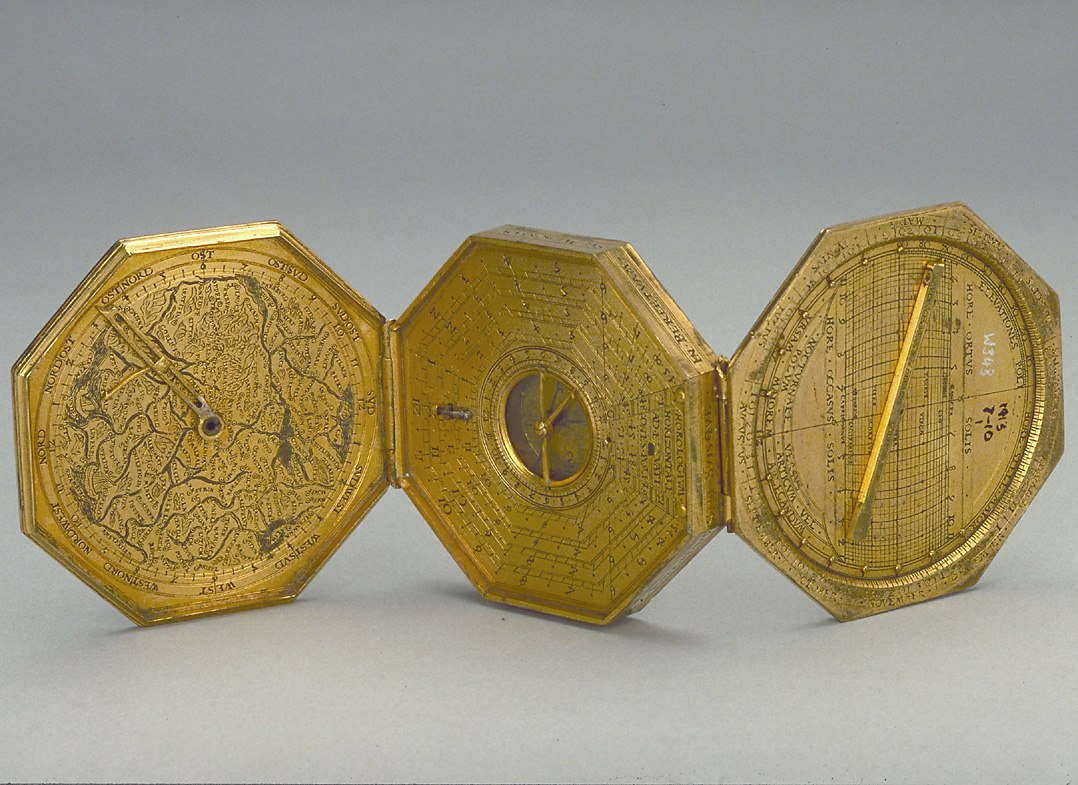
This astronomical compendium, signed by Christoph Schissler and dated 1557, is an octagonal instrument crafted from gilt brass. Measuring 77 x 77 x 15 mm, it comprises three primary leaves featuring complex integrated astronomical and time-reckoning devices. The upper leaf contains a polar projection of the northern hemisphere on a rotating plate and a map of central Europe on the interior. The central leaf features a compass and a horizontal gnomon dial calibrated for four specific latitudes. The lower leaf incorporates a lunar volvelle, an aspectarium, and a nocturnal for determining time. The outer case is engraved with a commemorative inscription naming Ioannes Rosenberg as the patron. The instrument is held by the British Museum, having been presented by Maurice Rosenheim in 1913. Its multifaceted design demonstrates the combination of cartography, solar, and lunar timekeeping.

The open octagonal astronomical compendium displaying the internal map of central Europe, the central dial with compass, and the nocturnal/Rojas projection.
The open octagonal astronomical compendium displaying the internal map of central Europe, the central dial with compass, and the nocturnal/Rojas projection. — British Museum, London. Rights pending — permission not yet requested. Original source

Catalogue identity

Source
www.mhs.ox.ac.uk
Category
Tool · Augsburg astronomical compendium
Maker / attribution
Christoph Schissler
Reference
Not recorded
Catalogue / lot identifier
MLA 1913, 7-10.1
Source-reported date
1557
Source-reported place
Augsburg

Source-reported attribution and specifications are not independent authentication. A listing does not establish present ownership, current display, availability or permission to reproduce.

Object description

Construction and Layout

The compendium is constructed as an octagonal device formed of three main leaves with additional hinged plates. The upper leaf includes a rotating circular plate engraved with a polar projection of the northern hemisphere, surrounded by an hour scale that functions as a pin gnomon dial when equipped with a gnomon. The interior of this leaf features a south-oriented map of central Europe, centered north of Nuremberg and surrounded by a scale of hours with cardinal points named in German.

The central leaf houses a compass and a gnomon dial with a folding solid gnomon. The reverse of this central plate provides a detailed list of cities and their associated latitudes across six distinct bands, secured with rose-shaped rivets. In the center of this plate is an engraving of a woman's bust.

Evidence for this section
  • “The compendium is made of three main leaves with additional hinged plates.”
  • “The inside of this leaf has a south oriented map of central Europe”
  • “The inside of the central leaf has a compass in the centre”
  • “The back of the central plate is inscribed with a list of cities and latitudes”

Astronomical and Timekeeping Functions

The lower leaf is configured with a lunar volvelle that is pierced to display lunar phases and figures numbered 1 to 29. It also functions as an aspectarium, with two sets of hours engraved along the edge. The exterior of this leaf is engraved with a Rojas projection and a nocturnal for time calculation by the stars, alongside a calendar scale.

The horizontal dial in the central leaf is designed for use at latitudes 45, 48, 51, and 54 degrees. The instrument facilitates various astronomical calculations, including sunrise and sunset times and the conversion of different systems of hours.

Evidence for this section
  • “The inside of the lower leaf, hinged opposite the upper leaf, has a lunar volvelle.”
  • “The lower side of the circle is a nocturnal with hinge at 21 August.”
  • “The dial can be used at latitudes 45?, 48?, 51? and 54?”
  • “various devices for finding the times of sunrise and sunset and converting different systems of hours.”

Inscription and Provenance

The exterior sides of the compendium feature an inscription documenting the commission by Ioannes Rosenberg for his own memory, dated 1557, along with the signature of Christoph Schissler. The piece was presented to the British Museum by Maurice Rosenheim in 1913.

The instrument is documented in the 1981 catalogue of European scientific instruments held by the British Museum, identifying it by the inventory number MLA 1913, 7-10.1.

Evidence for this section
  • “On the sides of the main box of the compendium is the inscription”
  • “ET CHRISTOPHORVS SCHISSLER FECIT”
  • “The instrument was presented by Maurice Rosenheim in 1913”
  • “described in F.A.B. Ward, A Catalogue of European Scientific Instruments in the Department of Medieval and Later Antiquities of the British Museum”

Open research questions

  • What specific purpose did the circle devoid of markings between the hinge and the compass case serve?
  • Could the missing gnomon and nocturnal index be reconstructed based on Schissler's known techniques of the period?

Source evidence

Recorded claims and source quotations for Astronomical Compendium
FieldSource-reported valueSource quotation
MakerChristoph Schissler“Signed by Christoph Schissler”
Date1557“Dated 1557”
Place of manufactureAugsburg“Augsburg”
MaterialGilt brass“Gilt brass”
Dimensions77 x 77 x 15 mm“77 x 77 x 15 mm”
PatronIoannes Rosenberg“commissioned from Christoph Schissler by Ioannes Rosenberg in his own memory”
Registration NumberMLA 1913, 7-10.1“Registration no. MLA 1913, 7-10.1”

Visible details

  • The compendium is octagonal in form and constructed of gilt brass.
  • The compass needle is reported as detached within the central leaf.

Research qualifications

  • The source notes the compass needle is detached.
  • The source reports the gnomon is missing, and the nocturnal index is missing.

Photograph identity and source facts were screened before import; rights clearance remains pending.

Consulted source

Astronomical Compendium

Reviewed 2026-10-26 · Record c7282ac42d

Terms in this record

Glossary explanations for terms named in this object’s record.