
Skip to content
The Encyclopedia of Horology

Tool · Augsburg astronomical compendium

Astronomical Compendium by Christoph Schissler

Partially verified

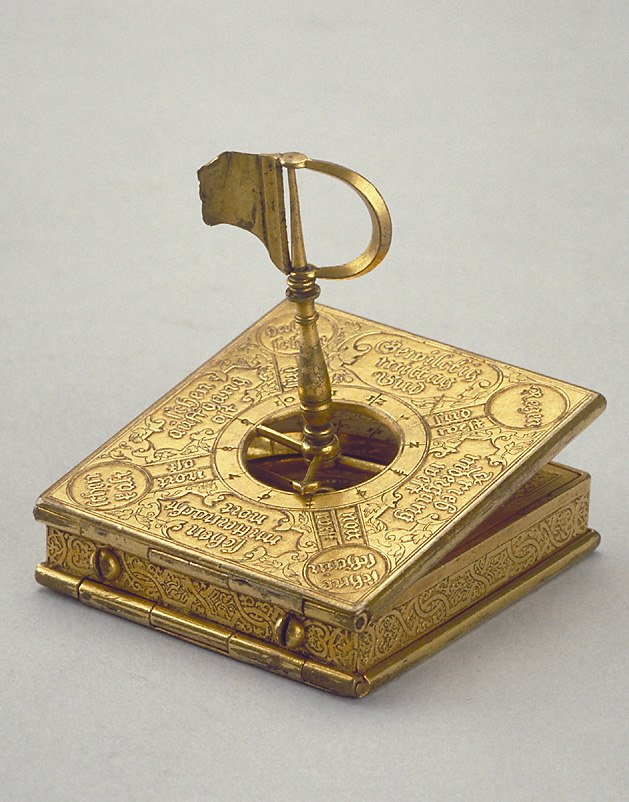
This astronomical compendium, fashioned from gilt brass, measures 60 x 65 x 12 mm when closed. It is signed by the Augsburg maker Christoph Schissler and is attributed to circa 1550 based on comparisons with dated pieces, which suggests it is among the maker's earliest instruments. The device features a 'wegweiser' on the lid, which includes a magnetic compass, a 12-hour scale, and a wind vane with weather prognostications. The interior contains a universal equatorial sundial, originally equipped with a pin gnomon, and a horizontal string gnomon dial that incorporates a latitude scale marked 'ELEVATION POLI'. The base of the instrument is engraved with a list of 24 European cities alongside their respective latitudes. The surface is decorated with arabesque patterns, and inscriptions are executed in raised lettering. It is currently part of the collection at the British Museum.

Gilt brass astronomical compendium by Christoph Schissler, circa 1550.
Gilt brass astronomical compendium by Christoph Schissler, circa 1550. — British Museum, London. Rights pending — permission not yet requested. Original source

Catalogue identity

Source
www.mhs.ox.ac.uk
Category
Tool · Augsburg astronomical compendium
Maker / attribution
Christoph Schissler
Reference
Not recorded
Catalogue / lot identifier
MLA 1855,9-4.1
Source-reported date
circa 1550
Source-reported place
Augsburg

Source-reported attribution and specifications are not independent authentication. A listing does not establish present ownership, current display, availability or permission to reproduce.

Object description

Instrument Layout and Exterior

The lid of the gilt brass box functions as a 'wegweiser', displaying the eight primary cardinal directions alongside weather forecasts and sun movement data. A central aperture exposes an internal magnetic compass, which shows a deviation of approximately 10 degrees east of north. Surrounding this aperture is a 12-hour scale, while a metal bridge, housing a wind vane, spans the centre.

The exterior ornamentation consists primarily of arabesque patterns. The inscriptions, detailing meteorological phenomena such as 'Gewilckig' and 'Regen' alongside directional headings like 'nord ost' and 'sud west', are executed in raised lettering.

Evidence for this section
  • “The lid of the box is laid out as a 'wegweiser' with the eight main directions and corresponding weather prognostications”
  • “All the inscriptions are done in raised lettering.”
  • “An inset magnetic compass shows a magnetic deviation of circa 10? east of north.”

Interior Dials and Functionality

Opening the instrument reveals a universal equatorial sundial plate, numbered in a clockwise direction. Beneath this component lies a horizontal string gnomon dial, featuring hour lines ranging from 4 to 8. This dial includes a latitude scale, labelled 'ELEVATION POLI', calibrated from 0 to 60 degrees.

Adjustability is achieved through a hinged supporting arm attached to the upper plate. The bottom of the instrument provides a reference list of 24 European cities, such as 'Venedig' and 'Paris', each paired with its specific latitude measurement.

Evidence for this section
  • “Opening the lid reveals a universal equatorial sundial plate, numbered twice clockwise 1 to 12.”
  • “Underneath this plate is a horizontal string gnomon dial with the hour lines marked 4 to 12 to 8 and a scale of latitudes (marked 'ELEVATION POLI') 0? to 60?”
  • “The bottom is inscribed with a list of 24 European places with their latitudes as follows: 'Granata 38', 'Lisibona 40'”

Attribution and History

The instrument is signed by the noted Augsburg maker Christoph Schissler. While the piece itself is undated, researchers compare its construction and decorative motifs with other dated instruments to arrive at an attribution of circa 1550. This comparison indicates the object may be one of Schissler’s early works.

The compendium was acquired by the British Museum in 1855. It is documented in the 1981 publication by F. A. B. Ward, which details European scientific instruments in the museum's collection.

Evidence for this section
  • “The compendium is undated, but the comparison with dated instruments suggests that it is one of Schissler's earliest pieces.”
  • “The instrument was purchased in 1855 and is described in F. A. B. Ward, A Catalogue of European Scientific Instruments in the Department of Medieval and Later Antiquities of the British Museum (London, 1981), p. 121, no. 350.”

Open research questions

  • What is the specific nature of the missing pin gnomon mechanism?
  • Are there variations in the latitude values listed on the base compared to modern measurements?

Source evidence

Recorded claims and source quotations for Astronomical Compendium by Christoph Schissler
FieldSource-reported valueSource quotation
MakerChristoph Schissler“Signed by Christoph Schissler”
Datecirca 1550“circa 1550”
MaterialGilt brass“Gilt brass”
Dimensions60 x 65 x 12 mm closed“60 x 65 x 12 mm closed”
LocationAugsburg“Augsburg”
Inventory NumberMLA 1855,9-4.1“MLA 1855,9-4.1”
SignatureCRISTOF SCHISLER AVGSPURG“'CRISTOF SCHISLER AVGSPURG'”

Visible details

  • Wegweiser on the lid with weather prognostications
  • Gilt brass construction with arabesque decoration
  • Horizontal string dial with adjustable arm
  • List of 24 cities with latitudes on the base

Research qualifications

  • The pin gnomon for the universal equatorial dial is missing.
  • The wind vane is partially broken.

Photograph identity and source facts were screened before import; rights clearance remains pending.

Consulted source

Astronomical Compendium

Reviewed 2026-10-26 · Record 65093dee31

Terms in this record

Glossary explanations for terms named in this object’s record.