
Skip to content
The Encyclopedia of Horology

Tool · Augsburg astronomical compendium

Astronomical Compendium by Christoph Schissler

Partially verified

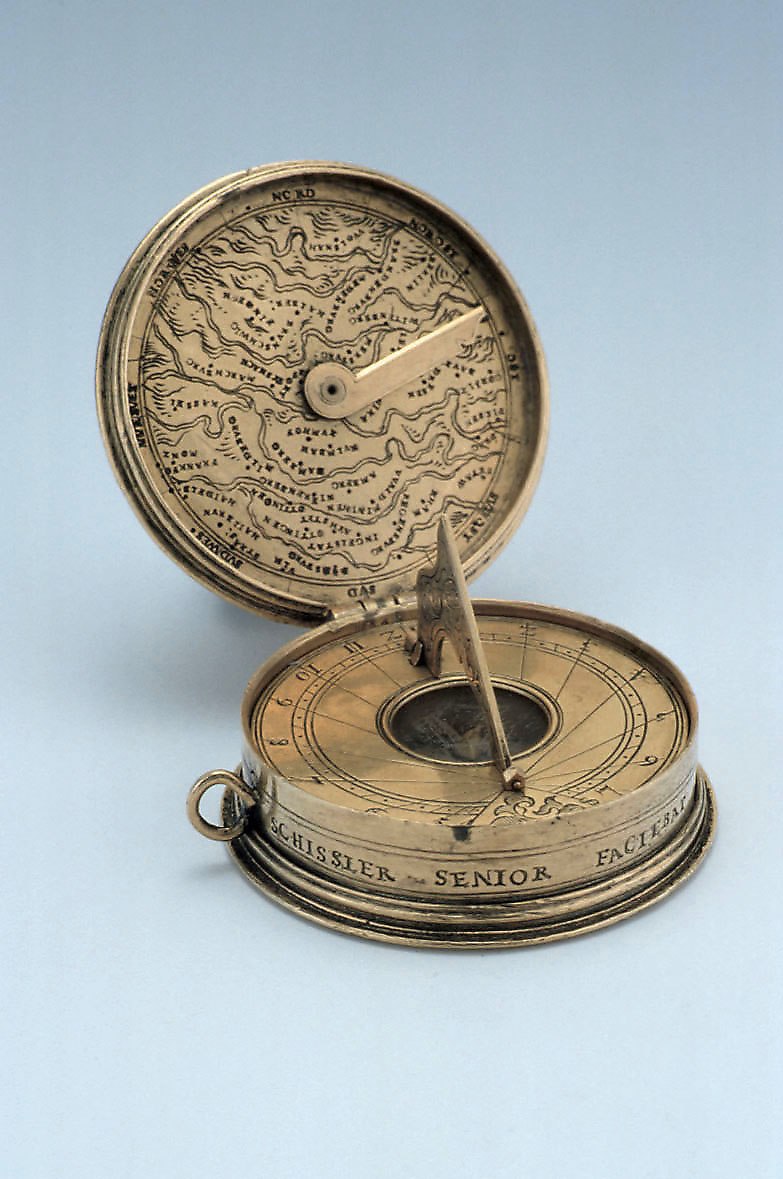
This circular astronomical compendium, dated 1608 and made of gilt brass, measures 62 mm in diameter. Signed by Christoph Schissler, The instrument features a suspension ring and a single cover. The interior of the main box contains an inclining sundial equipped with a folding gnomon and an integral compass bowl featuring a silvered base plate. The underside of the dial plate reveals latitude scales used for setting the device's inclination. The interior of the cover displays a map of Central Germany. Externally, the device includes a lunar volvelle and aspectarium, though these components and the associated retaining nut are suspected to be later replacements due to inconsistencies in engraving style and construction details. The base of the instrument is engraved with a circular table of latitudes for various European cities.

The open astronomical compendium showing the inclining sundial, internal compass, and the map of Central Germany on the interior of the cover.
The open astronomical compendium showing the inclining sundial, internal compass, and the map of Central Germany on the interior of the cover. — Museum of the History of Science, Oxford. Rights pending — permission not yet requested. Original source

Catalogue identity

Source
www.mhs.ox.ac.uk
Category
Tool · Augsburg astronomical compendium
Maker / attribution
Christoph Schissler
Reference
49061
Catalogue / lot identifier
49061
Source-reported date
1608
Source-reported place
Germany

Source-reported attribution and specifications are not independent authentication. A listing does not establish present ownership, current display, availability or permission to reproduce.

Object description

Construction and Signature

The compendium is constructed of gilt brass and measures 62 mm in diameter. It is fitted with a suspension ring and a single cover. The maker's signature is located within an engraved band that runs around the outer circumference of the main box.

The signature reads: 'CHRISTOPHORVS SCHISSLER SENIOR FACIEBAT AVGVSTAE VIN: Ao 1608'. The date of 1608 corresponds to the year of Christoph Schissler's death, and this device is described by the Museum of the History of Science as a potentially final instrument produced by the maker.

Evidence for this section
  • “'CHRISTOPHORVS SCHISSLER SENIOR FACIEBAT AVGVSTAE VIN: Ao 1608'”
  • “Gilt brass; 62 mm in diameter”

Components and Functions

The interior of the box features an inclining sundial with a folding gnomon that is sprung to the vertical. The dial plate moves on two pivots, allowing it to be depressed to expose latitude scales ranging from 33 to 60 degrees. An integral compass bowl with a silvered base plate is set into the dial, marked with four directions.

The cover's interior displays a map of Central Germany, featuring an index used for orientation. The base of the instrument serves as a table of latitudes for various locations across Europe, including England, listing cities such as London and Oxford.

Evidence for this section
  • “The main box holds an inclining sundial with a folding gnomon”
  • “The reverse of the cover carries a map of Central Germany”
  • “The base of the instrument has a circular table of latitudes”

Volvelle and Potential Replacements

The top of the cover features a lunar volvelle and aspectarium. Observations suggest these components may not be original to the instrument.

The central retaining nut and the rotating index on the map are also believed to be later additions, as they do not conform to the construction methods generally used in Schissler's other instruments.

Evidence for this section
  • “The volvelle may not be original.”
  • “If the volvelle is a replacement, the central retaining nut is likely to be too”
  • “If the cover's volvelle and retaining nut are replacements, it is highly likely that this index would have been fitted at the same time.”

Open research questions

  • What is the specific provenance history of this instrument between 1608 and its acquisition by the museum?
  • Are there any physical traces or comparative markers that definitively confirm the volvelle as a later replacement versus a rare variant by the maker?

Source evidence

Recorded claims and source quotations for Astronomical Compendium by Christoph Schissler
FieldSource-reported valueSource quotation
SignatureCHRISTOPHORVS SCHISSLER SENIOR FACIEBAT AVGVSTAE VIN: Ao 1608“'CHRISTOPHORVS SCHISSLER SENIOR FACIEBAT AVGVSTAE VIN: Ao 1608'”
Dimensions62 mm in diameter“62 mm in diameter”
MaterialGilt brass“Gilt brass”
Date1608“Dated 1608”
Sundial typeInclining sundial“comprising an inclining sundial”
Latitude coverage33 to 60 degrees“at north, there is a scale from 33 to 48? at 3? intervals; at south the scale runs 48 to 60?, again at 3? intervals.”

Visible details

  • Engraved signature along the outer box circumference
  • Folding gnomon with spring mechanism
  • Map of Central Germany on the interior cover
  • Silvered compass base plate

Research qualifications

  • The lunar volvelle and central retaining nut may be non-original replacements
  • The west point on the cover's map scale was corrected after initial engraving

Photograph identity and source facts were screened before import; rights clearance remains pending.

Consulted source

Astronomical Compendium

Reviewed 2026-10-26 · Record 077ef560da

Terms in this record

Glossary explanations for terms named in this object’s record.