
Skip to content
The Encyclopedia of Horology

Tool · German astronomical compendium

Astronomical Compendium

Partially verified

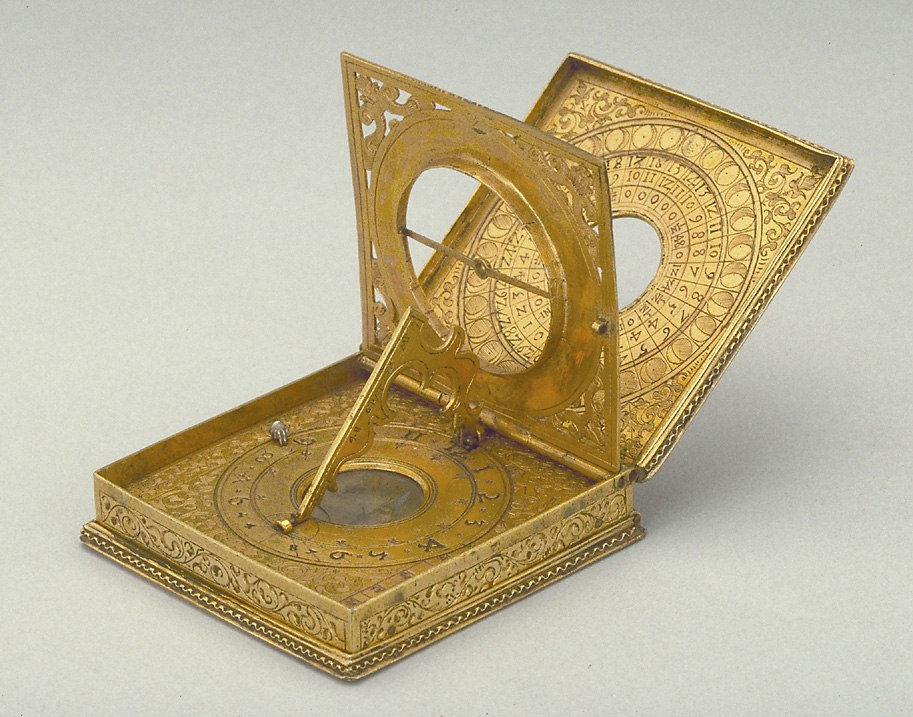
This unsigned astronomical compendium, dating to the late 16th century, is constructed from gilt brass and measures 70 x 70 x 15 mm. The instrument comprises multiple nested leaves hinged to allow for various astronomical and time-keeping functions. It features a horizontal dial for latitude 48°25', equipped with a folding gnomon secured by a silver catch shaped like a hand. The compendium includes a lunar volvelle with compass viewing hole, alongside tables for solar and lunar time conversions. A universal equatorial dial plate is provided, although the gnomon and the latitude adjustment arm for this component are missing. The outer surfaces are engraved with weather-related wind data, a list of 57 cities with their respective latitudes, and seasonal information tied to saints' days. It is currently housed in a leather box lined with red leather.

Top view of the gilt brass astronomical compendium showing the internal dial, folding gnomon, and lunar volvelle.
Top view of the gilt brass astronomical compendium showing the internal dial, folding gnomon, and lunar volvelle. — British Museum, London. Rights pending — permission not yet requested. Original source

Catalogue identity

Source
www.mhs.ox.ac.uk
Category
Tool · German astronomical compendium
Maker / attribution
Not established
Reference
Not recorded
Catalogue / lot identifier
MLA 1888, 12-1.294
Source-reported date
Late 16th century
Source-reported place
Germany

Source-reported attribution and specifications are not independent authentication. A listing does not establish present ownership, current display, availability or permission to reproduce.

Object description

Construction and Layout

The compendium is constructed from gilt brass in a square format. It features multiple folding leaves that provide surfaces for various scales, tables, and dials. The top leaf's exterior includes a lunar volvelle with a central compass viewing hole and three rotating rings for lunar tracking. The exterior surface also displays inscriptions of wind directions and their predicted effects on weather and health, alongside season names linked to saints' days.

The interior of the box contains a horizontal dial with a folding gnomon. The base of this dial is marked with a latitude of 48°25' and features a central compass. A separate plate within the box, intended for a universal equatorial dial, is decorated with pierced spandrels and engraving. The exterior of the lower leaf provides a table of 57 cities and their respective latitudes, allowing the user to adapt the instrument to different locations.

Evidence for this section
  • “Gilt brass; 70 x 70 x 15”
  • “The outside of the upper leaf of the compendium has a lunar volvelle with a central compass viewing hole.”
  • “On the edge is engraved '48 GRAT ? 25 MI'.”

Timekeeping and Astronomical Functions

The instrument functions as a multifaceted timekeeper. The horizontal dial is marked with hours from 4 to 12 to 8, with star symbols indicating half-hours. The lunar volvelle is designed to display moon phases and lunar days, with internal rings for hours and minutes to allow for the calculation of the differences between solar and lunar time.

A universal equatorial dial is provided within the main box, though its functionality is currently limited by the absence of its gnomon and the latitude adjustment arm. The instrument's versatility is further enhanced by the inclusion of a table relating solar and lunar time, engraved on the inside of the lid, alongside the regional latitude list on the base.

Evidence for this section
  • “The inside of the lid has a circular table giving the difference between solar and lunar time in hours and minutes.”
  • “Inside the main box is a plate for a universal equatorial dial (the gnomon is missing)”
  • “The hours are engraved from 4 to 12 to 8 with star symbols for the half hours”

Condition and Provenance

The instrument was bequeathed by Octavius Morgan to the British Museum. It is described as being housed in a leather box with a red leather lining. The condition of the internal compass is noted as damaged, with the glass broken and the needle detached.

Several components are listed as missing from the assembly, specifically the gnomon for the universal equatorial dial and the arm used to adjust the latitude for that dial. Despite these absences, the instrument retains its primary engraved surfaces and the silver catch for the horizontal dial's gnomon.

Evidence for this section
  • “At the centre of the dial is a compass (glass broken and needle detached)”
  • “The arm for adjusting the latitude, to be inserted below the plate, is missing.”
  • “The instrument was bequeathed by Octavius Morgan”

Open research questions

  • What was the intended purpose of the specific star symbols used for half-hour markings on the horizontal dial?
  • Could the spelling inconsistencies on the wind inscriptions be linked to a specific South German region?

Source evidence

Recorded claims and source quotations for Astronomical Compendium
FieldSource-reported valueSource quotation
Dimensions70 x 70 x 15 mm“70 x 70 x 15”
MaterialGilt brass“Gilt brass”
Inventory NumberMLA 1888, 12-1.294“MLA 1888, 12-1.294”
Latitude48°25'“48 GRAT ? 25 MI”
ProvenanceBequeathed by Octavius Morgan“The instrument was bequeathed by Octavius Morgan”
MakerUnsigned“Unsigned”

Visible details

  • Folding gnomon held by a hand-shaped catch
  • Compass needle detached with broken glass
  • Engraved list of 57 cities with latitudes
  • Lunar volvelle with three-ring assembly

Research qualifications

  • The universal equatorial dial gnomon is missing
  • The latitude adjustment arm for the equatorial dial is missing
  • Compass needle is detached and the glass is broken

Photograph identity and source facts were screened before import; rights clearance remains pending.

Consulted source

Astronomical Compendium

Reviewed 2026-10-26 · Record 659745a756

Terms in this record

Glossary explanations for terms named in this object’s record.