
Skip to content
The Encyclopedia of Horology

Tool · Latin-inscribed astrolabe

Astrolabe with Jesuit religious symbols

Partially verified

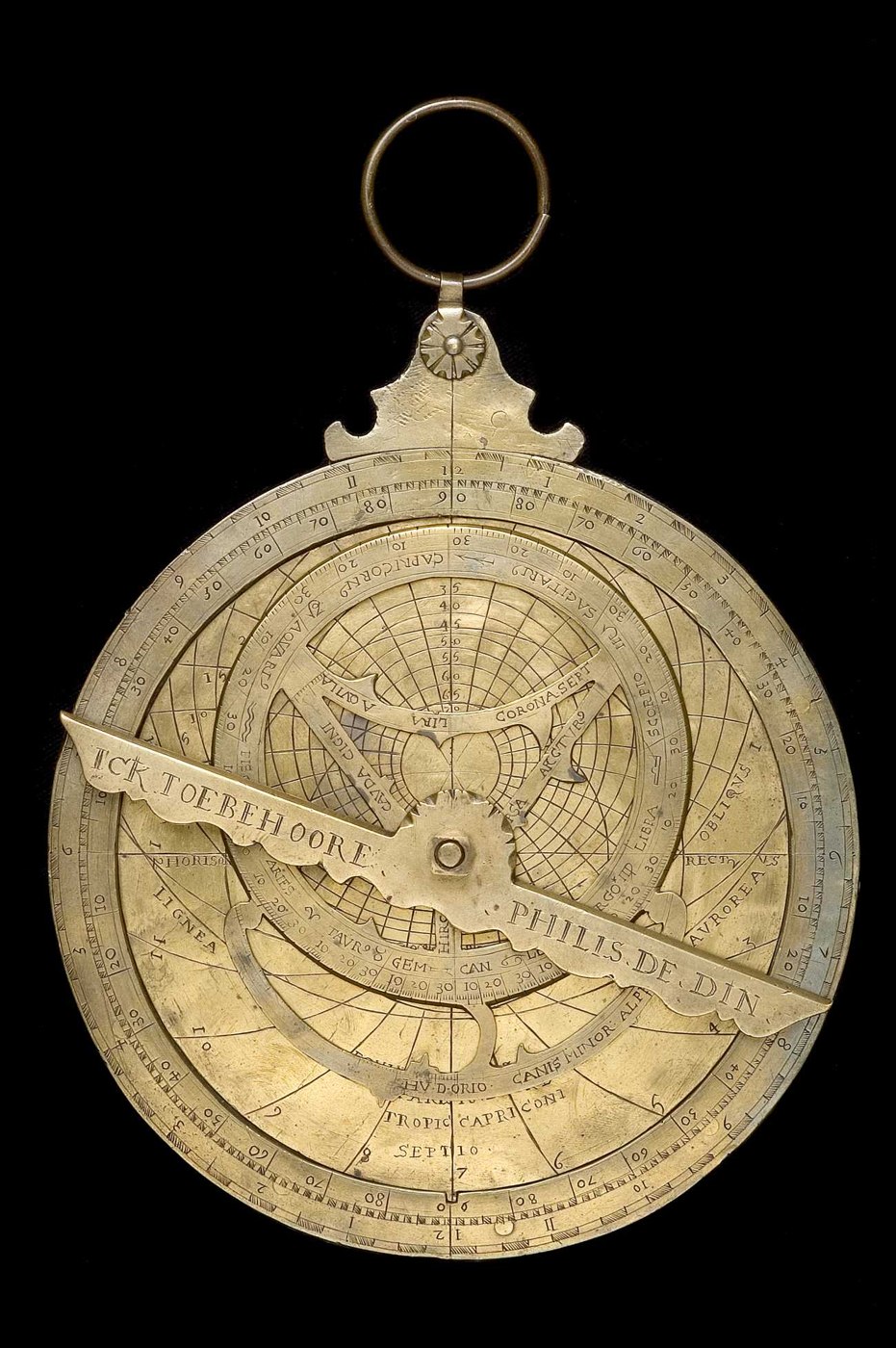
This 1595 brass astrolabe is attributed to Paris. The back displays altitude, zodiacal, unequal hours, and shadow square scales, and is inscribed with a prayer and the Jesuit emblem 'IHS' with a cross and pierced heart, which suggests the original owner may have been a Jesuit priest. An early ownership inscription on the rule reads in Flemish: 'Ick toebehoore Philis de Din'. The object was presented to the History of Science Museum by Lewis Evans in 1924, having been acquired from the dealer Percy Webster.

Front view of the 1595 brass astrolabe showing the rete and the rule inscription.
Front view of the 1595 brass astrolabe showing the rete and the rule inscription. — History of Science Museum, University of Oxford. Rights pending — permission not yet requested. Original source

Catalogue identity

Source
www.mhs.ox.ac.uk
Category
Tool · Latin-inscribed astrolabe
Maker / attribution
Not established
Reference
45975
Catalogue / lot identifier
45975
Source-reported date
1595
Source-reported place
Paris (?)

Source-reported attribution and specifications are not independent authentication. A listing does not establish present ownership, current display, availability or permission to reproduce.

Object description

Construction and Design

The astrolabe is constructed primarily of brass and features a simple, high throne of two-piece, riveted design, attached to an integrated base. The instrument utilizes a round cross-section ring and a disc-type shackle that pivots on a pin. The mater and limb are assembled from two riveted pieces, with the limb providing scales for altitude and equal hours.

The back of the instrument contains five scales, including altitude, zodiacal, unequal hours, and shadow square scales. These are arranged in concentric circles and boxes. The rete, identified as a replacement, is of the ecliptic type and features 13 stars indicated by flamant or dagger pointers, with a central nut and bolt attachment that appears original to the instrument.

Evidence for this section
  • “The throne is of the simple type made of brass attached with integrated base made of brass”
  • “The back contains 5 scales of the following types: Altitude; Zodiacal signs; Unequal hours; Shadow square.”
  • “The rete is a replacement.”

Inscriptions and Religious Symbolism

The back of the astrolabe is marked with a devotional Latin inscription, 'SIT NOMEN DOMINI BENEDICTVM IN SECVLA SECVLORVM 1595', surrounding a central emblem comprising the 'IHS' monogram, a cross, and a pierced heart.

The rule is engraved with the Flemish inscription 'Ick toebehoore Philis de Din', which serves as an owner's mark. This addition is noted as being early but is not considered to be from the original owner. The astrolabe’s single plate covers the specific latitudes of Paris and Lille, reflecting a link between these two locations at the time of manufacture.

Evidence for this section
  • “The back is inscribed: with a prayer marked as SIT NOMEN DOMINI BENEDICTVM IN SECVLA SECVLORVM 1595”
  • “In the center of this inscription is 'IHS', a cross and a pierced heart.”
  • “The inscription suggests that this astrolabe was owned by a Dutch or Flemish speaker.”

Provenance and History

The object was donated to the History of Science Museum in 1924 by Lewis Evans, following its acquisition from his London dealer, Percy Webster. Before entering the Evans collection, the instrument was sold at auction at Puttick & Simpson's in London on 18 June 1894.

The astrolabe has been studied for its association with the latitudes of Paris and Lille, the latter being a significant town in the Spanish Netherlands during the 16th century. The scholarly view is that the object was potentially manufactured in Paris for a client living in Lille, based on the geographical coverage provided by the single plate.

Evidence for this section
  • “Presented by Lewis Evans in 1924”
  • “It had been sold at Puttick & Simpson's, London, on 18 June 1894.”
  • “The astrolabe was made for the latitudes of Paris and Lille”

Open research questions

  • What is the specific identity of 'Philis de Din' beyond the suggested abbreviation?
  • To what extent did the Jesuit order influence the design specifications of scientific instruments in late 16th-century Paris?

Source evidence

Recorded claims and source quotations for Astrolabe with Jesuit religious symbols
FieldSource-reported valueSource quotation
Date1595“Date 1595”
MaterialBrass“Material Brass”
Inventory Number45975“Inventory no. 45975”
AcquisitionPresented by Lewis Evans in 1924“Presented by Lewis Evans in 1924”
Latitude coverage48°0' to 51°0'“latitudes ranging from 48°0' to 51°0'”
ProvenanceAcquired from Percy Webster“Evans bought it from Percy Webster, his main London dealer.”

Visible details

  • The alidade features scrollwork decoration at the center and edges.
  • The rete is of the ecliptic type and bears 13 stars.
  • The back inscription includes a prayer and the IHS symbol.
  • The rule bears the inscription 'Ick toebehoore Philis de Din'.

Research qualifications

  • The rete is a replacement.
  • The attribution to Paris is qualified as 'Paris (?)'.
  • The ownership name 'Philis de Din' is possibly an abbreviation for Philippus.

Photograph identity and source facts were screened before import; rights clearance remains pending.

Consulted source

Astrolabe, inventory 45975 (Paris (?), 1595)

Reviewed 2026-10-26 · Record 422e605119

Terms in this record

Glossary explanations for terms named in this object’s record.