
Skip to content
The Encyclopedia of Horology

Tool · Latin-inscribed astrolabe

Astrolabe

Partially verified

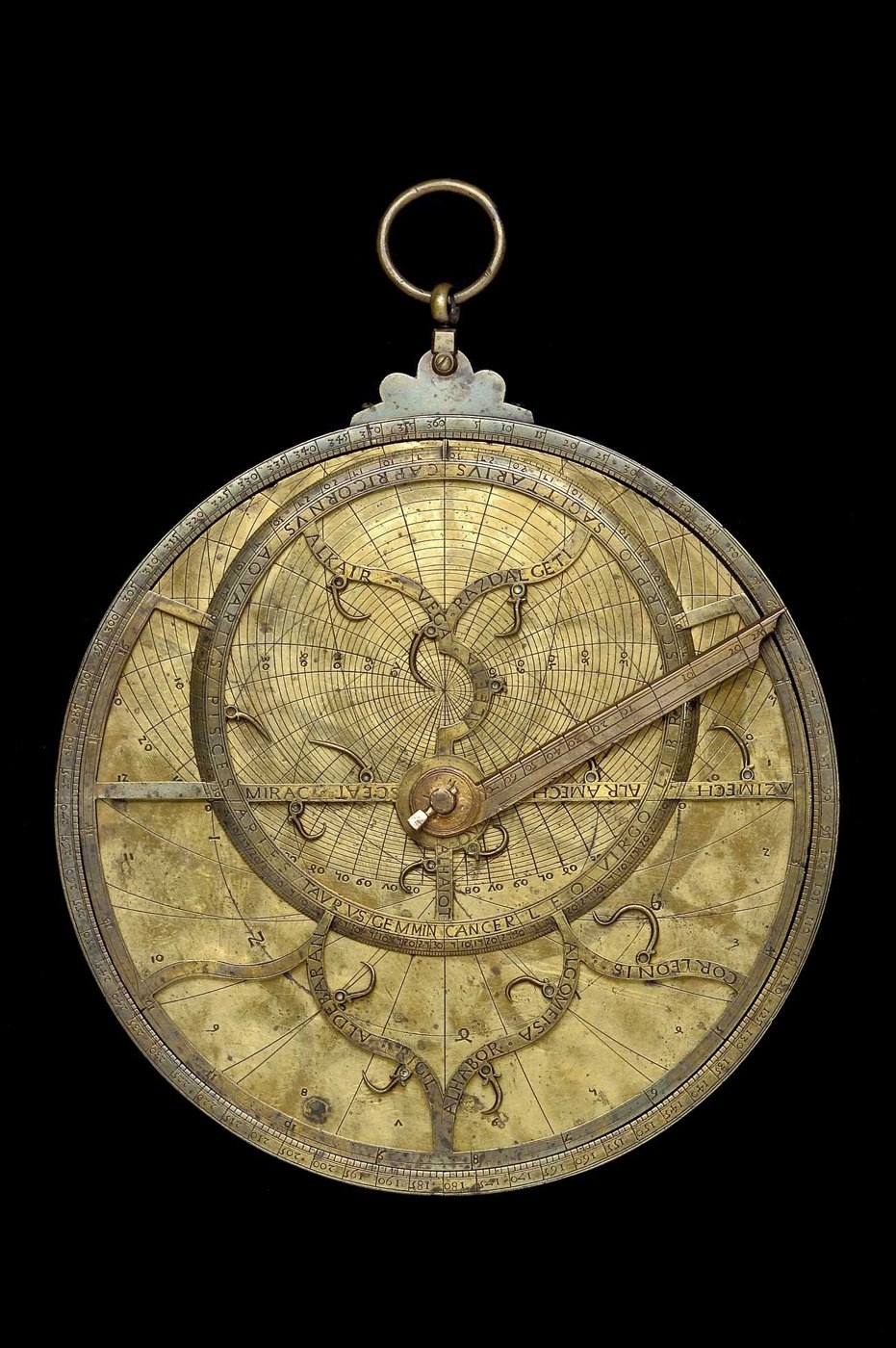
This brass astrolabe, inventory number 35146, is dated to approximately 1500 and attributed to Italy. The instrument features a three-lobed throne with a screwed base and a simple, round cross-section ring. It is constructed from two pieces (mater and limb) with soldered joints. The rete, which carries 16 stars with bulb pointers, follows a modified y-shaped design. The back contains six distinct scales including degree, zodiacal signs, calendar, unequal hours, and a shadow square. There are four plates with latitudes ranging from 33°0' to 54°0'. The instrument exhibits two distinct styles of script, suggesting that the body may be of later construction than the tympans and rete.

Full view of the astrolabe showing the rete, pin and wedge, and alidade.
Full view of the astrolabe showing the rete, pin and wedge, and alidade. — History of Science Museum, University of Oxford. Rights pending — permission not yet requested. Original source

Catalogue identity

Source
www.mhs.ox.ac.uk
Category
Tool · Latin-inscribed astrolabe
Maker / attribution
Not established
Reference
Not recorded
Catalogue / lot identifier
35146
Source-reported date
ca. 1500
Source-reported place
Italy (?)

Source-reported attribution and specifications are not independent authentication. A listing does not establish present ownership, current display, availability or permission to reproduce.

Object description

Construction and Componentry

The astrolabe is manufactured from brass and features a three-lobed throne attached to the body via a screwed base. The ring is a simple round cross-section, and the eye-bolt type shackle connects to the throne with a threaded screw. The mater and limb are joined by soldering.

The rete is designed in a modified y-shape and includes 16 stars indicated by bulb pointers. Four plates accompany the instrument, engraved for latitudes between 33°0' and 54°0'. An alidade and pointer are present, though both are described as potentially later additions to the main body.

Evidence for this section
  • “The throne is of the three-lobed type made of brass attached with screwed base”
  • “The mater and limb are of two pieces, soldered construction.”
  • “The rete is of the y-shaped (modified) type.”

Inscriptions and Chronology

The object displays two different styles of script. The tympans and rete feature an older, cruder style of square capitals created with a punch, accompanied by older number shapes. In contrast, the mater and back display a more recent script with serifed upper and lower-case letters formed with letter stamps.

The disparities in lettering and numbering suggest that the body of the astrolabe may have been constructed at a later time than the tympans and rete.

Evidence for this section
  • “There are two different styles of script on this astrolabe.”
  • “It seems likely, based on their markedly different numbering and lettering styles, that the body of the instrument is of somewhat later construction than the tympans and the rete.”
  • “The lower-case 's' is like the long 's' typical of 16th-century printing (that is, it resembles an ‘f’).”

Provenance and History

The instrument was accessioned by the museum in 1924 following its presentation by Lewis Evans. Records indicate that Evans obtained the astrolabe as part of the collection of S. Waters, which was purchased around 1910.

Evans had originally assisted Waters in forming this collection, having purchased the item for him in Venice in 1899, establishing a traceable history back to the end of the nineteenth century.

Evidence for this section
  • “Presented by Lewis Evans in 1924”
  • “Evans acquired it with the collection of S. Waters, which he purchased about 1910.”
  • “He had helped Waters form his collection, and initially bought it for him in Venice in 1899.”

Open research questions

  • What is the specific composition of the brass used in the different components, and can it confirm the hypothesized different periods of manufacture?
  • Are there any specific maker's marks or hidden stamps on the plates that could provide a more precise origin than the general 'Italy (?)' attribution?

Source evidence

Recorded claims and source quotations for Astrolabe
FieldSource-reported valueSource quotation
MaterialBrass“Material Brass”
Inventory Number35146“Inventory no. 35146”
Acquisition Date1924“Presented by Lewis Evans in 1924”
Star count16“The rete contains 16 stars.”
Throne styleThree-lobed“The throne is of the three-lobed type”
Plate latitude range33°0' to 54°0'“latitudes ranging from 33°0' to 54°0'”
Alidade conditionBroken sighting vanes“Both sighting vanes have broken off.”

Visible details

  • Three-lobed throne attached via screwed base
  • 16 stars marked on the rete with bulb pointers
  • Back features a central shadow square labeled with finger units
  • Sighting vanes on the alidade have broken off

Research qualifications

  • The body of the instrument is suspected to be of later construction than the tympans and rete
  • The alidade and pointer are noted as potentially later replacements

Photograph identity and source facts were screened before import; rights clearance remains pending.

Consulted source

Astrolabe, inventory 35146 (Italy (?), ca. 1500)

Reviewed 2026-10-26 · Record e4267d8151

Terms in this record

Glossary explanations for terms named in this object’s record.