
Skip to content
The Encyclopedia of Horology

Tool · Latin-inscribed astrolabe

Astrolabe by Thomas Gemini

Partially verified

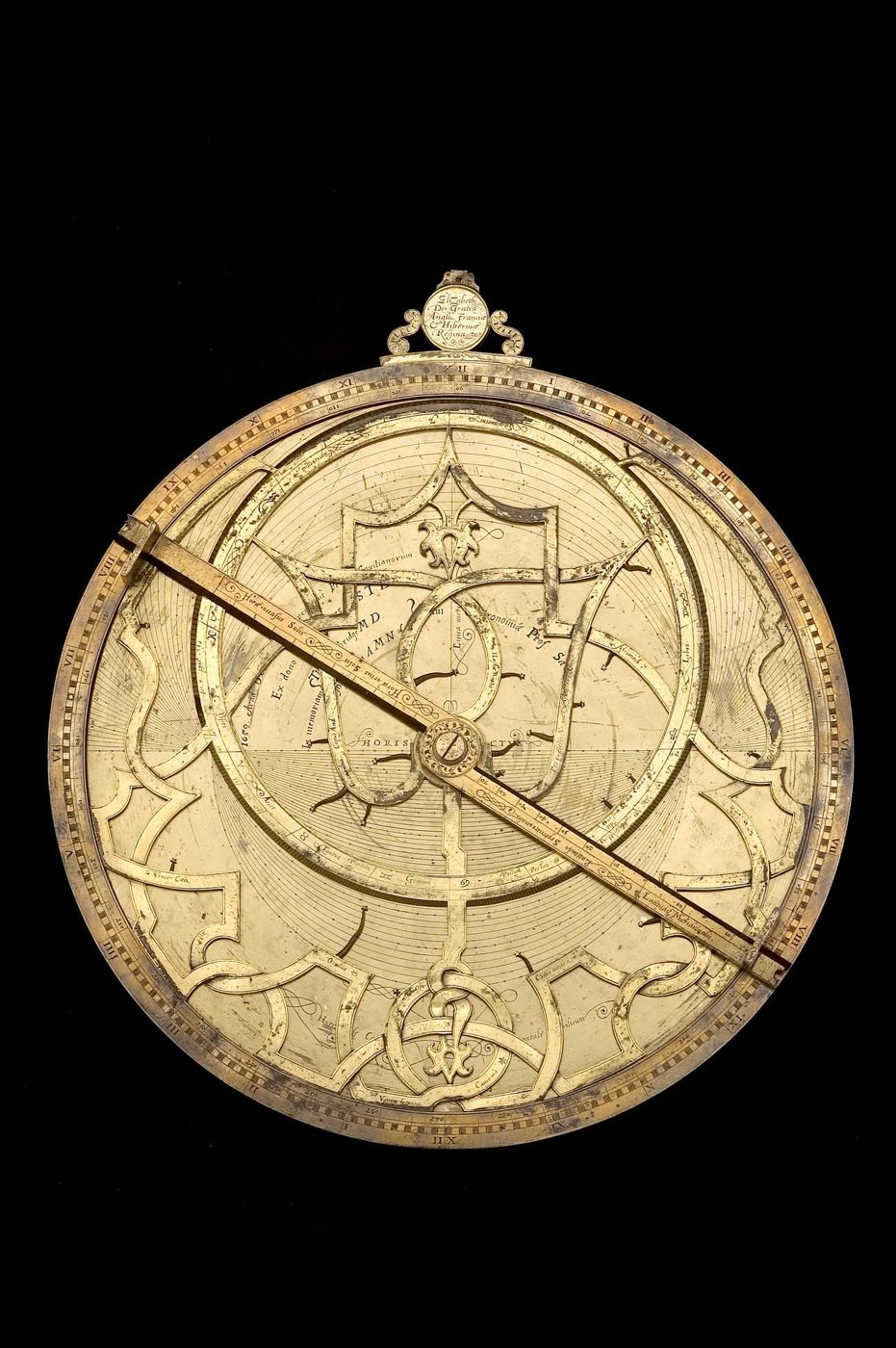
This 1559 brass astrolabe was produced by the craftsman Thomas Gemini in London. The object features a simple throne with s-shaped scrollwork, engraved with dedications to Queen Elizabeth I and bearing her coat-of-arms along with the Latin inscription 'Elizabeth Dei Gratia Angliæ Franciæ & Hiberniæ Regina etc.' The device incorporates an arsenius-type rete with three-dimensional strapwork and twenty-eight star pointers. The womb contains a windrose and a 'Quadratum Nauticum'. It is assembled with a central nut and bolt, and includes an alidade and rule for the universal planisphere.

Front view of the astrolabe showing the rete, throne, and rule.
Front view of the astrolabe showing the rete, throne, and rule. — History of Science Museum, University of Oxford. Rights pending — permission not yet requested. Original source

Catalogue identity

Source
www.mhs.ox.ac.uk
Category
Tool · Latin-inscribed astrolabe
Maker / attribution
Thomas Gemini
Reference
Not recorded
Catalogue / lot identifier
42223
Source-reported date
1559
Source-reported place
London

Source-reported attribution and specifications are not independent authentication. A listing does not establish present ownership, current display, availability or permission to reproduce.

Object description

Construction and Design

The astrolabe is constructed primarily of brass and features a three-piece construction for the mater and limb. The throne is of a simple type, attached via an integrated base, and decorated with s-shaped scroll work on both sides. The device is assembled using a central brass screw and washer mechanism.

The rete is characterized by its arsenius style, which utilizes true three-dimensional strapwork to distinguish the interlacing patterns, rather than relying on engraved shading. It features twenty-eight stars marked with pointers and contains an ecliptic scale with divisions every five degrees.

Evidence for this section
  • “The throne is of the simple type made of brass with s-shaped scroll work support(s)”
  • “The rete is of the arsenius type. This rete has true three-dimensionality in the strapwork”

Inscriptions and Royal Provenance

The instrument is engraved with royal iconography relating to Queen Elizabeth I, including her coat-of-arms and a formal Latin dedication. The inscriptions on the throne and womb identify the maker as Thomas Gemini and the year of manufacture as 1559, coinciding with the Queen's coronation year.

Historical records from 1559 link the instrument to the household accounts of Robert Dudley, who made a payment to Gemini for an astronomical instrument. The object later entered the possession of John Greaves, Savilian Professor of Astronomy at Oxford, who utilized the astrolabe for scientific measurements during his 1637–1640 journey to the Levant.

Evidence for this section
  • “This astrolabe was made for Queen Elizabeth I.”
  • “Dudley's household accounts for 1559 record a payment to Gemini for an unspecified but evidently substantial astronomical instrument.”

Provenance and Collection History

The astrolabe was part of the Savilian Collection at the University of Oxford. Following its use by John Greaves, the instrument was presented to the university by his brother, Nicholas Greaves, in memory of John Greaves and John Bainbridge.

The instruments were historically kept in the Savilian Tower's 'astronomy chamber' before being transferred to the University Observatory. The collection was identified and catalogued in 1936, at which point the astrolabe was assigned the inventory number 42223.

Evidence for this section
  • “The collection, including this astrolabe, was given to the university in 1659 by Nicholas Greaves, in memory of his brother John Greaves”
  • “The surviving parts of Oxford University's Savilian Collection of astronomical instruments were discovered in a neglected state at the University Observatory in 1936.”

Open research questions

  • What specific evidence links the 'unspecified' payment in Dudley's accounts to this specific inventory number?
  • Are there any physical traces on the instrument that provide evidence of its use during the Levant expedition?

Source evidence

Recorded claims and source quotations for Astrolabe by Thomas Gemini
FieldSource-reported valueSource quotation
MakerThomas Gemini“Made by the immigrant craftsman Thomas Gemini”
Date1559“Date 1559”
MaterialBrass“Material Brass”
Inventory Number42223“Inventory number: 42223”
ProvenanceUniversity of Oxford, Savilian Collection“The surviving parts of Oxford University's Savilian Collection of astronomical instruments were discovered in a neglected state at the University Observatory in 1936.”
InscriptionsElizabeth Dei Gratia Angliæ Franciæ & Hiberniæ Regina etc.“the inscription 'Elizabeth Dei Gratia Angliæ Franciæ & Hiberniæ Regina etc.'”
Rete TypeArsenius“The rete is of the arsenius type.”

Visible details

  • The rete exhibits distinct three-dimensional strapwork rather than mere engraved shading
  • The throne is engraved with the royal coat-of-arms of Queen Elizabeth I
  • The womb includes a windrose and a 'Quadratum Nauticum' grid
  • The alidade is double-ended, counter-changed, and original to the instrument

Research qualifications

  • The exact identity of the original commissioner remains unverified, although likely to be Robert Dudley
  • The specific purpose of the payment to Gemini in Dudley's 1559 accounts is stated as 'unspecified'

Photograph identity and source facts were screened before import; rights clearance remains pending.

Consulted source

Astrolabe, inventory 42223 (London, 1559)

Reviewed 2026-10-26 · Record 7589f4a8ea

Terms in this record

Glossary explanations for terms named in this object’s record.