
Skip to content
The Encyclopedia of Horology

Tool · Latin-inscribed astrolabe

Astrolabe by Johann Anton Linden

Partially verified

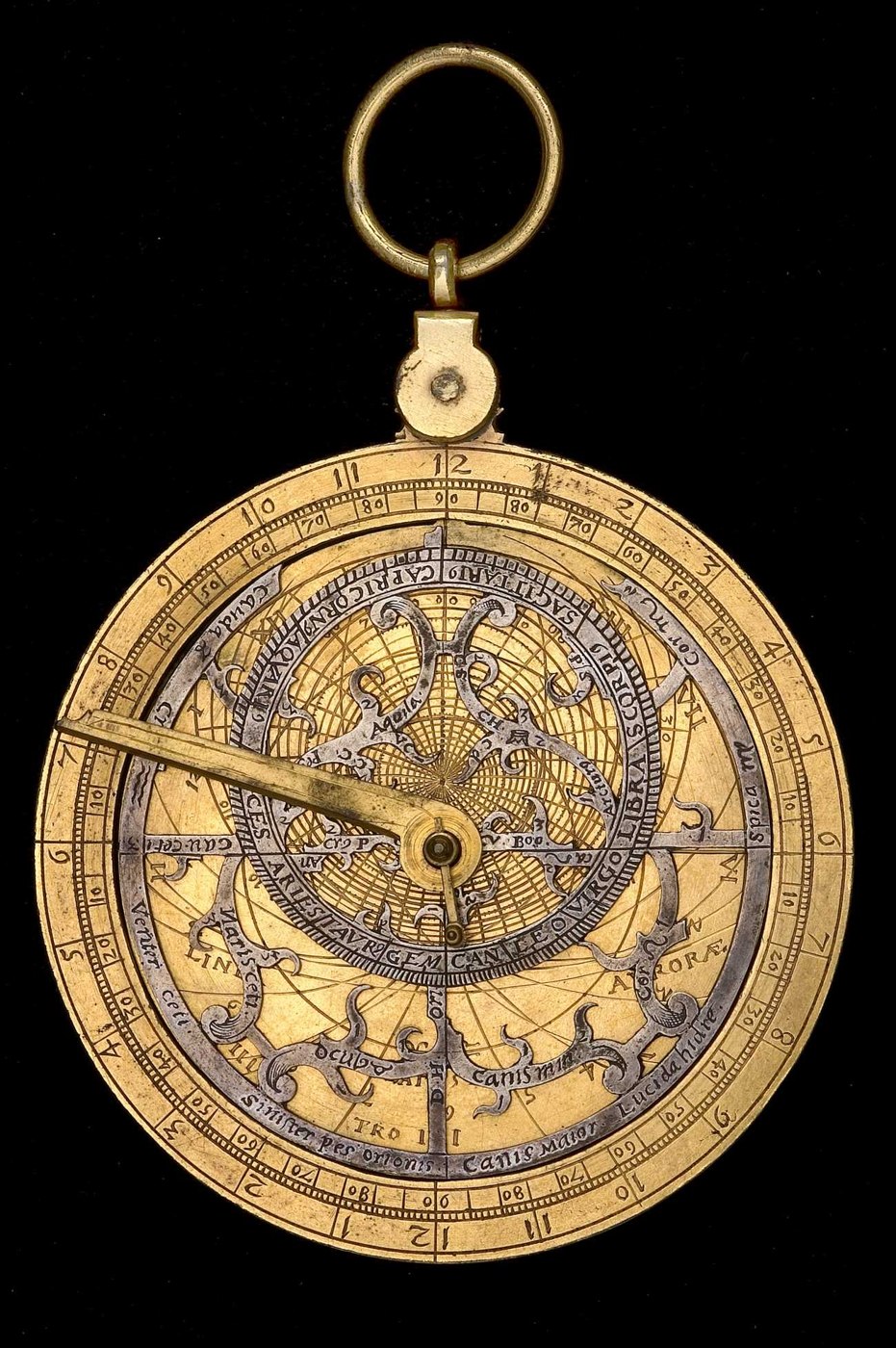
This gilt brass astrolabe is catalogued as inventory number 48380 by the History of Science Museum, Oxford. It features a simple throne with an integrated base and a round-section suspension ring, connected by a rotating pin-type shackle. The mater and limb are constructed from a single piece of brass, with scales for equal hours and degrees on the limb. The rete is of an ornate design featuring 34 stars with flamant pointers, held in place by a decorated pin and wedge. Two plates are provided with latitudes spanning from 46°0' to 55°0'. The back of the instrument includes six distinct functional scales, such as altitude, zodiacal signs, and shadow squares. The instrument was presented to the museum by Lewis Evans in 1924, having been acquired from a dealer in 1901.

The front of the astrolabe, displaying the rete, limb scales, and throne assembly.
The front of the astrolabe, displaying the rete, limb scales, and throne assembly. — History of Science Museum, University of Oxford. Rights pending — permission not yet requested. Original source

Catalogue identity

Source
www.mhs.ox.ac.uk
Category
Tool · Latin-inscribed astrolabe
Maker / attribution
Johann Anton Linden
Reference
Not recorded
Catalogue / lot identifier
48380
Source-reported date
ca. 1590
Source-reported place
Heilbronn (?)

Source-reported attribution and specifications are not independent authentication. A listing does not establish present ownership, current display, availability or permission to reproduce.

Object description

Construction and Design

The astrolabe is composed of gilt brass, featuring a simple throne type attached to an integrated base. The suspension assembly consists of a round cross-section ring and a rotating pin-type shackle joined via a U-shaped bracket. The mater and limb are fabricated as a single-piece construction. The limb itself contains two primary circular, concentric scales: an equal hours scale numbered 1 to 12 at one-hour intervals, and a degree scale ranging from 0 to 90 degrees at 10-degree increments.

The instrument includes an ornate rete that displays 34 stars, identified by flamant pointers. The zodiacal signs are engraved along the ecliptic band. The rete is secured by a pin and wedge assembly, both of which feature decorated heads. Two plates are included, offering latitude settings between 46°0' and 55°0'. The internal notch for fixing the tympan position is situated at the throne.

Evidence for this section
  • “The throne is of the simple type made of gilt brass attached with integrated base made of brass”
  • “The mater and limb are of one-piece construction.”
  • “The rete contains 34 stars.”
  • “The rete is attached using a pin & wedge. Both the pin and the wedge have decorated heads but are otherwise plain.”

Functional Scales and Components

The back of the astrolabe is equipped with six functional scales designed for astronomical and mathematical calculations. These include an altitude scale, zodiacal sign divisions, a calendar scale, and a shadow square. The altitude scale is positioned as the outermost ring, while the zodiacal and calendar scales occupy the circular bands immediately within. The shadow square, which is divided into 12 fingers with intervals of 3, is located in the lower portion of the back.

Additionally, the upper quadrants contain scales for unequal hours. The instrument utilizes a single-ended, counter-changed rule and a double-ended, counter-changed alidade. The alidade is noted for its rigid construction with a single sight and ornately carved tips, while the rule features minor decorative engraving without additional sighting components.

Evidence for this section
  • “The back contains 6 scales of the following types: Altitude; Zodiacal signs; Calendar; Shadow square; Unequal hours.”
  • “Shadow square 1 - 12, Fingers Every 3 fingers”
  • “Alidade Double-ended, counter-changed. No engraving or other ornamentation. The tips, however, are ornately carved.”
  • “Rule Single-ended, counter-changed. Minor decorative engraving.”

Provenance and Documentation

The history of the instrument is documented through its inclusion in the History of Science Museum, University of Oxford, under inventory number 48380. The object was formally acquired by the museum in 1924 through a presentation by Lewis Evans.

Further records indicate that Evans had previously purchased the astrolabe from a dealer named Gerard, operating out of Monte Carlo, in 1901. This provenance data provides a limited history of the object prior to its institutional integration. The catalogue maintains the attribution to Johann Anton Linden and the suggested manufacture location of Heilbronn, though both descriptors are qualified with uncertainty in the official report.

Evidence for this section
  • “Presented by Lewis Evans in 1924”
  • “Evans bought it from Gerard, a dealer of Monte Carlo, in 1901.”
  • “Maker Johann Anton Linden (?)”
  • “Place Heilbronn (?)”

Open research questions

  • Can the attribution of this astrolabe to Johann Anton Linden be substantiated by other surviving instruments from this maker?
  • What specific astronomical or navigational usage necessitated the latitude range of 46° to 55° on the included plates?

Source evidence

Recorded claims and source quotations for Astrolabe by Johann Anton Linden
FieldSource-reported valueSource quotation
Inventory Number48380“Inventory number: 48380”
MakerJohann Anton Linden (?)“Maker Johann Anton Linden (?)”
PlaceHeilbronn (?)“Place Heilbronn (?)”
MaterialGilt brass“Material Gilt brass”
Dateca. 1590“Date ca. 1590”
ProvenancePresented by Lewis Evans in 1924“Presented by Lewis Evans in 1924”
Rete Stars34“The rete contains 34 stars.”
Latitudes46°0' to 55°0'“latitudes ranging from 46°0' to 55°0'”

Visible details

  • Rete marked with 34 star locations using flamant pointers.
  • Six scales on the back include altitude and shadow squares.
  • Alidade tips feature ornate carved decoration.
  • Rule is single-ended and counter-changed with decorative engraving.

Research qualifications

  • The attribution to maker Johann Anton Linden is uncertain and carries a question mark in the source.
  • The place of manufacture as Heilbronn is presented as an uncertain attribution in the source records.

Photograph identity and source facts were screened before import; rights clearance remains pending.

Consulted source

Astrolabe, inventory 48380 (Heilbronn (?), ca. 1590)

Reviewed 2026-10-26 · Record 9933842159

Terms in this record

Glossary explanations for terms named in this object’s record.