
Skip to content
The Encyclopedia of Horology

Tool · Latin-inscribed astrolabe

Astrolabe by Erasmus Habermel

Partially verified

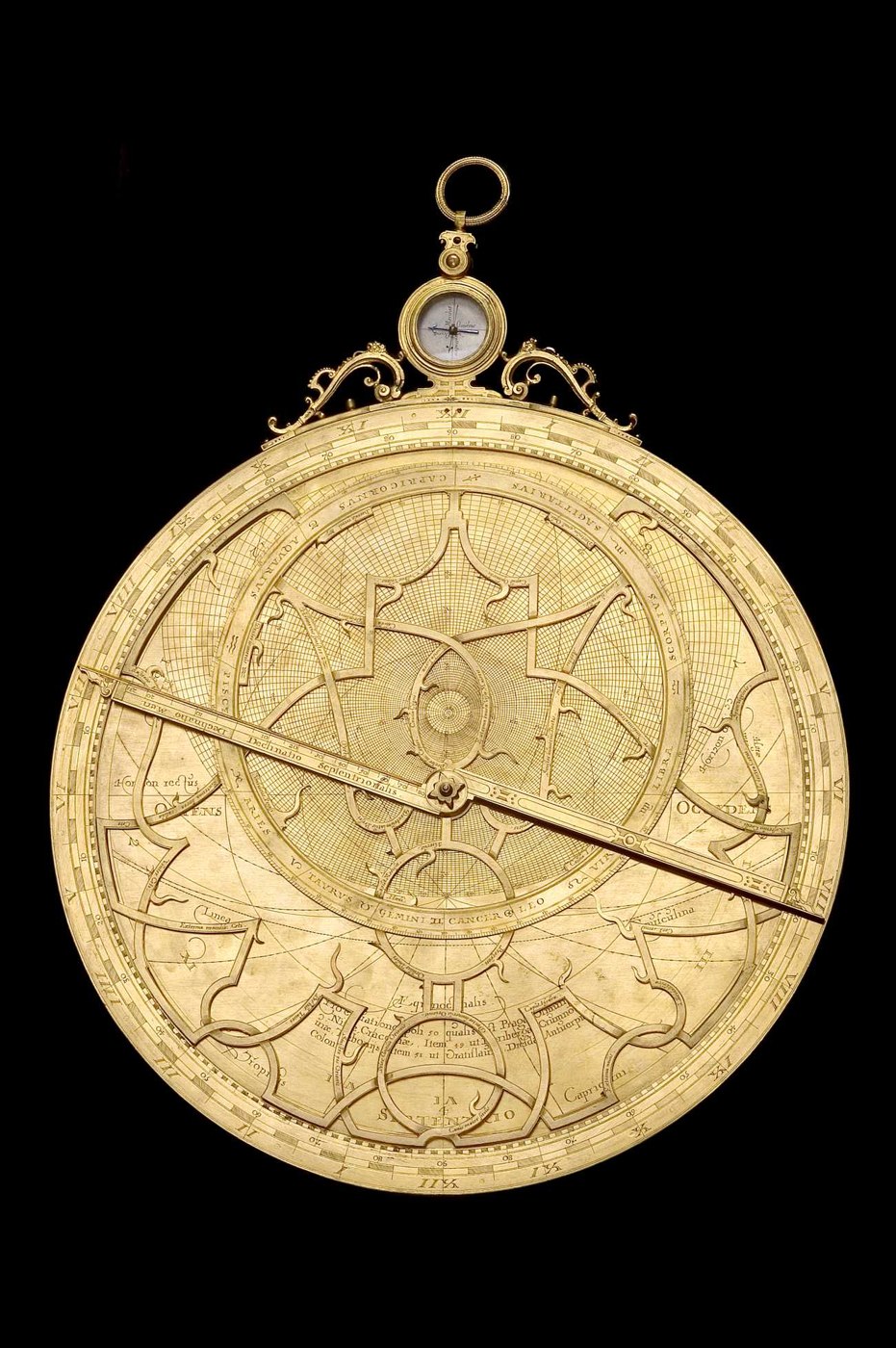
This astrolabe, inventory number 38097, is attributed to the maker Erasmus Habermel and dates to approximately 1590. Constructed from gilt copper and gilt brass, the instrument features a compass-bearing throne with s-shaped scrollwork, a square ornate shackle, and a rotating eye-pin. The limb includes equal hours and degree scales. The back displays nine scales, including zodiacal, calendar, saints' days, and shadow square functions, signed 'Erasmus Habermel fe:' below the shadow square ornament. The front houses a rete and mater with a wind rose. Accessories include a double-ended, counter-changed alidade and an ornate engraved rule with a declination scale. The instrument was part of the collection of Henri Michel and was presented to the History of Science Museum by J. A. Billmeir in 1957.

Front view of the Habermel astrolabe showing the rete and compass-bearing throne.
Front view of the Habermel astrolabe showing the rete and compass-bearing throne. — History of Science Museum, University of Oxford. Rights pending — permission not yet requested. Original source

Catalogue identity

Source
www.mhs.ox.ac.uk
Category
Tool · Latin-inscribed astrolabe
Maker / attribution
Erasmus Habermel
Reference
Not recorded
Catalogue / lot identifier
38097
Source-reported date
ca. 1590
Source-reported place
Prague (?)

Source-reported attribution and specifications are not independent authentication. A listing does not establish present ownership, current display, availability or permission to reproduce.

Object description

Construction and Features

The instrument is composed primarily of gilt copper and gilt brass components. It features a compass-bearing throne adorned with s-shaped scrollwork, which is attached to the body via a screwed base. The top of the assembly is finished with an ornate ring and a square box-type shackle, allowing for suspension. A magnetic compass is integrated into the front of the throne, with cardinal points labeled 'Septentrio', 'Occidens', 'Meridies', and 'Oriens', and an arrow indicating magnetic deviation.

The mater and limb are constructed of two pieces joined by screws. The limb is calibrated with degree and equal hours scales. Internally, the womb features a decorative wind rose and a Quadratum nauticum. On the reverse of the throne, a volvelle serves to convert time between 12-hour and 24-hour systems.

Evidence for this section
  • “The throne is of the compass bearing type made of gilt brass with s-shaped scroll work”
  • “The mater and limb are of two pieces, screwed construction.”
  • “The womb bears an ornate wind rose and Quadratum nauticum”

Scales and Inscriptions

The reverse of the astrolabe is highly detailed, containing nine distinct scales. These include circular, concentric scales for degrees, zodiacal signs, the calendar, and saints' days. Upper quadrants are reserved for unequal hours, while the center features a shadow square with multiple faces for different calculations. A planetary hours scale is also present in the inner box.

The maker's signature, 'Erasmus Habermel fe:', is engraved below the ornament situated under the shadow square. This mark identifies the maker as Erasmus Habermel, consistent with the source attribution.

Evidence for this section
  • “The back contains 9 scales of the following types: Degree; Zodiacal signs; Calendar; Saints' Days; Unequal hours; Shadow square; Planetary hours.”
  • “The back is inscribed: with a maker's signature marked as Erasmus Habermel fe: (Erasmus Habermel made this).”

Provenance and History

The astrolabe was acquired by J. A. Billmeir as part of a collection purchased from Henri Michel of Brussels around 1950. Billmeir subsequently presented the instrument to the History of Science Museum in Oxford in 1957, where it is currently held under inventory number 38097.

Historical accounts linked to the object suggest it was formerly held by the Habsburg family.

Evidence for this section
  • “Billmeir acquired it with the collection of Henri Michel, of Brussels, which he purchased about 1950.”
  • “It was said to have been long in the possession of the Habsburg family, with the consequent assumption that it was made for the Emperor Rudolf II.”

Open research questions

  • What specific evidence supports the potential association with Emperor Rudolf II?
  • Does the magnetic compass represent an original feature from the 1590 construction or a later modification?

Source evidence

Recorded claims and source quotations for Astrolabe by Erasmus Habermel
FieldSource-reported valueSource quotation
MakerErasmus Habermel“Erasmus Habermel”
MaterialGilt copper“Material Gilt copper”
Inventory number38097“Inventory no. 38097”
Maker's signatureErasmus Habermel fe:“Erasmus Habermel fe:”
Dateca. 1590“Date ca. 1590”
AcquisitionPresented by J. A. Billmeir in 1957“Presented by J. A. Billmeir in 1957”
Throne typeCompass bearing type“The throne is of the compass bearing type”

Visible details

  • Magnetic compass mounted on the front of the throne.
  • Volvelle on the back of the throne for 12/24-hour conversion.
  • Ornate wind rose and Quadratum nauticum in the womb.
  • Double-ended counter-changed alidade and rule.

Research qualifications

  • The place of manufacture is listed as 'Prague (?)', indicating uncertainty.
  • The connection to the Habsburg family and Emperor Rudolf II is noted as an assumption rather than a proven fact.

Photograph identity and source facts were screened before import; rights clearance remains pending.

Consulted source

Astrolabe, inventory 38097 (Prague (?), ca. 1590)

Reviewed 2026-10-26 · Record 0cf272d760

Terms in this record

Glossary explanations for terms named in this object’s record.