
Skip to content
The Encyclopedia of Horology

Tool · Latin-inscribed astrolabe

Astrolabe

Partially verified

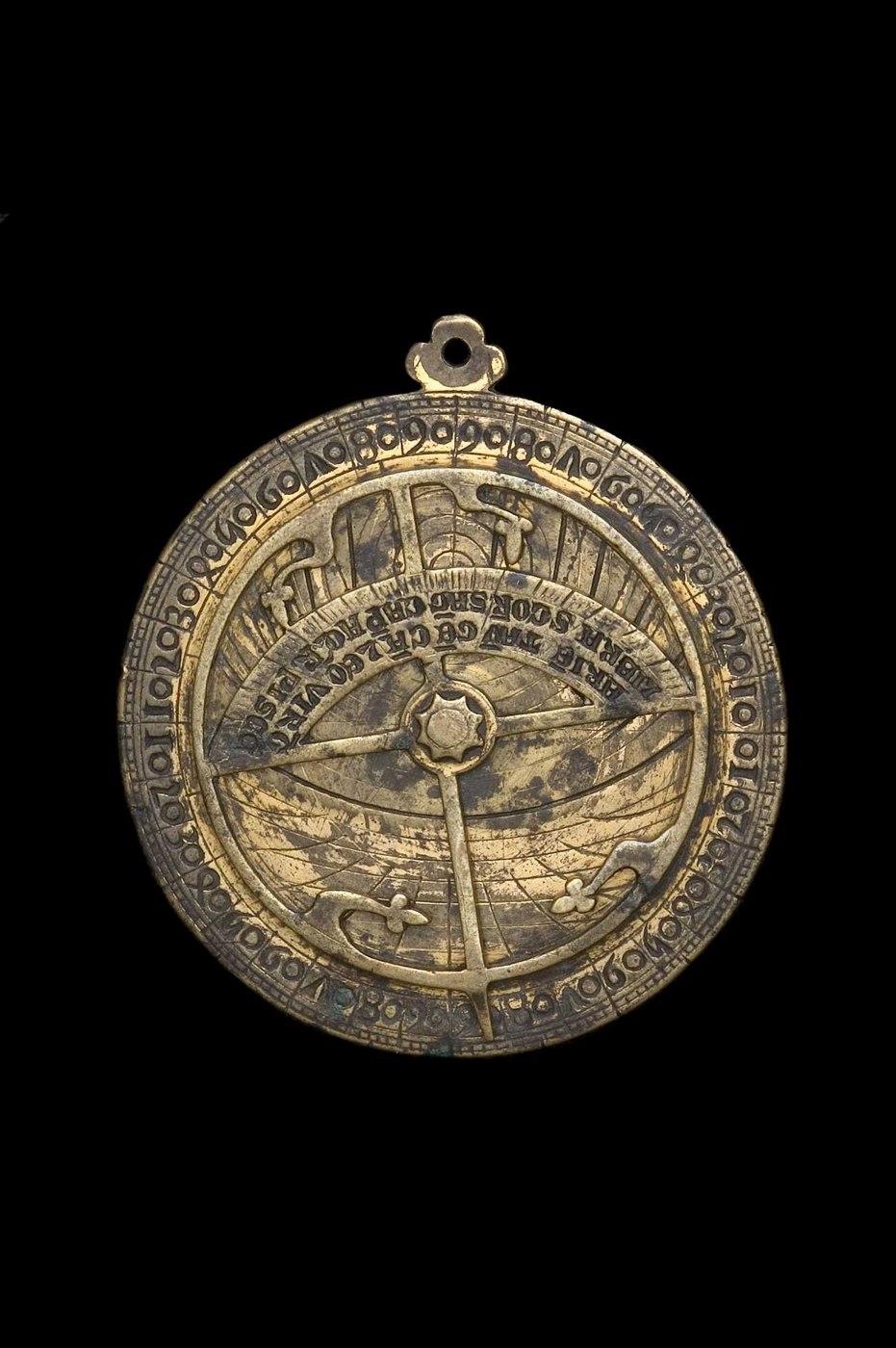
This gilt brass astrolabe, inventory number 40829, is attributed to Sicily and dated to approximately 1300. , it features a unique rete design that integrates northern and southern projections of the ecliptic, causing the twelve zodiacal signs to align on a single arc below the center. Its construction, where the rete's outer edge corresponds to the equator rather than the Tropic of Capricorn, renders the instrument an abstract model rather than a functional representational tool. The object includes a three-lobed throne attached to a one-piece mater and limb. The back displays scales for degrees, unequal hours, and a shadow square. Four star pointers are present on the rete, though they remain unnamed. The instrument is held together by a rivet featuring a star-shaped head. The piece was presented to the History of Science Museum by Lewis Evans in 1924, having been acquired from a Florence bookseller.

Front view of the astrolabe showing the rete, the star-shaped rivet, and the degree scale on the limb.
Front view of the astrolabe showing the rete, the star-shaped rivet, and the degree scale on the limb. — History of Science Museum, University of Oxford. Rights pending — permission not yet requested. Original source

Catalogue identity

Source
www.mhs.ox.ac.uk
Category
Tool · Latin-inscribed astrolabe
Maker / attribution
Not established
Reference
Not recorded
Catalogue / lot identifier
40829
Source-reported date
ca. 1300 (?)
Source-reported place
Sicily

Source-reported attribution and specifications are not independent authentication. A listing does not establish present ownership, current display, availability or permission to reproduce.

Object description

Design and Construction

The astrolabe is constructed from gilt brass and is notable for its small scale. The throne is fashioned as a three-lobed tab at the top of the instrument, attached via an integrated base. Both the shackle and the ring are missing from the current configuration. The mater and limb are built as a single-piece construction, with the limb extending beyond the rete.

The instrument utilizes a rivet to secure the rete, which is visible on the front as a star-shaped head. The back of the astrolabe incorporates three distinct scale types: a circular degree scale spanning 0 to 90 degrees, two sets of unequal hours, and a shadow square divided every three fingers.

Evidence for this section
  • “The throne is of the three-lobed type made of gilt brass attached with integrated base made of gilt brass”
  • “The mater and limb are of one-piece construction.”
  • “The pin appears to be a rivet with a star-shaped head on the front.”

The Rete and Projection

The rete design is unusual, combining a southern projection for summer signs and a northern projection for winter signs. This forces the ecliptic to fold back upon itself, resulting in all twelve zodiacal signs occupying the same arc beneath the central horizontal line. Unlike common astrolabes, the rete edge is set to the equator, not the Tropic of Capricorn.

The rete holds four star pointers, all of which are foliate in style but currently unnamed. Due to the unconventional arrangement of the projections, the user must distinguish between northern and southern readings, a process complicated by the lack of star identification.

Evidence for this section
  • “It combines the typical southern projection of the summer signs with a northern projection of the winter signs.”
  • “The rete was then reduced so that the outer edge is the equatorial circle rather than the Tropic of Capricorn”
  • “There are 4 stars on the rete marked with foliate pointers.”

Provenance and History

The instrument was acquired by Lewis Evans from the Florence bookseller Leo S. Olschki circa 1901. It was subsequently presented to the History of Science Museum in 1924. The dating of the instrument has been a subject of analysis, with Evans initially suggesting 1460, while recent studies have proposed an earlier date of approximately 1300.

Its physical limitations regarding representation and observation suggest it served purposes outside of standard astronomical utility.

Evidence for this section
  • “Evans bought it from Leo S. Olschki, the Florence bookseller, about 1901.”
  • “Presented by Lewis Evans in 1924”
  • “A recent study looking at this instrument as evidence of 'an ingenious tradition of non-standard astrolabes' proposes the much earlier date of about 1300.”

Open research questions

  • What specific workshop or regional tradition in 14th-century Sicily produced non-standard astrolabes?
  • How does the lack of star labels compare to other known non-standard astrolabes of the same period?

Source evidence

Recorded claims and source quotations for Astrolabe
FieldSource-reported valueSource quotation
Inventory number40829“Inventory no. 40829”
MaterialGilt brass“Material Gilt brass”
Dateca. 1300 (?)“Date ca. 1300 (?)”
Place of manufactureSicily“Place Sicily”
Acquisition date1924“Presented by Lewis Evans in 1924”
Throne typeThree-lobed“The throne is of the three-lobed type”
ProvenancePurchased from Leo S. Olschki, Florence, circa 1901“Evans bought it from Leo S. Olschki, the Florence bookseller, about 1901.”

Visible details

  • The rete features a star-shaped rivet head at the center.
  • The throne is a small, three-lobed tab configuration.
  • The shadow square is centrally located on the back of the instrument.
  • The alidade is double-ended and counter-changed.

Research qualifications

  • The dating of circa 1300 is speculative, with historical debate between this and an alternative proposal of circa 1460.
  • The instrument's actual astronomical utility is described as limited due to its abstract design and small size.

Photograph identity and source facts were screened before import; rights clearance remains pending.

Consulted source

Astrolabe, inventory 40829 (Sicily, ca. 1300 (?))

Reviewed 2026-10-26 · Record 431826dd97

Terms in this record

Glossary explanations for terms named in this object’s record.