
Skip to content
The Encyclopedia of Horology

Tool · Latin-inscribed astrolabe

Astrolabe

Partially verified

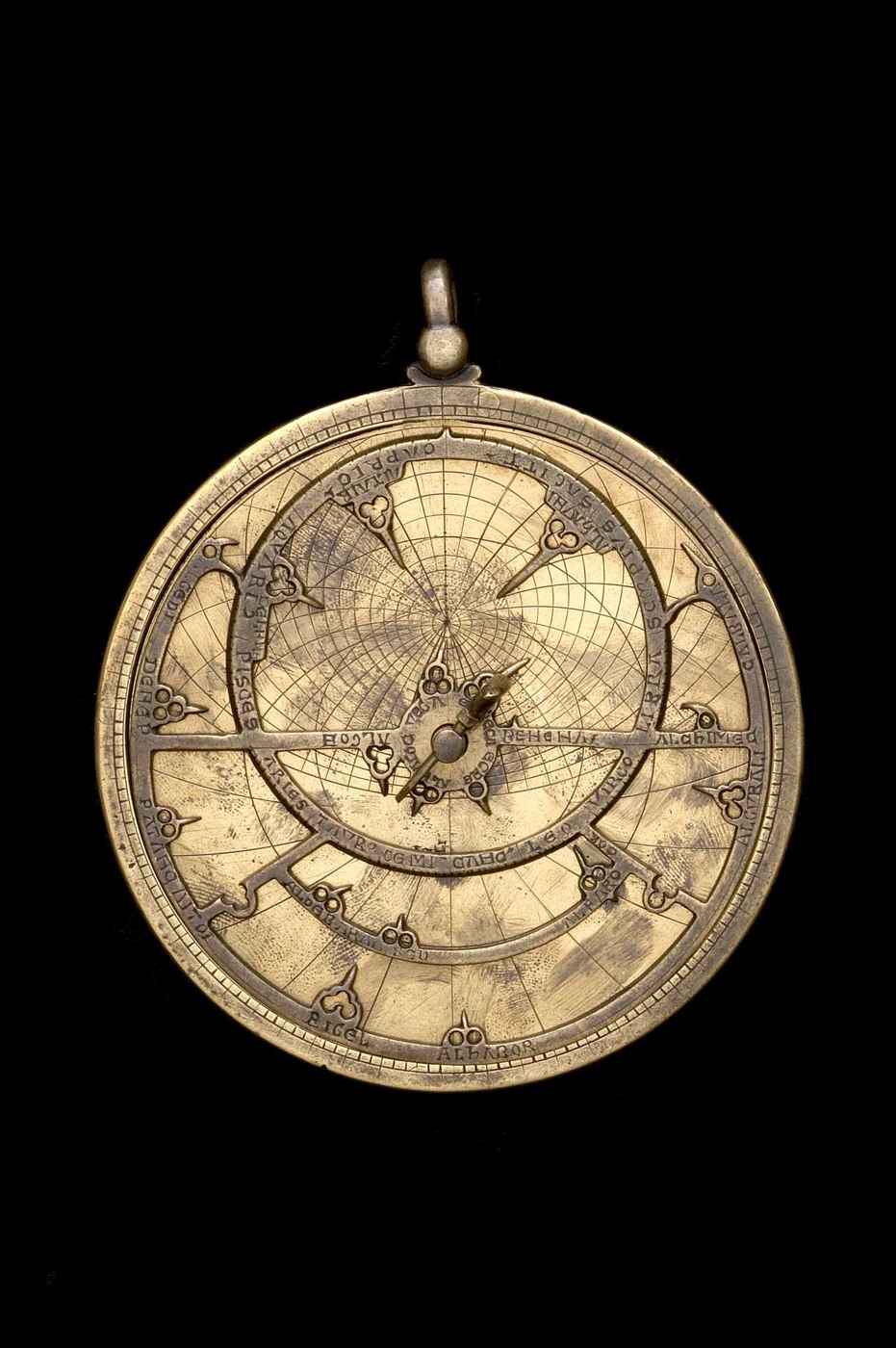
This brass astrolabe, identified as inventory number 49033, is attributed to Spain circa 1250 and is maintained in the History of Science Museum, Oxford. It features a simple throne with an integrated base and an omega-type shackle. The instrument includes a riveted mater and limb, and a rete of the indicator-line type containing 21 stars marked with dagger pointers. The zodiacal signs are engraved on the rete. Four plates are provided, covering latitudes from 30° to 60°. The back of the instrument features unfinished scales, including a shadow square, a calendrical table based on the 28-year solar cycle, and zodiacal and calendar scales. The double-ended, counter-changed alidade is original but has broken tips. The instrument was presented to the collection by Lewis Evans in 1924, having been purchased from dealer Percy Webster in 1911. It is considered an early Western example.

Front view of the brass astrolabe (inventory 49033), showing the rete, pin, and horse.
Front view of the brass astrolabe (inventory 49033), showing the rete, pin, and horse. — History of Science Museum, University of Oxford. Rights pending — permission not yet requested. Original source

Catalogue identity

Source
www.mhs.ox.ac.uk
Category
Tool · Latin-inscribed astrolabe
Maker / attribution
Not established
Reference
49033
Catalogue / lot identifier
49033
Source-reported date
ca. 1250
Source-reported place
Spain (?)

Source-reported attribution and specifications are not independent authentication. A listing does not establish present ownership, current display, availability or permission to reproduce.

Object description

Construction and Design

The astrolabe is constructed primarily from brass, featuring a simple throne attached with an integrated base and an omega-type shackle. The mater and limb are joined via a riveted construction, with the notch for plate tabs positioned at the throne. The design incorporates a rete of the indicator-line type, which is secured to the main body by a pin and horse mechanism.

The rete displays 21 stars, each indicated by a dagger pointer, and features a labelled zodiac. The four accompanying plates provide latitude ranges between 30° and 60°. The alidade is a double-ended, counter-changed component. While it retains its original form, the tips have suffered damage and are broken, and the sighting vanes include notches of an indeterminate function.

Evidence for this section
  • “The throne is of the simple type made of brass attached with integrated base made of brass and omega type shackle made of brass”
  • “The mater and limb are of two pieces, riveted construction.”
  • “The rete is attached using a pin & horse.”
  • “Both tips have broken off.”

Scales and Markings

The back of the astrolabe contains four distinct scales: zodiacal signs, a calendar, a shadow square, and a solar cycle. These elements are currently unfinished. The shadow square lacks both labels and numbers, and the calendrical table, which is based on a 28-year solar cycle, remains incomplete. The zodiacal signs and the calendar are arranged in circular patterns.

The limb features a degree scale for measurement, though these degrees are not numbered. The womb of the instrument is inscribed with specific latitude details, and the almucantars and azimuths are divided every 5 degrees, represented by plain lines.

Evidence for this section
  • “The shadow square is not labeled or numbered, and the calendrical table (based on the 28-year solar cycle) has not been completed.”
  • “The back contains 4 scales of the following types: Zodiacal signs; Calendar; Shadow square; Solar cycle.”
  • “Scales on the limb: degree scale.”

Provenance and Historical Context

This instrument was presented to the Oxford collection by Lewis Evans in 1924, accessioned under number 1924-0/2090. Evans had acquired the piece in 1911 through Percy Webster, a London-based dealer. Although the object displays Hispano-Moorish stylistic influences, it is not signed or dated.

Research suggests that the inclusion of specific plates for 48° and 52° latitudes indicates that it may have originally been intended for use by an individual located in Paris or London.

Evidence for this section
  • “Presented by Lewis Evans in 1924”
  • “Evans bought it from Percy Webster, his main London dealer, in 1911.”
  • “Though not signed or dated, this is understood to be the earliest Western astrolabe in the Oxford collection.”
  • “the existence of specific plates for 48° and 52° suggest it was originally made for someone based in Paris and/or London.”

Open research questions

  • What is the intended function of the unusual notches found on the bottom of the alidade's sighting vanes?
  • Can the origin be definitively confirmed as Spanish given the current status of 'Spain (?)'?
  • Is there any archival evidence linking the plates for 48° and 52° to specific owners or makers?

Source evidence

Recorded claims and source quotations for Astrolabe
FieldSource-reported valueSource quotation
Inventory number49033“Inventory number: 49033”
Dateca. 1250“Date ca. 1250”
MaterialBrass“Material Brass”
PlaceSpain (?)“Place Spain (?)”
Acquisition1924“Presented by Lewis Evans in 1924”
Star count21“The rete contains 21 stars.”
Plate latitudes30°0' to 60°0'“There are 4 plates with latitudes ranging from 30°0' to 60°0'”

Visible details

  • The alidade exhibits broken tips at both ends.
  • The back scales, including the shadow square and calendrical table, remain incomplete.
  • The rete features star names engraved alongside dagger-shaped pointers.
  • The instrument is held together by a pin and horse.

Research qualifications

  • The manufacture is tentatively attributed to Spain with uncertainty.
  • The original purpose or intended user location in Paris or London remains speculative based on plate latitudes.
  • The functionality of the notches on the alidade sighting vanes is unidentified.

Photograph identity and source facts were screened before import; rights clearance remains pending.

Consulted source

Astrolabe, inventory 49033 (Spain (?), ca. 1250)

Reviewed 2026-10-26 · Record 4065e9164e

Terms in this record

Glossary explanations for terms named in this object’s record.