
Skip to content
The Encyclopedia of Horology

Clock · Table clock

Antoine Gaudron Table Clock

Partially verified

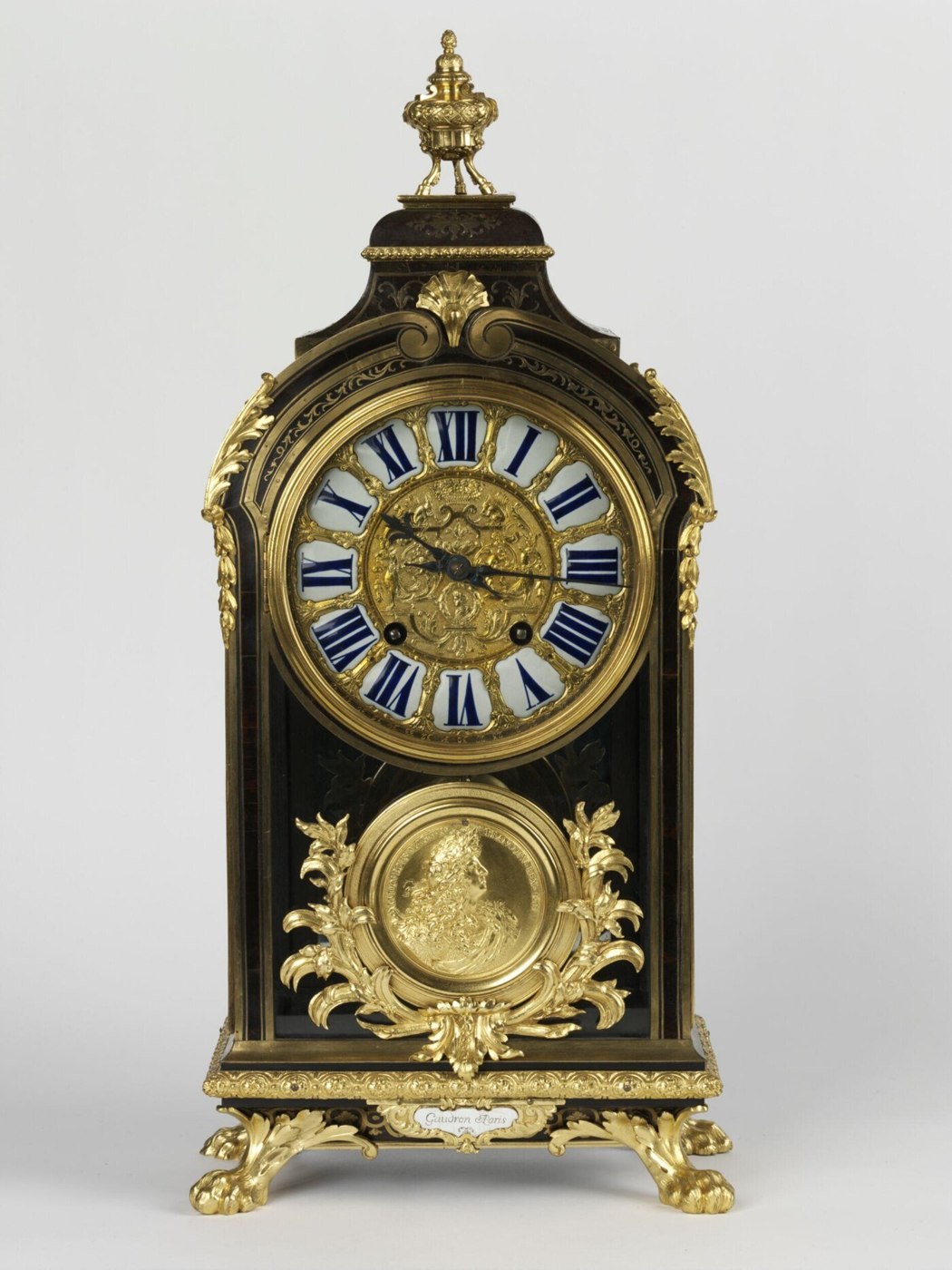
This late 17th-century table clock, attributed to Antoine Gaudron of Paris, features a case constructed of tortoiseshell with intricate brass marquetry of foliated scrollwork. The case rests on four gilt-bronze claw feet and is adorned with chased gilt-bronze mounts, including acanthus foliage corner pieces and a bell-top finished with a tripod vase. The 20.3 cm diameter ormolu dial displays relief-carved strapwork, monsters, and squirrels, with Roman numeral hours on blue and white enamel plaques. An integrated gilt-bronze medallion below the dial depicts Louis XIV and is signed by Bertinet. The movement includes two trains with going barrels and an internal Brocot escapement with a steel escape wheel. The clock has undergone modifications, including the replacement of an original verge escapement with the current Brocot system, and is currently missing its bell hammer.

Front view showing the gilt-bronze medallion and dial detail.
Front view showing the gilt-bronze medallion and dial detail. — Victoria and Albert Museum, London. Rights pending — permission not yet requested. Original source

Catalogue identity

Source
collections.vam.ac.uk
Category
Clock · Table clock
Maker / attribution
Antoine Gaudron
Reference
Not recorded
Catalogue / lot identifier
4:1 to 3-1903
Source-reported date
late 17th century
Source-reported place
Paris

Source-reported attribution and specifications are not independent authentication. A listing does not establish present ownership, current display, availability or permission to reproduce.

Object description

Case Construction

The clock is housed in a case primarily composed of tortoiseshell, which serves as a ground for marquetry of brass in a foliated scrollwork pattern. The structure is accented by chased gilt-bronze mounts, specifically utilizing acanthus leaf motifs at the corners and enriched mouldings throughout.

The assembly rests on four cast claw feet and features glazed side panels of an arched form. The top of the clock is of a bell-top design, surmounted by a tripod-style vase crafted in ormolu. Access to the interior is provided by a wooden rear door.

The dial assembly includes a prominent 9.2cm gilt-bronze medallion positioned below the main dial. This medallion displays a low-relief bust of Louis XIV, accompanied by the inscription 'LVDOVICVS MAGNVS FRANCORV. REX. 1677' and the signature 'Bertinet', surrounded by a decorative wreath.

Evidence for this section
  • “case of tortoiseshell with marquetry of brass, mounts of chased gilt bronze and glass panels”
  • “The case rests on four claw feet, and decorated with enriched mouldings and corner mounts of acanthus foliage”
  • “an applied gilt-bronze medallion 9.2cm in diameter, with an embossed head of Louis XIV in low relief and inscribed ''LVDOVICVS MAGNVS FRANCORV. REX. 1677', and signed 'Bertinet'.”

Dial and Timekeeping

The main dial is constructed of ormolu and measures 20.3cm in diameter. It is decorated in relief with foliated strapwork, which terminates in depictions of monsters, alongside a bust set within laurel leaves and two squirrels located above the center.

Time is indicated via Roman numerals I through XII, which are presented on individual convex white-enamel plaques with blue lettering, inset into the ormolu dial. The minutes, numbered 1 to 60, are engraved along the outer edge. Quarter marks are engraved within the hour markers, and the time is indicated by steel hands equipped with tails.

A capstan for regulation is positioned above the 60-minute marker. The winding holes are located internally, beneath the IIII and VII hour positions.

Evidence for this section
  • “Ormolu dial, 20.3cm in diameter, decorated in relief with foliated strapwork”
  • “Roman hour figures I to XII are each in blue on a convex white-enamel plaque inset in the dial.”
  • “Minutes 1 to 60 engraved at outer edge of the dial.”

Movement and Mechanism

The movement is signed on the backplate as 'Gaudon Paris' and features plates measuring 15.3cm by 12.7cm. Both the going and striking trains utilize going barrels for power. The striking train on the left includes an outside locking-plate with notches numbered 1 through 12, though the bell hammer is currently missing.

The going train currently incorporates an internal Brocot escapement with steel pallets and a 32-tooth escape wheel. This is paired with a Brocot-type regulator and a pendulum of 27.9cm in length, which carries a brass-cased lead lenticular bob 7cm in diameter.

The movement record notes that the current Brocot escapement is not original to the clock, as the piece was formerly fitted with a verge escapement.

Evidence for this section
  • “the backplate signed 'Gaudon Paris'.”
  • “The going train to the right has an internal Brocot escapement with steel pallets and escape wheel of 32T, with a Brocot-type regulator.”
  • “Formerly with a verge escapement.”

Open research questions

  • What is the specific relationship between the medallion signature 'Bertinet' and the clock maker Antoine Gaudron?
  • When was the verge escapement replaced by the Brocot mechanism?

Source evidence

Recorded claims and source quotations for Antoine Gaudron Table Clock
FieldSource-reported valueSource quotation
MakerAntoine Gaudron“Maker: Antoine Gaudron”
Datelate 17th century“Date: late 17th century”
Place of originParis“Place of origin: Paris (made)”
Case materialsTortoiseshell, brass, gilt bronze, glass“Case of tortoiseshell inlaid with brass, mounts of chased gilt bronze, and glass panels.”
Medallion signatureBertinet“inscribed ''LVDOVICVS MAGNVS FRANCORV. REX. 1677', and signed 'Bertinet'.”
Movement signatureGaudon Paris“the backplate signed 'Gaudon Paris'.”
Dimensions66.7 cm high, 31 cm wide, 17.5 cm deep“Height: 66.7 cm; Width: 31 cm; Depth: 17.5 cm”
Dial featuresFoliated strapwork, Louis XIV medallion, Roman numerals“Ormolu dial, 20.3cm in diameter, decorated in relief with foliated strapwork”

Visible details

  • Case features brass marquetry of foliated scrollwork
  • Roman hour numerals presented on convex white-enamel plaques
  • Dial includes a relief medallion signed by Bertinet
  • Movement includes an internal Brocot escapement

Research qualifications

  • The bell hammer is noted as missing from the striking train
  • The current Brocot escapement is a modification of an original verge escapement

Photograph identity and source facts were screened before import; rights clearance remains pending.

Consulted source

Clock

Reviewed 2026-10-26 · Record 0f62d3eaa4

Terms in this record

Glossary explanations for terms named in this object’s record.