
Skip to content
The Encyclopedia of Horology

Clock · Longcase clock

Antique 8-Day Mahogany Longcase Clock by Vincent of Bath

Partially verified

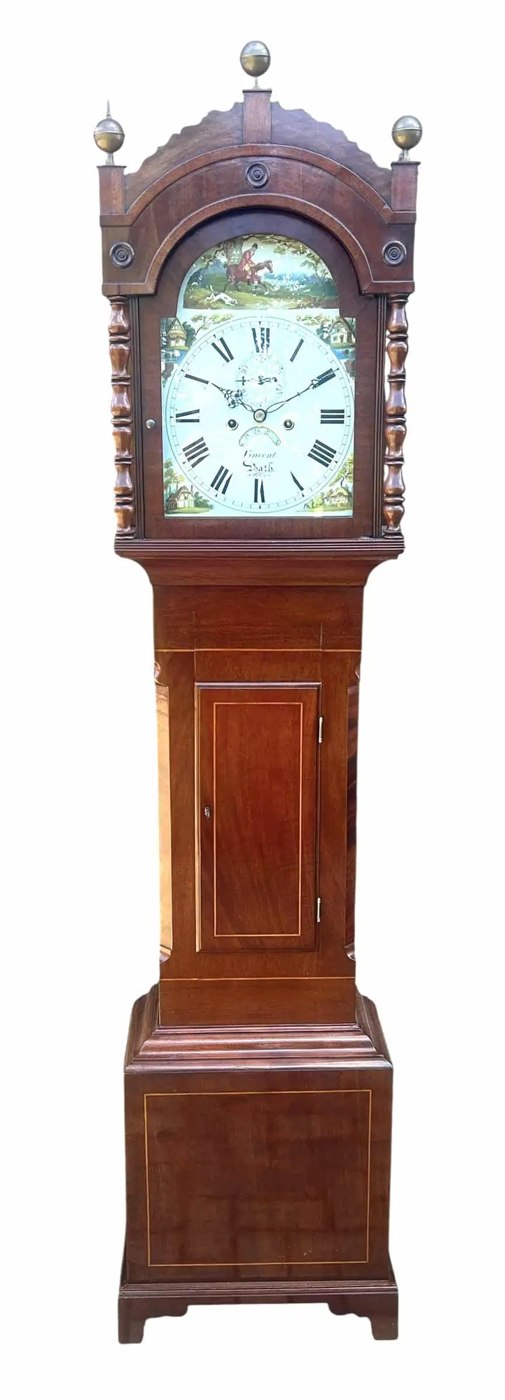
This early 19th-century Georgian longcase clock is attributed to the maker Vincent of Bath. Standing 214cm high, it features a weight-driven, 8-day brass movement that performs an hour strike on an internal bell. The clock is housed in a flame mahogany case with a hood design that incorporates hand-painted floral and geometric motifs on the spandrels, alongside a landscape scene in the arch. The white, hand-painted square dial displays a date aperture and a subsidiary seconds hand. Included with the clock are the original weights, pendulum, and winding key. The dial displays age-related glaze crazing, and the mahogany cabinet exhibits varied grain figuring. The movement is reported as fully operational, maintaining accurate time, with correct calendar advancement and hour strike functions.

Full front view of the mahogany longcase clock by Vincent of Bath, showing the arched hood with brass finials, dial, and cabinet structure.
Full front view of the mahogany longcase clock by Vincent of Bath, showing the arched hood with brass finials, dial, and cabinet structure. — Vintage Clocks UK. Rights pending — permission not yet requested. Original source

Catalogue identity

Source
vintageclocks.uk
Category
Clock · Longcase clock
Maker / attribution
Vincent of Bath
Reference
Not recorded
Catalogue / lot identifier
Source URL identifies the listing
Source-reported date
early 19th-century
Source-reported place
England
Source-reported serial
JN143

Source-reported attribution and specifications are not independent authentication. A listing does not establish present ownership, current display, availability or permission to reproduce.

Object description

Case and Design

The structure includes a hood with a square-style dial configuration, flanked by side columns. Three spherical finials with tapered supports are positioned atop the hood arch.

The waist section includes a central door, decorated with perimeter inlay lines, which continues onto the base panel. The overall height is 214cm, with a width of 45cm and a depth of 24cm.

Evidence for this section
  • “Housed in a beautifully figured flame mahogany cabinet”
  • “Measures 214cm high, 45cm wide, 24cm deep”
  • “Excellent antique condition.”

Dial and Timekeeping

The timepiece features a hand-painted white dial signed by Vincent of Bath. It is laid out with Roman numerals for the primary hour markers and includes a subsidiary seconds dial located above the central arbor, as well as an aperture for the date display. The spandrels are decorated with floral and geometric motifs, while the arch contains a landscape scene featuring a rider on horseback.

The auction description states that the dial is clean and displays fine glaze crazing, which is noted as evidence of its age. The movement is a brass, weight-driven type requiring winding on an weekly basis. It is described as fully operational, capable of striking the hours on an internal bell.

Evidence for this section
  • “hand-painted square white dial is equipped with an integrated date calendar aperture and a subsidiary seconds dial”
  • “It strikes the hours clearly on a resonant internal bell.”
  • “It displays fine, genuine glaze crazing consistent with its age”

Components and Attribution

The clock is attributed to Vincent of Bath, a maker cited in the source as regionally documented. The object is sold as a complete unit, which includes the necessary mechanical components for operation. The auction house confirms the inclusion of the weights, the pendulum, and the winding key with the purchase.

The movement is confirmed to be in functional status, with the calendar wheel and strike sequence described as working correctly. The source identifies the item as an early 19th-century Georgian piece.

Evidence for this section
  • “signed on the dial face by Vincent of Bath”
  • “Included with purchase: Original weights, pendulum, and winding key.”
  • “Up for sale is an exceptional early 19th-century Georgian longcase clock”

Open research questions

  • What are the specific operational years for the maker Vincent of Bath?
  • Does the serial number JN143 correspond to a recorded register of this maker's work?

Source evidence

Recorded claims and source quotations for Antique 8-Day Mahogany Longcase Clock by Vincent of Bath
FieldSource-reported valueSource quotation
MakerVincent of Bath“signed on the dial face by Vincent of Bath”
Overall dimensions214cm x 45cm x 24cm“Measures 214cm high, 45cm wide, 24cm deep”
Cabinet materialFlame mahogany“Housed in a beautifully figured flame mahogany cabinet”
Dial featuresHand-painted white dial with calendar aperture and seconds subsidiary“hand-painted square white dial is equipped with an integrated date calendar aperture and a subsidiary seconds dial”
SKUJN143“SKU: JN143”

Visible details

  • Three decorative brass finials mounted on top of the hood
  • Hand-painted arched dial featuring a equestrian scene
  • Inlaid line decoration visible on the waist and base panels
  • Column-style side mouldings on the hood

Research qualifications

  • The specific production date within the early 19th century is not verified
  • Attribution to Vincent of Bath relies on the signature on the dial

Photograph identity and source facts were screened before import; rights clearance remains pending.

Consulted source

Antique 8-Day Mahogany Longcase Grandfather Clock Vincent of Bath 214cm

Reviewed 2026-11-02 · Record 5e669b9a4b

Terms in this record

Glossary explanations for terms named in this object’s record.