
Skip to content
The Encyclopedia of Horology

Clock · Alarm Tabernacle Clock

Alarm Tabernacle Clock

Partially verified

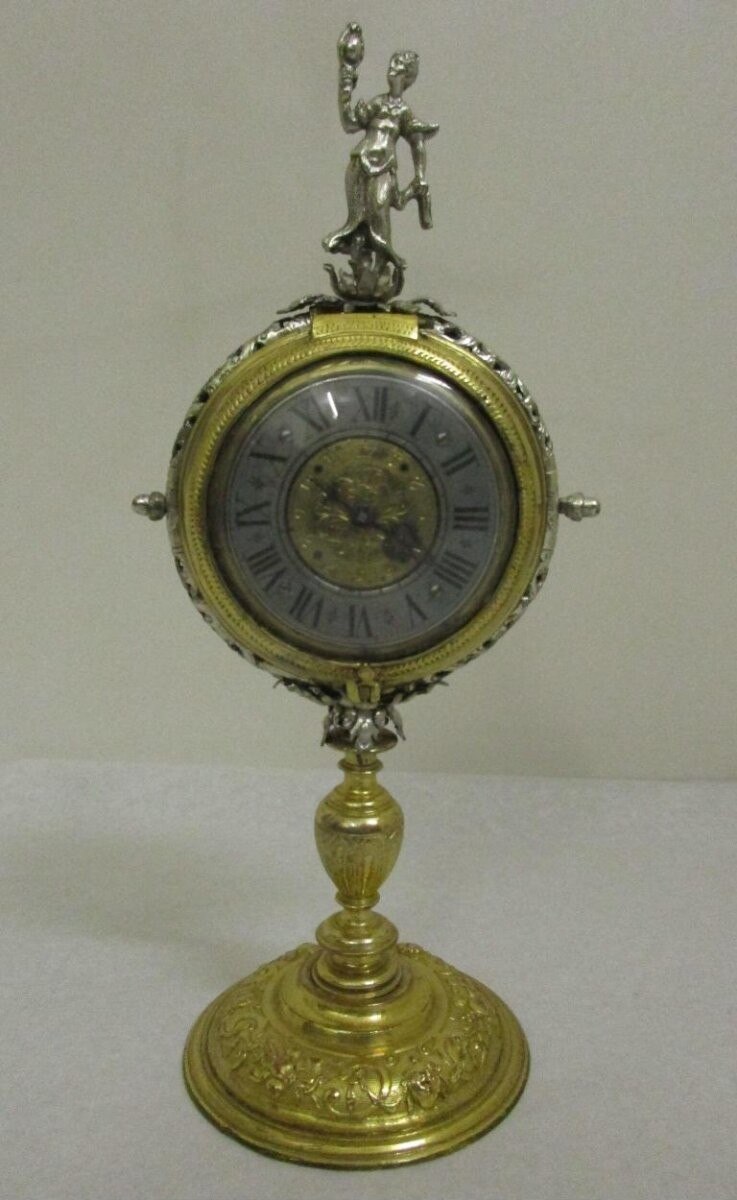
This German alarm tabernacle clock, dating to approximately 1580, features a lens-shaped, vertical gilt-brass case. The clock is supported by a chased baluster pillar resting on a splayed foot decorated with repousse masks, fruit, and foliage. A silver ring, pierced with foliage, separates the front and rear portions of the case. The top of the clock is adorned with a silver figure of Prudence, depicted with an upraised right hand. The dial includes a silver chapter-ring with Roman hours and half-hour star markers, surrounding a central brass disc numbered one to twelve. The movement, which hinges into the bell, includes a stackfreed, a verge escapement, and a striking train with a count-wheel. It was bequeathed to the Victoria and Albert Museum in 1919 by John George Joicey. The rear plate bears the punched initials SA HA.

Front view of the German alarm tabernacle clock, circa 1580, featuring a silver figure of Prudence.
Front view of the German alarm tabernacle clock, circa 1580, featuring a silver figure of Prudence. — Victoria and Albert Museum, London. Rights pending — permission not yet requested. Original source

Catalogue identity

Source
collections.vam.ac.uk
Category
Clock · Alarm Tabernacle Clock
Maker / attribution
Not established
Reference
Not recorded
Catalogue / lot identifier
M.219-1919
Source-reported date
1575-1600
Source-reported place
Germany

Source-reported attribution and specifications are not independent authentication. A listing does not establish present ownership, current display, availability or permission to reproduce.

Object description

Case and External Features

The clock is contained within a lens-shaped vertical gilt-brass housing. This structure is mounted on a chased baluster pillar, which sits upon a spreading, splayed foot. The foot is decorated in repoussé with motifs of masks, fruit, and foliage. The central case section is bounded by a silver ring featuring pierced foliage detailing.

Above the main casing, silver leaves and florets serve as a base for a silver figure of Prudence, who is shown with her right hand raised. The rear cover of the brass case is pierced and chased with a decorative pattern of floral scrolls that originate from a central vase design. The dial is protected by a hinged, glazed cover with an engraved gilt-brass bezel.

Evidence for this section
  • “The clock movement enclosed in a lens-shaped vertical case”
  • “is supported on a gilt-brass chased pillar of baluster shape resting on a splayed foot repousse with masks, fruit and foliage.”
  • “The brass rear cover of the case pierced and chased with a symmetrical design of floral scrolls issuing from a vase.”

Dial and Movement

The time is indicated on a silver chapter ring measuring 4.5 cm in diameter and 1.0 cm in breadth, featuring Roman numerals for the hours and star symbols at the half-hour marks. A central brass disc displays Arabic numerals from one to twelve. The time is shown by a pierced double-ended steel hand.

The movement, which hinges into the bell, includes a going train at the front fitted with a stackfreed and a verge escapement. The great wheel is constructed of iron, while the other wheels are brass. The balance wheel is a three-armed brass component, currently fitted with a balance-spring but lacking a regulator. The striking train features an engraved resting-barrel and a sliding-ring count-wheel marked one to twelve.

Evidence for this section
  • “Dial with silver chapter-ring (4.5cm, 1.0cm broad). Roman hours, stars at the half-hours.”
  • “Going train at front with stackfreed, the great wheel of iron, the remaining wheels of brass; verge escapement.”
  • “Striking train with engraved resting-barrel, and count-wheel in the form of a sliding ring, cut and numbered for a sequence 1 to 12.”

Provenance and Markings

The object was part of a 1919 bequest to the Victoria and Albert Museum from the collection of John George Joicey.

A specific marking, '.SA.HA', is punched into the rear plate of the movement. There is ambiguity regarding the purpose of these initials, as they may refer to the identity of a previous owner or could record a historical repair conducted on the movement.

Evidence for this section
  • “The clock was one of two beqeathed by J.G.Joicey in 1919 with over thirty watches.”
  • “Movement punched on rear plate “.SA.HA”.”
  • “possibly initials recording ownership of the clock or repair of the movement.”

Open research questions

  • What is the specific function of the sliding-ring count-wheel in this horological configuration?
  • Can the 'SA HA' initials be linked to known metalworkers or collectors of the late 16th century?

Source evidence

Recorded claims and source quotations for Alarm Tabernacle Clock
FieldSource-reported valueSource quotation
Maker/OriginGerman, about 1580“German, about 1580.”
Accession NumberM.219-1919“M.219-1919”
EscapementVerge escapement“verge escapement.”
InscriptionsSA HA“Movement punched on rear plate “.SA.HA”.”
MaterialsGilt-brass and silver“gilt-brass case surmounted by a silver figure”
ProvenanceJohn George Joicey bequest“The clock was one of two beqeathed by J.G.Joicey in 1919”

Visible details

  • The clock dial features a pierced double-ended steel hand.
  • The rear of the case displays a symmetrical pierced design of floral scrolls issuing from a vase.
  • The balance-wheel is a three-armed brass construction.
  • The figure of Prudence stands atop the case assembly.

Research qualifications

  • The movement is described as incomplete.
  • The punched initials SA HA may represent either original ownership or later repair work.

Photograph identity and source facts were screened before import; rights clearance remains pending.

Terms in this record

Glossary explanations for terms named in this object’s record.

Other alarm tabernacle clock records