
Skip to content
The Encyclopedia of Horology

Clock · Alarm Tabernacle Clock

Alarm Tabernacle Clock

Partially verified

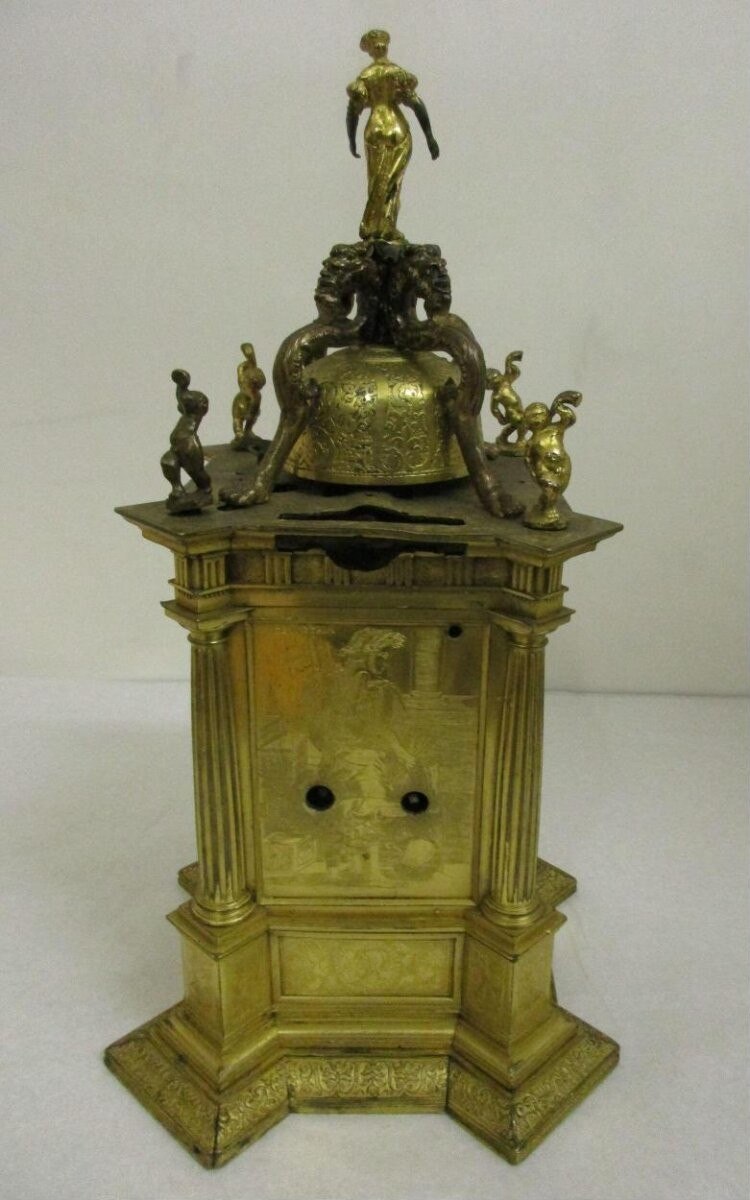
This alarm tabernacle clock, originating from Southern Germany and dated to 1580-1585, features a gilt copper case constructed in a square section with Doric columns on plinths at each corner. The side panels are engraved with allegorical figures of Astrology, Geometry, and Arithmetic, derived from woodcuts by Hans Sebald Beham, and signed with the monogram A.P. The clock dial is a later replacement, inscribed with the name 'Thobias Küster' and the date 1620. The movement is predominantly iron with brass wheels, utilizing a posted frame with square baluster pillars. The striking train is of the count-wheel type, and the clock originally included an alarm train. A bell etched with arabesques sits atop the case, suspended from a frame adorned with grotesque bearded heads and lion paws, supporting a central draped female figure. The globe, half-gilt and half-blue, completes the upper assembly.

A view of the alarm tabernacle clock, showing the gilt copper case, the bell assembly with the central female figure, and the side panel engraving.
A view of the alarm tabernacle clock, showing the gilt copper case, the bell assembly with the central female figure, and the side panel engraving. — Victoria and Albert Museum. Rights pending — permission not yet requested. Original source

Catalogue identity

Source
collections.vam.ac.uk
Category
Clock · Alarm Tabernacle Clock
Maker / attribution
Thobias Küster
Reference
Not recorded
Catalogue / lot identifier
M.106-1953
Source-reported date
1580-1585 (case), 1620 (dial)
Source-reported place
Southern Germany

Source-reported attribution and specifications are not independent authentication. A listing does not establish present ownership, current display, availability or permission to reproduce.

Object description

Case and Exterior Decoration

The clock is housed in a gilt copper case of square section, constructed with a Doric column on a plinth at each of the four corners. The structure is capped by a Doric frieze and entablature. The side panels are decorated with intricate engravings representing the figures of Astrology, Geometry, and Arithmetic, which are attributed to designs by Hans Sebald Beham, signed with the monogram A.P. Between the plinths, additional panels feature foliage motifs enclosing roundels with Roman heads.

The summit of the clock features a bell etched with arabesque patterns, suspended from a frame formed by four legs topped with grotesque bearded heads and finishing in lion's paws. The apex forms a pedestal for a draped female figure. At each corner, a putto blowing a horn is positioned. One of these figures appears to be a replacement, and restoration is evident on the arms of the central female figure.

Evidence for this section
  • “The case of square section with an attached Doric column on a plinth at each corner.”
  • “The intervening panels between the columns are engraved with the allegorical figures of Astrology, Geometry and Arithmetic.”
  • “These representations are copied from woodcuts by Hans Sebald Beham.”

Movement and Dial

The internal movement is constructed primarily of iron, utilizing a posted frame with square baluster corner pillars. The going train features a 'tic-tac' type escapement, with the escape wheel containing 35 teeth. Striking is managed by a count-wheel mechanism, with the train situated at the rear of the movement. The alarm train, previously located at the top right, is currently absent.

The dial assembly is a later addition to the original 1580-1585 case, dated 1620. It comprises an engraved chapter-ring with Roman numerals for the hours and an alarm indicator disc with Arabic numerals. A revolving sphere is mounted above the dial, completing one rotation every twenty-four hours.

Evidence for this section
  • “Frame and movement mainly of iron, but with two brass wheels, probably renewals.”
  • “Going train, in front of movement, now with escapement of "tic-tac" type”
  • “The whole plate a later replacement.”

History and Provenance

The object was donated to the museum by Dr. W. L. Hildburgh, a fellow of the Society of Antiquaries.

While the movement and case structure are attributed to South Germany in the 1580s, the dial serves as a marker for later 17th-century activity. The inscription bearing the name Thobias Küster may represent a retailer or restorer who provided the replacement dial, suggesting ongoing maintenance or modification of the instrument in 1620.

Evidence for this section
  • “One of five clocks given by Dr W.L.Hildburgh FSA.”
  • “The clock case is South German, about 1580.”
  • “This may be the name of a later retailer who supplied the earlier clock.”

Open research questions

  • Can the identity of the engraver with the monogram 'A.P.' be linked to specific 16th-century workshops in Southern Germany?
  • Does the 'tic-tac' escapement reflect a later 17th-century conversion of the movement, and what was the original escapement type?

Source evidence

Recorded claims and source quotations for Alarm Tabernacle Clock
FieldSource-reported valueSource quotation
Accession NumberM.106-1953“M.106-1953”
MakerThobias Küster“signed by Thobias Küster”
Place of OriginSouthern Germany“South German”
MaterialsGilt copper, iron“Gilt copper and iron”
Dial InscriptionTHOBIAS KUSTER 1620“Signed elow chapter-ring "THOBIAS KUSTER 1620".”
ProvenanceGiven by Dr. W. L. Hildburgh“Given by Dr W.L. Hildburgh”

Visible details

  • Doric columns serve as corner supports for the square case.
  • Engravings on the side panels depict allegorical figures from Hans Sebald Beham's designs.
  • Top assembly features a bell suspended within a frame with grotesque heads and lion paws.
  • A central draped female figure stands as a finial atop the bell structure.

Research qualifications

  • The clock face and dial plate are identified as later replacements inserted in 1620.
  • The alarm indicator hand is missing.
  • Restoration is noted on the upper arms of the central female figure, and one putto figure may be a replacement.

Photograph identity and source facts were screened before import; rights clearance remains pending.

Terms in this record

Glossary explanations for terms named in this object’s record.

Other alarm tabernacle clock records