
Planispheric astrolabe · Isfahan, Iran
Persian planispheric astrolabe, Smithsonian MA.316761
Partially verifiedThe National Museum of American History describes MA.316761 as made in Isfahan about 1715 and attributes it to ‘Abd al-A’imma. It is CCA40 on the international checklist cited by the museum. These two identifiers refer to the same object in different documentation systems, not two separate acquisitions.
Technical facts
- Museum ID
- MA.316761
- Accession number
- 215454
- Checklist
- CCA40
- Material
- Brass
- Overall dimensions
- 3.2 × 9.35 × 14.9 cm (museum order; axes not specified)
- Latitude plates
- Five, with different engraved coverage
Historical significance
- The National Museum of American History describes MA.316761 as made in Isfahan about 1715 and attributes it to ‘Abd al-A’imma. It is CCA40 on the international checklist cited by the museum. These two identifiers refer to the same object in different documentation systems, not two separate acquisitions.
- Its body includes a throne and a ring for suspension. The museum lists five plates. One plate face has quarter horizons for every three degrees of latitude between 12° and 66°; the other faces carry stereographic projections for latitudes between 29° and 40°. The special face should not be collapsed into a claim that every plate covers the whole range.
- The rotating rete acts as a star map, while an alidade on the back is used for sighting. A central pin passes through the assembly and a wedge retains it. A selected latitude plate supplies the local sky geometry against which the rete is turned. This explains astronomical time-finding without implying that an astrolabe contains an escapement or advances automatically.
- The upper-left back quadrant carries a grid representing sines and cosines; a box below the centre includes tangent and cotangent scales. The official record refers researchers to Gibbs and Saliba’s 1984 catalogue, pages 74–77, for a fuller description. That is recorded further reading, not a claim that the volume was newly consulted for this page.
- The museum specifies horizontal lines for sines and vertical lines for cosines in that upper-left grid. These scale directions are recorded for this instrument, not inferred from its front photograph. The accession number 215454 is distinct from museum ID MA.316761 and international checklist CCA40: preserve all three labels so a researcher does not mistake alternative identifiers for separate instruments or production dates.
- The museum acquired the instrument from Samuel V. Hoffman’s collection in 1959; the recorded credit is Gift of International Business Machines Corporation. The retrieved page said the object was not on display. Check the custodian for current access; this page does not offer a guarantee of exhibition or a new condition assessment.
Reading this instrument’s evidence
| Feature | Recorded evidence | Limit of the claim |
|---|---|---|
| Identity | MA.316761 | A collection identifier, not a manufacture date. |
| Authorship | ‘Abd al-A’imma (museum attribution) | Keep role and qualification; an inscribed name is not always the builder. |
| Place | Isfahan, Iran | Do not infer a workshop city from language, style or a maker’s name. |
| Components | Five, with different engraved coverage | A catalogue or photograph is not a new completeness or calibration examination. |
Evidence checklist
- Match every view to this accession before comparing engravings.
- Separate original components, reported replacements and unexamined surfaces.
- Use the custodian’s latest record for display and access questions.
A user-operated astrolabe is not a self-running clock. Do not look directly at the Sun or handle fragile historic components to test a calculation.
Photographs
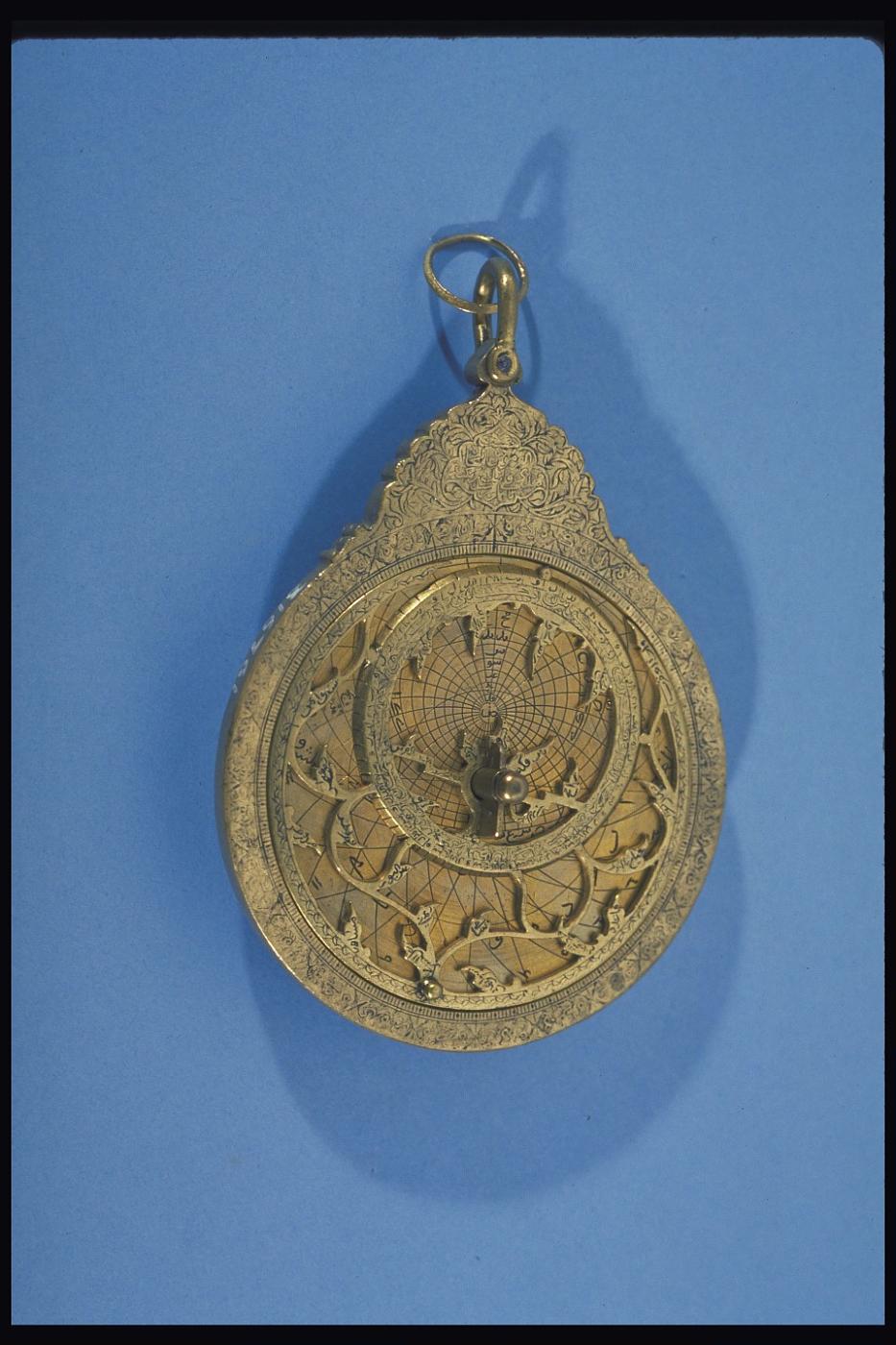
Photographs are illustrative examples of the type, not necessarily the exact object described. Verify details against the source file page.
Sources & references
Where sources disagree, the disagreement is stated rather than resolved silently.