
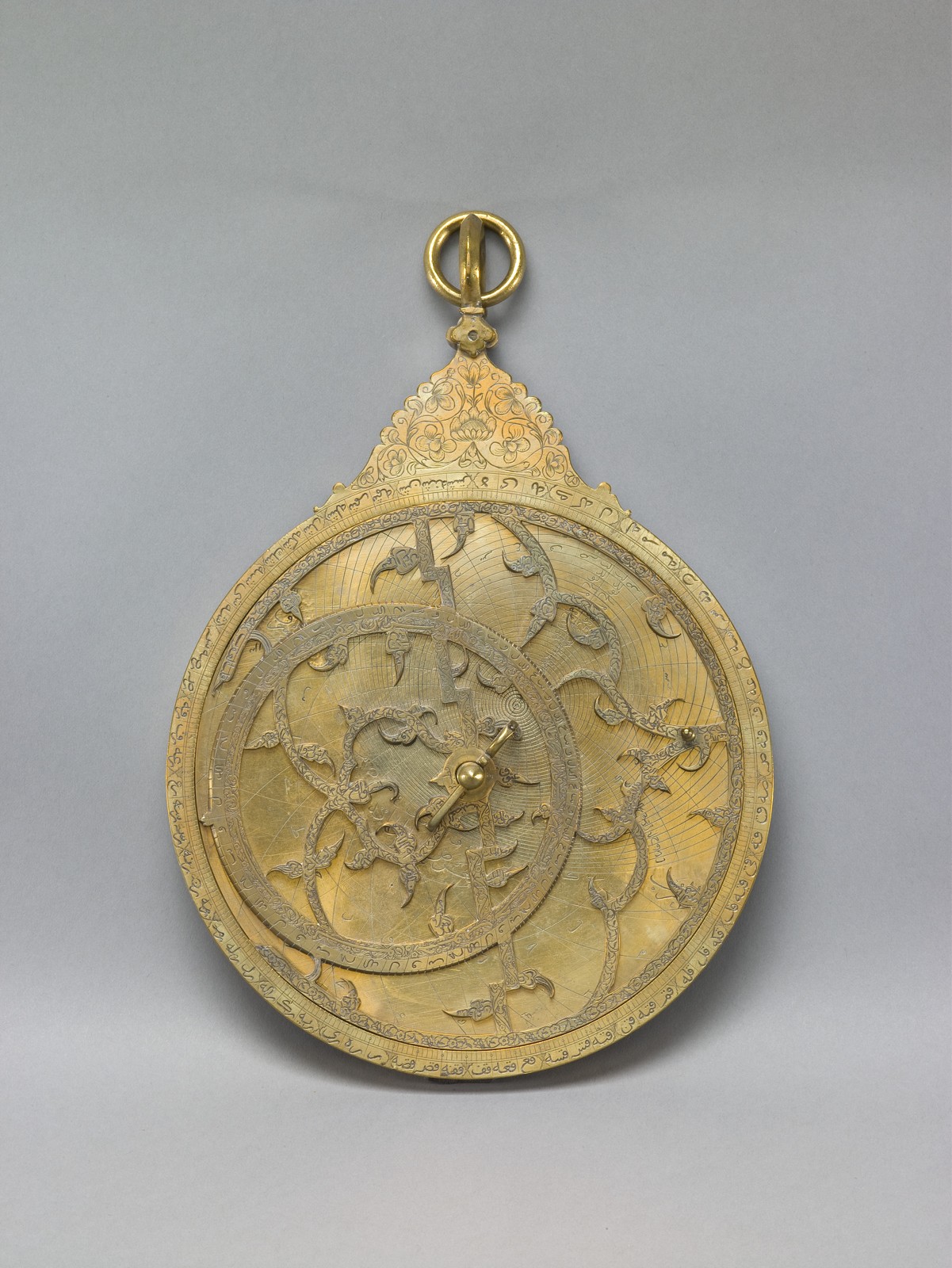
Planispheric astrolabe · Isfahan, Iran
Isfahan planispheric astrolabe, Saint Louis 41:1926
Partially verifiedThe Saint Louis Art Museum identifies this brass instrument as Persian, made in Isfahan in 1715 during the Safavid dynasty. Its record separates Mohammad Amin ibn Mohammad Taher as maker from Abd al-A'immah as decorator. Those roles must remain distinct even though the museum notes that the two instrument makers worked both together and separately.
Technical facts
- Accession
- 41:1926
- Material
- Brass
- Overall dimensions
- 28.3 × 18.4 × 3.5 cm (museum)
- Manufacture
- Isfahan, Iran
- Roles
- Maker and decorator separately identified
Historical significance
- The Saint Louis Art Museum identifies this brass instrument as Persian, made in Isfahan in 1715 during the Safavid dynasty. Its record separates Mohammad Amin ibn Mohammad Taher as maker from Abd al-A'immah as decorator. Those roles must remain distinct even though the museum notes that the two instrument makers worked both together and separately.
- A planispheric astrolabe models the sky on a flat surface. Its rotating pierced rete represents celestial positions over an engraved plate. Unlike a mechanical clock, the instrument does not advance autonomously: a user combines a sighting with the appropriate engraved scales to solve a time or astronomical problem. The front photograph documents this particular instrument rather than every Isfahan workshop design.
- The photograph shows the circular body, finely pierced metalwork and suspension assembly. Their ornamental treatment belongs alongside the scientific function, not in place of it. Comparing this object with another dated 1715 requires accession numbers, signatures and component descriptions; a shared date or a similarly decorated rete does not make two catalogue records duplicates.
- The museum classifies the object with metalwork, timepieces and measuring devices. This collection grouping connects its scientific and artistic interpretation without converting it into a mechanical watch. The descriptive note says the two named makers worked both together and separately in Isfahan; the distinct maker and decorator fields, rather than the fame of either name, determine the roles recorded for this accession.
- The museum lists height 28.3 cm, width 18.4 cm and depth 3.5 cm. These are its overall dimensions, not dimensions inferred from the image. The number 41:1926 identifies the collection object and should not be read as a production date. No running accuracy, calibration test or completeness examination is claimed here.
- The retrieved record listed Gallery 120 on 23 October 2026. Exhibition arrangements can change, so confirm the exact accession with the museum before travelling. Museum Purchase is the recorded credit line; the locally hosted photograph retains the official collection source and a separate permission-review status.
Reading this instrument’s evidence
| Feature | Recorded evidence | Limit of the claim |
|---|---|---|
| Identity | 41:1926 | A collection identifier, not a manufacture date. |
| Authorship | Mohammad Amin ibn Mohammad Taher (maker); Abd al-A'immah (decorator) | Keep role and qualification; an inscribed name is not always the builder. |
| Place | Isfahan, Iran | Do not infer a workshop city from language, style or a maker’s name. |
| Components | Visible structure documented by the exact accession photo. | A catalogue or photograph is not a new completeness or calibration examination. |
Evidence checklist
- Match every view to this accession before comparing engravings.
- Separate original components, reported replacements and unexamined surfaces.
- Use the custodian’s latest record for display and access questions.
A user-operated astrolabe is not a self-running clock. Do not look directly at the Sun or handle fragile historic components to test a calculation.
Photographs
Photographs are illustrative examples of the type, not necessarily the exact object described. Verify details against the source file page.
Sources & references
- https://www.slam.org/collection/objects/32416/
- https://www.americanhistory.si.edu/collections/object/nmah_997138
Where sources disagree, the disagreement is stated rather than resolved silently.