
Component record · Power
Rotor Bridge (Automatic Bridge)
Partially verifiedThe bridge or plate that carries the rotor's bearing and the automatic winding train (reversers and reduction wheels) on top of the movement.
What it does
Holds the self-winding mechanism in position over the barrel and train, and in modular designs lets the whole automatic device be removed as one unit.
How it works
The bridge carries the rotor arbor or ball bearing at its centre and the pivots of the reversers and reduction wheels. Its final wheel meshes with the ratchet wheel on the barrel bridge beneath it.
In many Swiss calibres the automatic device is a separate sub-assembly: removing a few screws lifts the rotor bridge with its wheels, exposing a movement that can then be serviced like a manual-wind calibre.
Because it supports the rotor, the bridge must be fully seated and its screws tight; a bridge sitting high by a fraction of a millimetre can let the rotor touch the case back.
Evolution
Early automatics often built the winding work directly into the movement's bridges. Modular automatic bridges became common in high-volume Swiss calibres, while integrated designs remain in many manufacture movements.
Known variations
- Modular automatic device (bridge plus wheels as one unit)
- Integrated automatic work built into the main bridges
- Micro-rotor layouts where the rotor sits within the movement's plane
Identification for collectors
- Decoration such as Geneva stripes or perlage on the rotor bridge is often visible through display backs
- Calibre and maker markings are frequently engraved on this bridge
Common failure modes
- Loose or missing screws
- Worn pivot holes for the reduction wheels
- Bridge not seated, causing rotor rub
Photographs
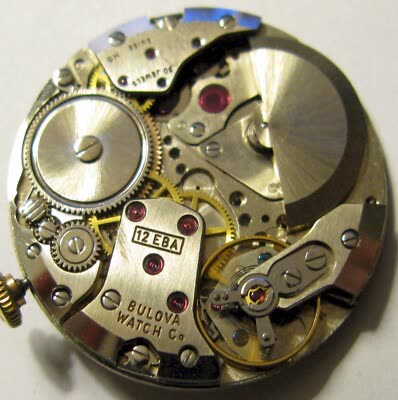
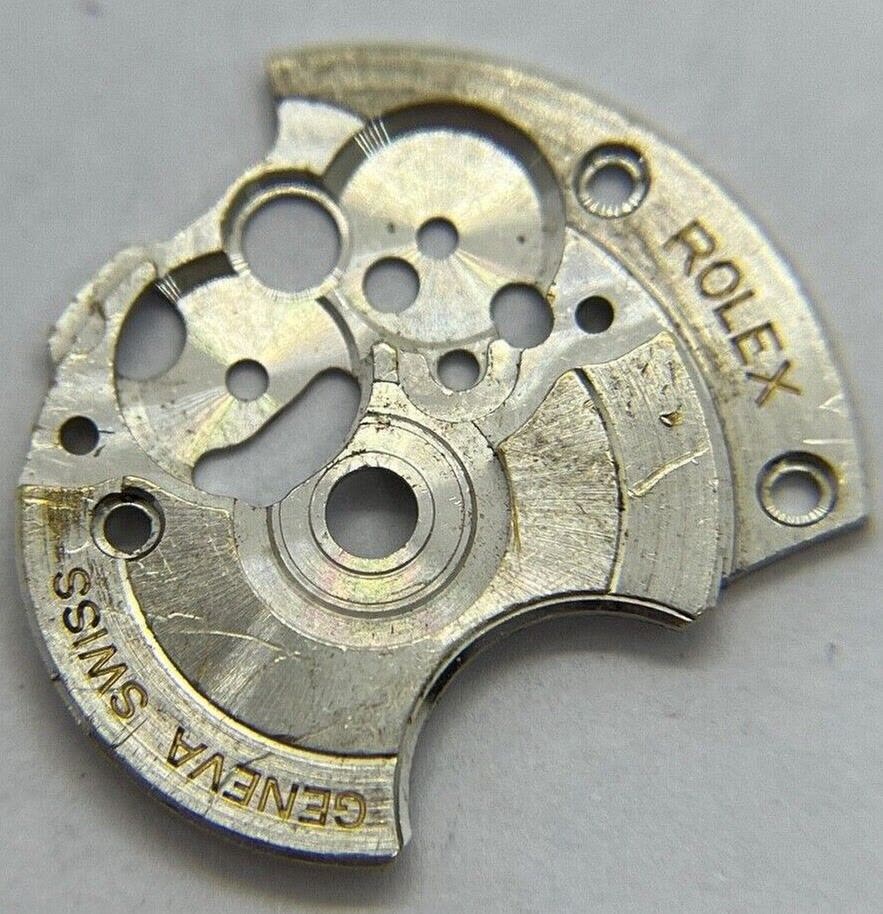
Photographs are illustrative examples of the type, not necessarily the exact object described. Verify details against the source file page.
Sources & references
- de Carle, D., Practical Watch Repairing
- de Carle, D., Watch and Clock Encyclopedia
- Fried, H. B., The Watch Repairer's Manual
- Daniels, G., Watchmaking
Where sources disagree, the disagreement is stated rather than resolved silently.