
Component record · Train
Striking Governor
Partially verifiedThe speed regulator of a repeating watch's striking train, which controls how fast the blows follow one another once the train is released.
What it does
Gives an even, unhurried rhythm to the striking sequence; without it the train would run off in a rush.
How it works
An anchor governor works like a small escapement without a balance: the last wheel of the striking train drives an anchor to and fro, and its inertia slows the train. It is effective but produces an audible buzz between blows.
A centrifugal governor carries small weights that swing outwards as it speeds up and rub against a drum or are restrained by springs; the friction limits the speed with little noise, which is why it is preferred in fine repeaters.
In either case the governor runs only while the time is being struck, so dirt and dried oil, rather than running wear, are the usual causes of a slow or irregular repeat.
Evolution
Anchor governors dominated earlier repeaters; quieter centrifugal governors became a mark of high-grade repeating work.
Known variations
- Anchor governor
- Centrifugal (inertia) governor
Identification for collectors
- A buzzing sound between blows indicates an anchor governor; near silence suggests a centrifugal one
Common failure modes
- Dirty or dry governor making the strike slow or irregular
- Stuck centrifugal weights
- Worn anchor pallets
Photographs
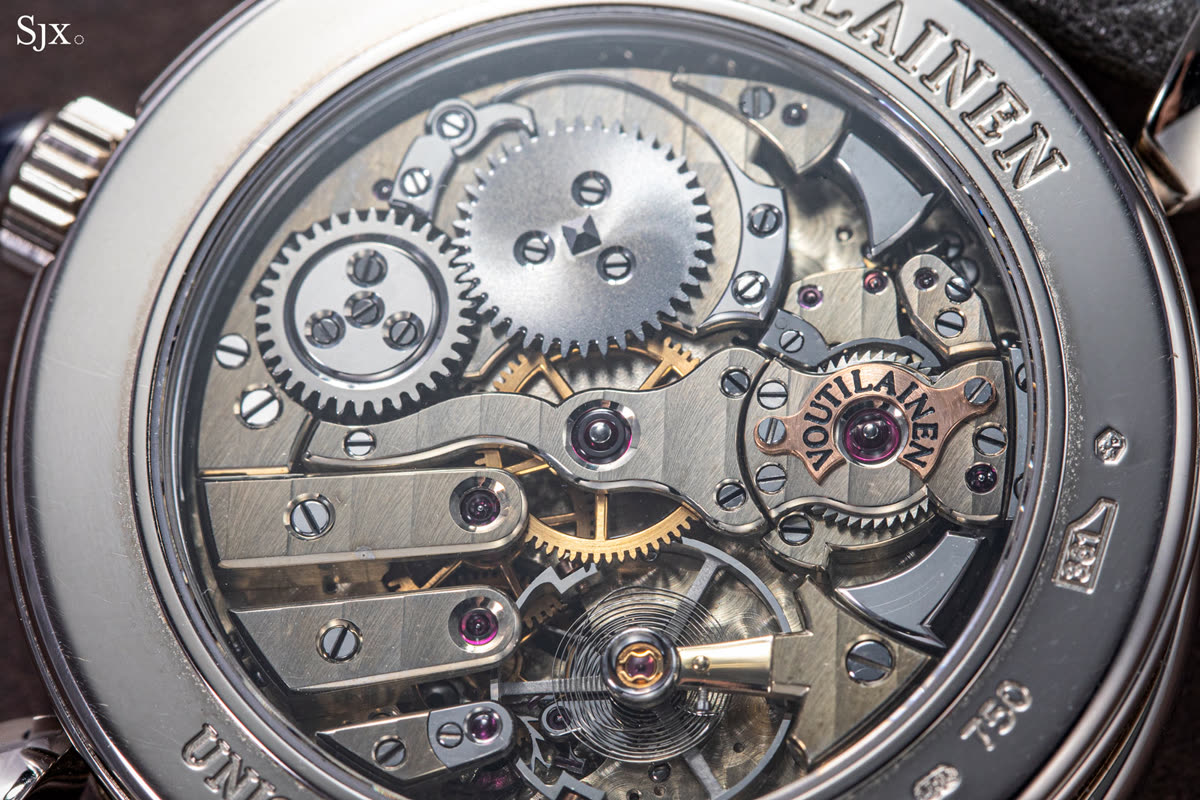
Photographs are illustrative examples of the type, not necessarily the exact object described. Verify details against the source file page.
Sources & references
- de Carle, D., Practical Watch Repairing
- de Carle, D., Watch and Clock Encyclopedia
- Fried, H. B., The Watch Repairer's Manual
- Daniels, G., Watchmaking
Where sources disagree, the disagreement is stated rather than resolved silently.