
Component record · Escapement
Escape Pinion
Partially verifiedThe small pinion on the escape-wheel arbor, driven by the fourth wheel.
What it does
Carries power from the going train into the escapement, turning the escape wheel that the pallets lock and release.
How it works
The fourth wheel drives the escape pinion, and the ratio between them, together with the number of escape-wheel teeth, sets how many beats the balance must make for the fourth wheel to turn once. In a watch with seconds on the fourth wheel, that ratio fixes the beat rate the balance must keep.
Because the escape pinion turns quickly and transmits the last of the train's power, polished leaves and a correct depth with the fourth wheel matter for the amplitude of the balance.
The pinion, wheel and arbor are one assembly; a damaged pinion is replaced with the complete escape wheel.
Evolution
Leaf counts and ratios changed with the move to faster beat rates in the twentieth century, which required different train calculations.
Known variations
- Pinion with different leaf counts depending on train design
Identification for collectors
- The pinion on the escape-wheel arbor, meshing with the fourth wheel
Common failure modes
- Worn or rusted pinion leaves
- Bent arbor after the escape wheel is dropped
- Dirt in the pinion reducing balance amplitude
Photographs
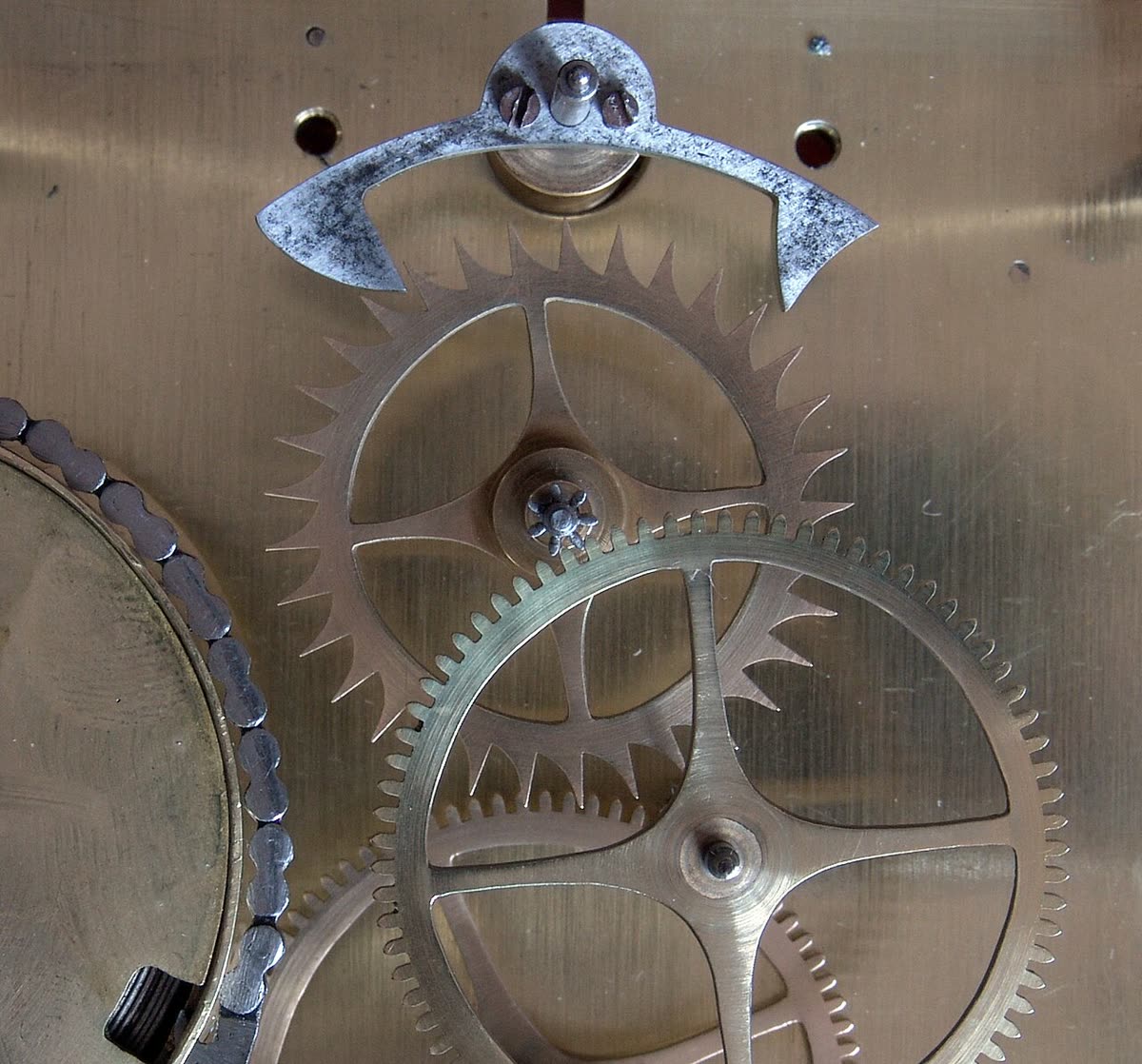
Photographs are illustrative examples of the type, not necessarily the exact object described. Verify details against the source file page.
Sources & references
- de Carle, D., Practical Watch Repairing
- de Carle, D., Watch and Clock Encyclopedia
- Fried, H. B., The Watch Repairer's Manual
- Daniels, G., Watchmaking
Where sources disagree, the disagreement is stated rather than resolved silently.