
Skip to content
The Encyclopedia of Horology

Clock · Skeleton clock

Weight-driven skeleton clock with experimental escapement

Partially verified

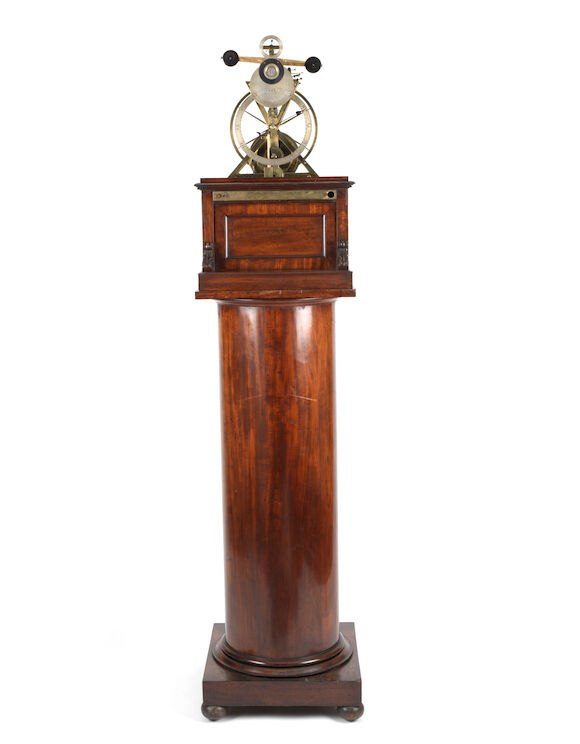
This skeleton clock features an experimental mechanism invented by James Wright and constructed by clockmaker George Andrew Jepson in 1826. It incorporates a silvered brass dial arrangement comprising four interlinked circles displaying running seconds, jumping hours through an aperture, and minutes indicated by blued steel hands. The weight-driven movement utilizes a 360-toothed centre wheel and an experimental escapement with a wedge-shaped sapphire entry pallet and jewelled deadbeat-type exit pallet, transmitting impulse to a top-mounted gilt wood dumb-bell balance. The assembly is supported on a two-part mahogany case structured as a columnar pedestal on bun feet with an integrated mercury thermometer.

James Wright and George Andrew Jepson skeleton clock on pedestal case, 1826.
James Wright and George Andrew Jepson skeleton clock on pedestal case, 1826. — Bonhams. Rights pending — permission not yet requested. Original source

Catalogue identity

Source
www.bonhams.com
Category
Clock · Skeleton clock
Maker / attribution
George Andrew Jepson (invented by James Wright)
Reference
Not recorded
Catalogue / lot identifier
136
Source-reported date
1826
Country
Not established

Source-reported attribution and specifications are not independent authentication. A listing does not establish present ownership, current display, availability or permission to reproduce.

Object description

Dial Configuration

The clock features a silvered brass dial arrangement comprising four interlinked circles, measuring between 2.5 and 8.5 inches in diameter. The display includes a seconds dial, a minutes ring, and a jumping-hour aperture, with time indicated by original blued steel hands. The seconds hand advances every two seconds.

The third dial ring bears the Latin signature: "Inventum a Jacobo Wright quondam Coll: Hert et nuper Aul Mag: Oxon 1826 Jepson Fecit." The jumping-hour system is weight-activated; a three-wheeled pin begins to lift a weight on the half-hour, which is then released precisely on the hour to advance the display.

Evidence for this section
  • “The silvered brass dial consisting of four interlinked circles, measuring between 2.5 and 8.5 inches in diameter”
  • “carrying the full signature "Inventum a Jacobo Wright quondam Coll: Hert et nuper Aul Mag: Oxon 1826 Jepson Fecit."”
  • “on the half hour, a three-wheeled pin begins to lift a weight set below the hour dial, as the minute hand revolves, the weight is lifted over a pulley so that precisely on the hour, the pin is released and the hour jumps forward.”

Movement and Escapement

The movement is driven by a lead weight on a double pulley connected to a barrel with 16 turns. Power is transmitted through three geared winding wheels to a 360-toothed centre wheel measuring 10 inches in diameter, which drives the minute hand and a 6-leaf pinion connected to a 30-toothed steel scape wheel.

The escapement features a wedge-shaped sapphire entry pallet and a jewelled deadbeat-type exit pallet. These act on counter-balanced levers to provide impulse to a gilt-wood 'dumb bell' balance mounted above on a knife-edge suspension. The movement is housed in a brass frame with plates 5/8ths of an inch thick.

Evidence for this section
  • “the great wheel driving a 16 leaf pinion to a 360-toothed centre wheel measuring 10 inches in diameter”
  • “The scape wheel is controlled by a wedge shaped sapphire entry pallet acting in conjunction with a jewelled deadbeat-type exit pallet.”
  • “set within a heavy brass frame, the plates measuring 5/8ths of an inch thick and cast in the form of a stylised hour glass”

Case and External Features

The clock is mounted on a two-part mahogany case, consisting of an upper rectangular section supported by a circular column, socle, and square base on bun feet. The upper section features carved foliate corner volutes and a moulded cornice.

The front of the case incorporates a 12-inch mercury thermometer with a silvered scale ranging from minus 10 to plus 110 degrees. The scale is hinged to provide access to the shuttered winding square. The total height of the assembly is 2.05 metres (6ft 9in), which includes the dome.

Evidence for this section
  • “In two parts in mahogany, the upper part of rectangular cross section”
  • “applied to the front with a 12 inch long mercury thermometer with large bulb and engraved silvered scale”
  • “Total height including the dome is 2.05m (6ft 9in) high.”

Open research questions

  • What is the mechanical function of the 'dumb bell' balance's micrometer regulation?
  • How does the shuttered winding square interact with the hinged thermometer scale?

Source evidence

Recorded claims and source quotations for Weight-driven skeleton clock with experimental escapement
FieldSource-reported valueSource quotation
Maker and InventorInvented by James Wright, made by George Andrew Jepson“Invented by James Wright, made for him by the clockmaker George Andrew Jepson in 1826”
Dial InscriptionLatin inscription recording the invention by James Wright and execution by Jepson in 1826“carrying the full signature "Inventum a Jacobo Wright quondam Coll: Hert et nuper Aul Mag: Oxon 1826 Jepson Fecit."”
Escapement PalletsWedge-shaped sapphire entry pallet and jewelled deadbeat-type exit pallet“The scape wheel is controlled by a wedge shaped sapphire entry pallet acting in conjunction with a jewelled deadbeat-type exit pallet.”
Hour DisplayWeight-activated jumping hour system“The hours are displayed through an aperture and are shown on a weight-activated jumping hour system”
Total Height2.05 metres (6 feet 9 inches)“Total height including the dome is 2.05m (6ft 9in) high.”
Maker and InventorInvented by James Wright; made by George Andrew Jepson“Invented by James Wright, made for him by the clockmaker George Andrew Jepson in 1826”
RegulationEndless screws on balance timing discs“offering some form of micrometer regulation via a pair of endless screws.”
Movement Frame Height27cm (10.5in)“Movement frame height 27cm (10.5in) high.”

Visible details

  • Full-height view of the skeleton clock movement mounted atop a tall mahogany column pedestal with bun feet.
  • Prominent circular skeleton dial rings and top-mounted dumbbell balance with outer timing discs.
  • Upper rectangular plinth section featuring carved foliate corner volutes beneath the movement.

Research qualifications

  • Glazed hood described in the auction text is not present in this photograph.
  • Fine dial engravings and the thermometer scale are not legible at this scale.

Photograph identity and source facts were screened before import; rights clearance remains pending.

Terms in this record

Glossary explanations for terms named in this object’s record.