
Skip to content
The Encyclopedia of Horology

Pocket watch · Pocket watch

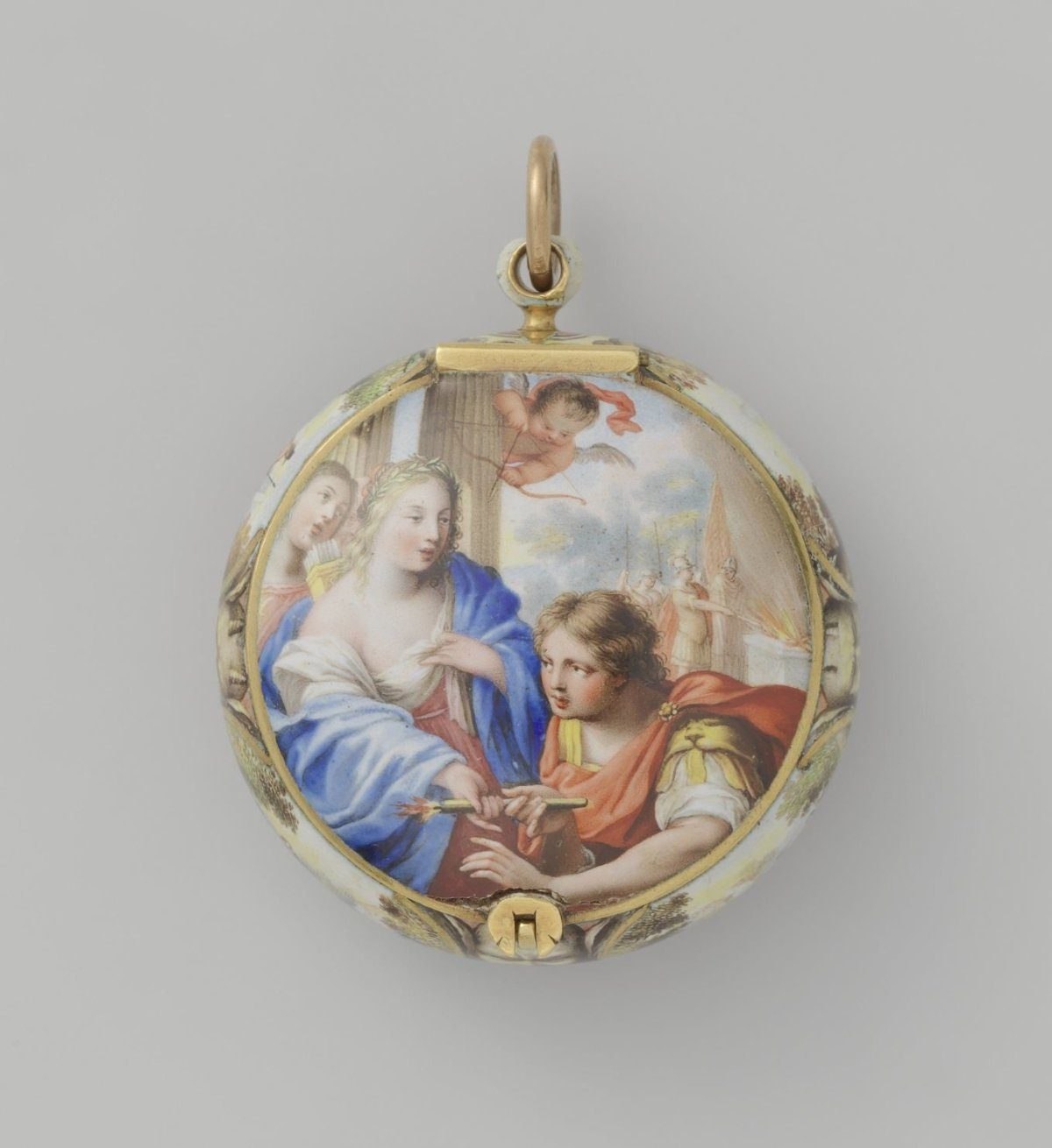
Watch with the Meeting and Farewell of Dido and Aeneas

Partially verified

This pocket watch, identified by the Rijksmuseum as object BK-15074, features enamel decoration depicting the meeting and farewell of Dido and Aeneas. The watch is signed by maker Andreas Zelling of Hamburg. The creation date is attributed to a range between circa 1640 and 1660, though the records also note a secondary date range of circa 1740 to 1760. The case is constructed from gold with enamel work. The watch was previously part of the Carl Marfels collection before being sold at auction in Frankfurt am Main in 1929. Following this, it entered the collection of Maurits Elzas in Arnhem. It was later bequeathed to the Rijksmuseum in 1937 as part of a larger collection of 107 watches.

Exterior case view showing the enamel painting of Dido and Aeneas.
Exterior case view showing the enamel painting of Dido and Aeneas. — Rijksmuseum. Rights pending — permission not yet requested. Original source

Catalogue identity

Source
www.rijksmuseum.nl
Category
Pocket watch · Pocket watch
Maker / attribution
Andreas Zelling
Reference
Not recorded
Catalogue / lot identifier
BK-15074
Source-reported date
ca. 1640 - ca. 1660
Source-reported place
Hamburg

Source-reported attribution and specifications are not independent authentication. A listing does not establish present ownership, current display, availability or permission to reproduce.

Object description

Case and Enamel Decoration

The exterior of this gold pocket watch is decorated with intricate enamel work. The subject matter depicts the classical mythological narrative of the meeting and farewell of Dido and Aeneas. The imagery is executed in polychrome enamel, covering the back of the case and extending onto the case band.

The enamel technique employed displays detailed figurative work, including Cupid and figures representing the protagonists. The construction incorporates a gold base, and the overall design is consistent with decorative practices of the mid-17th century. The case remains in a state suitable for study within the museum collection, showing clear evidence of the enameller's technical execution.

The enamel work is specifically attributed to an anonymous French hand, while the horological components are credited to the Hamburg maker Andreas Zelling.

Evidence for this section
  • “Horloge met emailschilderingen, met klassieke liefdesverhalen, de ontmoeting en het afscheid van Dido en Aeneas”
  • “edelsmid: anoniem, Frankrijk”
  • “email op goud”

Provenance and History

The object possesses a documented history of ownership spanning the early 20th century. It was included in the sale of the collection belonging to Baron Von Mecklenburg and Carl Marfels. The auction took place at Hugo Helbing in Frankfurt am Main on 27 November 1929, where it was assigned lot number 86.

Following his ownership, the watch became part of the 'Maurits Elzas Collection'. Upon Elzas's death in 1937, the watch, alongside 106 other pieces, was bequeathed to the Rijksmuseum. This acquisition forms a significant portion of the museum's horological holdings and has been recorded in the museum's inventory under object number BK-15074.

Evidence for this section
  • “sale, collection Baron Von Mecklenburg et al. [section Carl Marfels (1854-1929)], Frankfurt am Main (Hugo Helbing), 27 November 1929, no. 86, fl. 2,210, to Maurits Elzas (1868-1937), Arnhem, 1929”
  • “by whom bequeathed with 106 other watches, as part of the 'Maurits Elzas Collection', to the museum, 1937”

Attribution and Dating

The dating of this piece remains somewhat open, as the museum lists two separate time frames: 1640–1660 and 1740–1760. These dates potentially reflect uncertainty regarding the production of the watch movement versus the later application of the enamel, or a reassessment of the style. The primary horological attribution is to Andreas Zelling of Hamburg.

The museum catalog entries indicate the watch is a combined work of art, involving both a horologist and a separate enameller. While Zelling is the identified maker of the watch, the reliance on an anonymous French source for the decorative enamel adds a layer of complexity to the attribution of the object's components.

Evidence for this section
  • “Andreas Zelling, ca. 1640 - ca. 1660”
  • “Datering ca. 1640 - ca. 1660 ca. 1740 - ca. 1760”

Open research questions

  • What is the reason for the two conflicting date ranges listed in the official museum record?
  • Are there visible hallmarks on the internal plate or case that might confirm the date or place of manufacture?

Source evidence

Recorded claims and source quotations for Watch with the Meeting and Farewell of Dido and Aeneas
FieldSource-reported valueSource quotation
MakerAndreas Zelling“uurwerkmaker: Andreas Zelling, Hamburg (stad)”
Object numberBK-15074“Objectnummer BK-15074”
GoldsmithAnonymous, France“edelsmid: anoniem, Frankrijk”
Primary date rangeca. 1640 - ca. 1660“Datering ca. 1640 - ca. 1660”
Secondary date rangeca. 1740 - ca. 1760“ca. 1740 - ca. 1760”
MaterialGold and enamel“Fysieke kenmerken email op goud”
ProvenanceCollection Carl Marfels, sold 1929“sale, collection Baron Von Mecklenburg et al. [section Carl Marfels (1854-1929)], Frankfurt am Main (Hugo Helbing), 27 November 1929, no. 86”

Visible details

  • Case back features multi-colored enamel miniature painting
  • Polychrome enamel extends to the side of the watch case
  • Integrated pendant loop for attachment to a chain or chatelaine
  • Hinged closure mechanism visible at the bottom of the case

Research qualifications

  • Dual dating ranges of 1640-1660 and 1740-1760 are provided without clarification
  • The goldsmith responsible for the enamel work is noted only as 'anoniem, Frankrijk'

Photograph identity and source facts were screened before import; rights clearance remains pending.

Consulted source

Watch with the Meeting and Farewell of Dido and Aeneas

Reviewed 2026-11-02 · Record 2a7761a74b

Terms in this record

Glossary explanations for terms named in this object’s record.