
Skip to content
The Encyclopedia of Horology

Pocket watch · Enamelled pocket watch

Watch with enamel case and rubies

Partially verified

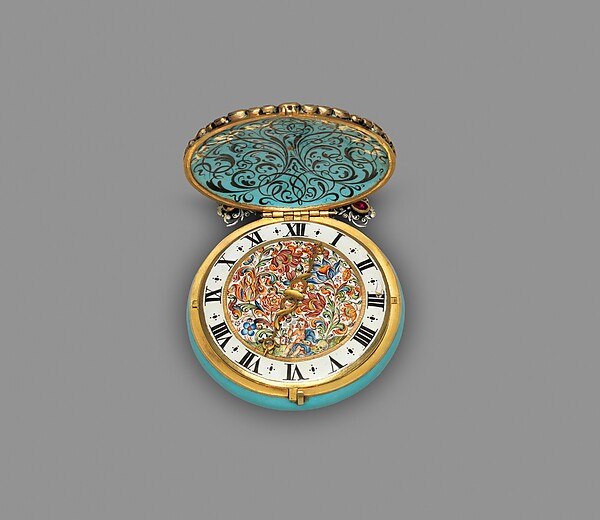
This pocket watch, dating to approximately 1670, is attributed to the clockmaker Nicolaus Rugendas the Younger (1619–1694/95) of Augsburg. The case is constructed from gold with painted and raised enamel, featuring a dense floral motif. The exterior of the case cover is embellished with a cluster of twenty-six rubies arranged in a repeating pattern, with a further twenty-two gems set into the pendant. Internally, the cover displays scrolls painted in black against a pale blue enamel ground. The dial features a central floral enamel design with a painted infant personification of Time positioned at the six o'clock mark, accompanied by a sandglass and a skull. A single hand indicates the hours and half-hours on a white enamel chapter ring.

Exterior view of the enameled gold watchcase featuring rubies set in a floral design.
Exterior view of the enameled gold watchcase featuring rubies set in a floral design. — The Metropolitan Museum of Art. Rights pending — permission not yet requested. Original source

Catalogue identity

Source
www.metmuseum.org
Category
Pocket watch · Enamelled pocket watch
Maker / attribution
Nicolaus Rugendas the Younger
Reference
Not recorded
Catalogue / lot identifier
17.190.1520
Source-reported date
ca. 1670
Source-reported place
Germany

Source-reported attribution and specifications are not independent authentication. A listing does not establish present ownership, current display, availability or permission to reproduce.

Object description

Case and Dial Construction

The case of this watch is a gold structure featuring painted and raised enamel, a characteristic technique of seventeenth-century Augsburg work. The exterior cover is decorated with a complex floral design executed in low relief. A prominent feature is the center arrangement of twenty-six rubies, placed in a repeating sequence of one large stone followed by three smaller ones. The watch pendant is also set with twenty-two gemstones. The interior of the lid is finished in a pale blue enamel, overlaid with black painted scrollwork.

The dial is similarly decorated with enamel, featuring a floral pattern in natural colors. Positioned at the bottom is an allegorical depiction of an infant representing Time, set alongside a skull and a sandglass. Time is indicated by a single hand traversing a white enamel chapter ring that displays Roman numerals for hours and markers for half-hours.

Evidence for this section
  • “The maker enameled the cover of the Museum’s watchcase with an openwork design over a gold ground in low relief, adding a circular border of forty-seven rubies”
  • “The dial of the watch contains yet another enamel with the center painted in natural colors in an allover floral design.”
  • “The pure-white enamel chapter ring registers only hours (I–XII) and half hours.”

Movement and Maker

The movement is identified as a pre-balance spring mechanism, constructed of gilded brass and blued steel. The movement is attributed to Nicolaus Rugendas the Younger, who was born in Augsburg and achieved the status of master clockmaker in 1662 by right of inheritance.

The movement is described as a finely finished but unremarkable example of the period's horology. While it is known that the Rugendas family produced numerous timepieces, it remains difficult to confirm if Nicolaus II specialized in creating movements specifically for highly decorated cases, though other examples of his signed movements in opulent cases exist in museum collections.

Evidence for this section
  • “Nicolaus II (1619–1694/95), was born in Augsburg and became a master clockmaker there by inheritance in 1662.”

Provenance and Historical Context

This watch was donated to the Metropolitan Museum of Art by J. Pierpont Morgan in 1917. Records from the 1912 catalogue of the Morgan collection identify the object as the "Great Ruby Watch." Documentation traces its provenance to the collection of Baroness Alphonse de Rothschild, and prior to that, it was held by Charles Mannheim.

The watch reflects the practices of seventeenth-century Augsburg goldsmiths, whose trade was closely associated with the production of silverware until 1702. Because of the technical risks associated with firing enamel, watchcases such as this were often exempted from the mandatory punchmarking required of other precious metal items, resulting in the anonymity of the case maker.

Evidence for this section
  • “In Morgan’s collection catalogue published in 1912, it is called the “Great Ruby Watch” and documented as coming from the collection of Baroness Alphonse de Rothschild”
  • “Enameled gold objects, such as this watchcase, were usually exempt from the requirement owing to the danger of cracking the enamel. The maker of this watchcase thus remains anonymous.”

Open research questions

  • What specific chemical composition of the pale blue enamel was used by Augsburg workshops in the 1670s?
  • Are there any identifiable micro-engravings on the movement plates that could link the watch to specific workshop output beyond the general attribution?

Source evidence

Recorded claims and source quotations for Watch with enamel case and rubies
FieldSource-reported valueSource quotation
MakerNicolaus Rugendas the Younger“Nicolaus Rugendas the Younger, Maker”
Datingcirca 1670“ca. 1670”
MaterialsGold, rubies, and enamel“Case and dial: painted and raised enamel on gold, set with gemstones (rubies)”
Movement materialGilded brass and blued steel“Movement: gilded brass and partly blued steel”
Accession number17.190.1520“17.190.1520”
Design motifsFloral patterns and personification of Time“At the bottom, in the six o’clock position, an infant personification of Time sits between a sandglass and a human skull as a reminder that life is fleeting.”
ProvenanceFormerly in the collection of Baroness Alphonse de Rothschild“documented as coming from the collection of Baroness Alphonse de Rothschild (Leonora von Rothschild, 1837–1911)”

Visible details

  • Case features a cluster of 26 rubies arranged in a specific repeating pattern
  • Dial includes a central painted enamel scene showing an infant, sandglass, and skull
  • Interior of the watch cover decorated with black scrollwork on pale blue enamel
  • Single hand for time indication on a chapter ring marked with Roman numerals I-XII

Research qualifications

  • The maker of the watchcase remains anonymous as enameled gold objects were exempt from standard hallmarking requirements
  • The exact function of the movement in relation to this specific opulent case is a matter of speculation among historians

Photograph identity and source facts were screened before import; rights clearance remains pending.

Consulted source

Watch

Reviewed 2026-10-26 · Record 5f62cc0f97

Terms in this record

Glossary explanations for terms named in this object’s record.