
Skip to content
The Encyclopedia of Horology

Pocket watch · Alarm pocket watch

Watch with alarm by Nicholas Vallin

Partially verified

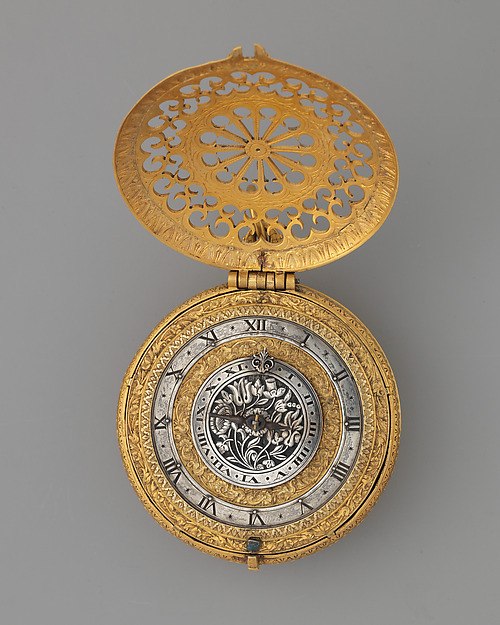
This watch with an alarm mechanism is signed by Nicholas Vallin, a Flemish maker who was active in London until his death in 1603. The watch is dated circa 1600. It measures 2 1/2 inches (6.4 cm) in diameter. The case is constructed from gilded brass and silver. The internal movement is fashioned from gilded brass, and it incorporates an alarm train composed of iron. The watch is held in the collection of The Metropolitan Museum of Art as accession number 17.190.1476. The design features an alarm function, which was a specific horological complication for the period. The decorative elements include intricate floral and foliage-style metalwork across the outer case and dial components. The watch is documented as part of the gift of J. Pierpont Morgan. It reflects the output of makers working in London around the turn of the 17th century.

Watch with alarm by Nicholas Vallin, ca. 1600.
Watch with alarm by Nicholas Vallin, ca. 1600. — The Metropolitan Museum of Art, New York. Rights pending — permission not yet requested. Original source

Catalogue identity

Source
orbiscollectibles.com
Category
Pocket watch · Alarm pocket watch
Maker / attribution
Nicholas Vallin
Reference
Not recorded
Catalogue / lot identifier
17.190.1476
Source-reported date
ca. 1600
Source-reported place
London, British

Source-reported attribution and specifications are not independent authentication. A listing does not establish present ownership, current display, availability or permission to reproduce.

Object description

Case and Dial Construction

The object is housed in a circular case measuring 2 1/2 inches in diameter, crafted from gilded brass and silver. The exterior of the case features elaborate pierced metalwork, presenting detailed floral and foliate designs. This protective outer structure encloses the dial, which is revealed when the cover is opened.

The dial surface integrates a primary hour chapter ring with Roman numerals. A smaller, concentric inner dial provides functionality for the alarm setting. This inner section is decorated with floral engraving and contains the alarm hand, separate from the primary time-telling hands. The overall aesthetic displays metalwork techniques associated with late 16th-century London decorative arts.

Evidence for this section
  • “Case: gilded brass, slver”
  • “Diameter: 2 1/2 in. (6.4 cm).”

Movement and Mechanism

The watch functions as an alarm timepiece, driven by a movement constructed primarily from gilded brass. Integral to this mechanism is an alarm train manufactured from iron, which provides the necessary power and sound-generating function for the alarm complication.

The movement plate is finished with ornate engraving, and the center is secured by a highly decorative, pierced metal bridge. The arrangement of the components and the use of iron for the alarm train are consistent with the period's horological engineering requirements for audible time-keeping devices.

Evidence for this section
  • “movement: gilded brass, with an alarm train of iron.”
  • “Movement by Nicholas Vallin (Flemish, active ca. 1590–died 1603)”

Maker and Documentation

The watch is attributed to Nicholas Vallin, a Flemish maker who was active in London until his death in 1603. The object is dated to approximately 1600. It is currently maintained by The Metropolitan Museum of Art as part of the European Sculpture and Decorative Arts department.

The watch entered the museum's holdings as part of a 1917 gift from J. Pierpont Morgan. The museum identifies the object by the accession number 17.190.1476, and the documentation serves as the primary record for its physical attributes and maker attribution.

Evidence for this section
  • “Movement by Nicholas Vallin (Flemish, active ca. 1590–died 1603)”
  • “The Metropolitan Museum of Art holds this object as 17.190.1476”
  • “Gift of J. Pierpont Morgan, 1917”

Open research questions

  • What is the specific mechanical design of the iron alarm train compared to contemporary European models?
  • Does the signature on the movement provide further evidence of the exact workshop location in London?

Source evidence

Recorded claims and source quotations for Watch with alarm by Nicholas Vallin
FieldSource-reported valueSource quotation
MakerNicholas Vallin“Movement by Nicholas Vallin (Flemish, active ca. 1590–died 1603)”
Dateca. 1600“dated ca. 1600”
CultureBritish, London“British, London”
Dimensions2 1/2 in. (6.4 cm)“Diameter: 2 1/2 in. (6.4 cm).”
Case Materialgilded brass, silver“Case: gilded brass, slver”
Movement Materialgilded brass, iron alarm train“movement: gilded brass, with an alarm train of iron.”
Accession number17.190.1476“17.190.1476”

Visible details

  • Case features intricate pierced metalwork with floral motifs
  • Alarm set dial inside the main hour chapter ring
  • Movement plate includes ornate cut-out bridge work over the center
  • The watch case includes a suspension loop for attachment

Research qualifications

  • The exact provenance history prior to the J. Pierpont Morgan gift is not provided
  • The specific mechanics of the internal alarm train are not detailed beyond material composition

Photograph identity and source facts were screened before import; rights clearance remains pending.

Consulted source

Watch with alarm by Nicholas Vallin, British, London, ca. 1600

Reviewed 2026-11-02 · Record 6ae31a83cb

Terms in this record

Glossary explanations for terms named in this object’s record.