
Skip to content
The Encyclopedia of Horology

Pocket watch · Pocket watch

Watch by David Buschman

Partially verified

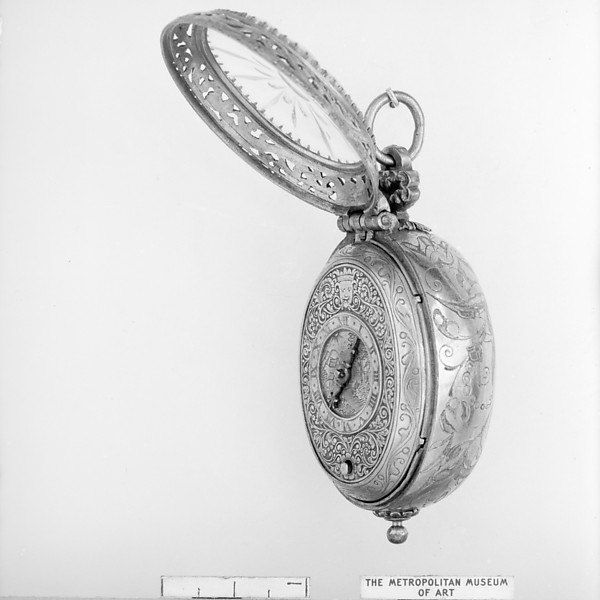
This pocket watch, held in the collection of The Metropolitan Museum of Art, is attributed to the German maker David Buschman (1626–1701). Produced in Augsburg between circa 1640 and 1660, the object represents the watchmaking practices associated with this center during the mid-seventeenth century. The watch is constructed from a combination of gilt metal, rock crystal, and silver, measuring approximately 2 1/4 by 1 1/2 inches (5.7 by 3.8 cm). It was acquired by the museum as a gift of J. Pierpont Morgan in 1917. The design incorporates a hinged cover and is notable for its material composition. As a museum-documented piece, the watch serves as an example of Buschman's output, though further horological research is required to detail its internal mechanism and verify the original state of its components.

A side-view of the pocket watch by David Buschman showing the hinged cover, the intricate engraving of the case, and the dial layout.
A side-view of the pocket watch by David Buschman showing the hinged cover, the intricate engraving of the case, and the dial layout. — The Metropolitan Museum of Art, New York. Rights pending — permission not yet requested. Original source

Catalogue identity

Source
orbiscollectibles.com
Category
Pocket watch · Pocket watch
Maker / attribution
David Buschman
Reference
Not recorded
Catalogue / lot identifier
17.190.1515
Source-reported date
ca. 1640–60
Source-reported place
Germany

Source-reported attribution and specifications are not independent authentication. A listing does not establish present ownership, current display, availability or permission to reproduce.

Object description

Construction and Materials

The object is a pocket watch constructed primarily from gilt metal, silver, and rock crystal. Its dimensions are recorded as 2 1/4 by 1 1/2 inches, reflecting its relatively compact size. The design incorporates an oval case with a hinged cover that allows for viewing the dial. The exterior surface displays dense engraving, consistent with the decorative practices utilized in Augsburg at the time of its production.

The use of rock crystal as a cover material is a component of the watch's construction, protecting the face while maintaining a degree of transparency. The combination of these specific materials is documented in the museum's inventory records for the object.

Evidence for this section
  • “Gilt metal, rock crystal, silver”
  • “2 1/4 × 1 1/2 in. (5.7 × 3.8 cm)”

Attribution and Origin

The watch is attributed to the clockmaker David Buschman, who was active from 1626 to 1701. The geographic origin is identified as Augsburg, Germany. This attribution is based on the museum's documentation of the piece. The dating of the watch is placed within the range of circa 1640 to 1660, capturing the mid-century output of the Augsburg region.

The identification relies on the historical record maintained by The Metropolitan Museum of Art. As with many timepieces of this nature, the provenance is linked to the collection of J. Pierpont Morgan, who gifted the watch to the institution in 1917.

Evidence for this section
  • “Watchmaker: David Buschman (German, 1626–1701)”
  • “German, Augsburg”
  • “ca. 1640–60”
  • “Gift of J. Pierpont Morgan, 1917.”

Documentation and Research

This watch is catalogued by The Metropolitan Museum of Art under the accession number 17.190.1515 within the Department of European Sculpture and Decorative Arts. The record status is categorized as individual and documented, supported by the museum's institutional files. These records provide the baseline for the object's physical and historical identification.

The source notes that confirming the wider collectible type and specific internal specifications requires further consultation of horological references. The provided details reflect the current museum classification, and the source emphasizes that potential variability in the assembly of historical watches means that individual components should be verified through inspection of hallmarks and internal signatures.

Evidence for this section
  • “The Metropolitan Museum of Art holds this object as 17.190.1515.”
  • “European Sculpture and Decorative Arts.”
  • “Compare the case maker's marks and hallmarks inside the case back, the movement signature and serial number, and the dial signature”

Open research questions

  • What markings are present on the movement or inside the case back to confirm the maker's attribution?
  • Does the current dial and hand assembly match the documented date range, or are they later replacements?

Source evidence

Recorded claims and source quotations for Watch by David Buschman
FieldSource-reported valueSource quotation
MakerDavid Buschman“Watchmaker: David Buschman (German, 1626–1701)”
Dateca. 1640–60“ca. 1640–60”
MaterialsGilt metal, rock crystal, silver“Gilt metal, rock crystal, silver”
Dimensions2 1/4 × 1 1/2 in. (5.7 × 3.8 cm)“2 1/4 × 1 1/2 in. (5.7 × 3.8 cm)”
Museum ID17.190.1515“17.190.1515”
AttributionGerman, Augsburg“German, Augsburg”

Visible details

  • The watch features an oval-shaped case with engraved decorative detailing.
  • A hinged cover is present, fitted with a rock crystal or glass viewing aperture.
  • The dial area displays Roman numerals and is surrounded by an intricate engraved foliate or floral pattern.
  • The object includes a suspension loop attached to the top of the case for attachment to a chain or fob.

Research qualifications

  • The source notes that cases and movements were often supplied by different makers, and it is unclear if this specific example retains its original components.
  • The source states that the wider collectible type has not been independently verified beyond the museum record.

Photograph identity and source facts were screened before import; rights clearance remains pending.

Consulted source

Watch by David Buschman, German, Augsburg, ca. 1640–60

Reviewed 2026-11-02 · Record 705f7869cb

Terms in this record

Glossary explanations for terms named in this object’s record.