
Skip to content
The Encyclopedia of Horology

Pocket watch · Watch and chatelaine

Watch and chatelaine by Francis Perigal

Partially verified

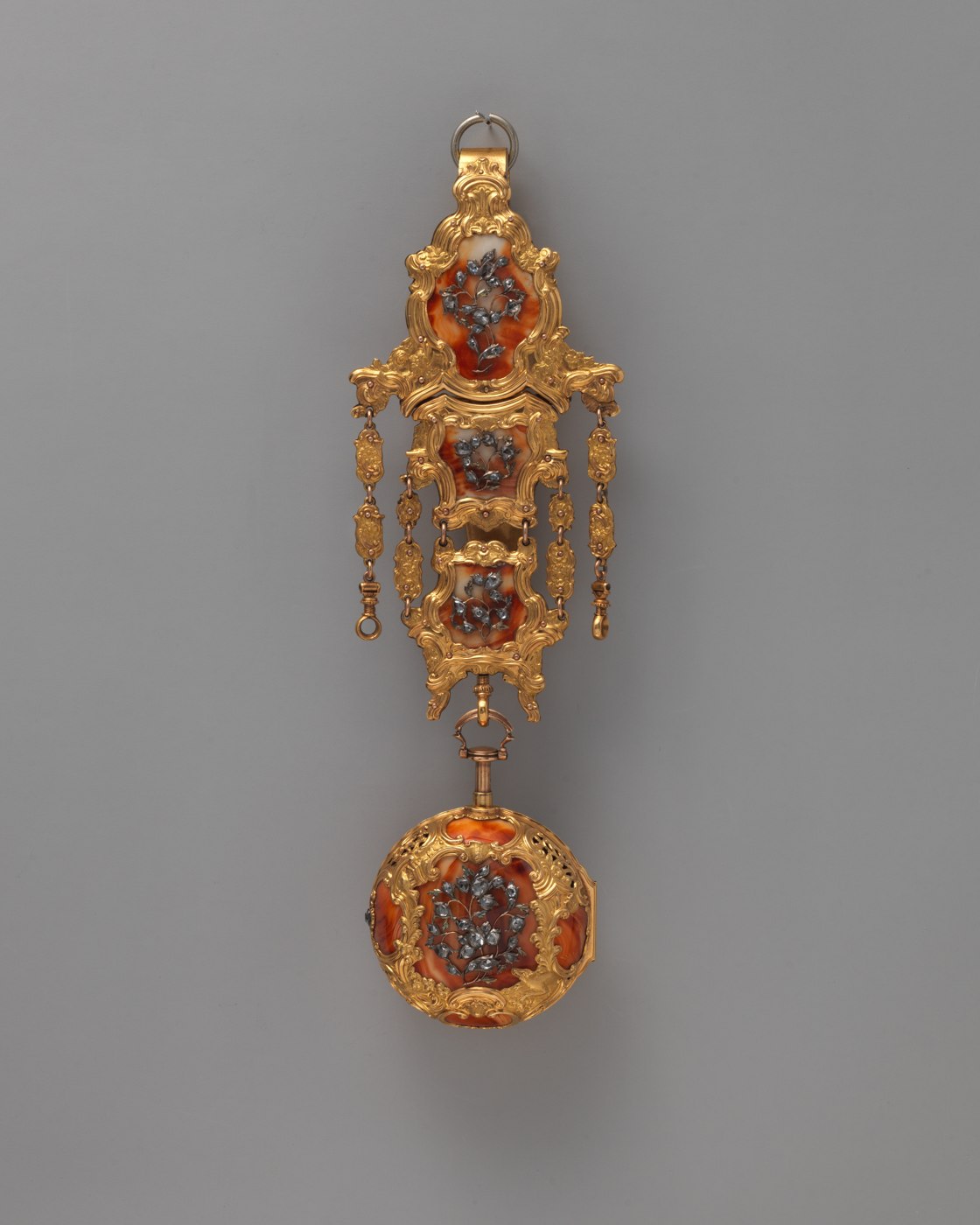
This 18th-century watch and chatelaine is attributed to the London-based maker Francis Perigal, active between 1741 and 1767. The set is identified as being intended for the Turkish market. The watch features an enamel dial with silver hands, while the case is composed of gold, enamel, and diamonds. The accompanying chatelaine shares similar decorative elements, incorporating enamel and floral arrangements set with diamonds. Technical details for the movement include a diamond endstone. The overall dimensions of the object are approximately 14.6 by 5.8 by 2.9 cm, with the watch case itself measuring 4.8 cm in diameter. The item is currently held by The Metropolitan Museum of Art as part of the gift of J. Pierpont Morgan. Documentation confirms the association with the London maker, although the specific designation as a product for the Turkish market remains a point of identification provided by the museum.

Watch and chatelaine by Francis Perigal, featuring a gold and enamel case with diamond-set floral decoration.
Watch and chatelaine by Francis Perigal, featuring a gold and enamel case with diamond-set floral decoration. — The Metropolitan Museum of Art — Gift of J. Pierpont Morgan, 1917. Rights pending — permission not yet requested. Original source

Catalogue identity

Source
orbiscollectibles.com
Category
Pocket watch · Watch and chatelaine
Maker / attribution
Francis Perigal
Reference
Not recorded
Catalogue / lot identifier
17.190.1439a–c
Source-reported date
18th century
Source-reported place
British

Source-reported attribution and specifications are not independent authentication. A listing does not establish present ownership, current display, availability or permission to reproduce.

Object description

Construction and Materials

The watch and its attached chatelaine are constructed from a combination of gold, enamel, and diamonds. The watch case displays a high level of decorative complexity, featuring gold metalwork alongside enamel sections that are inlaid with diamond-set floral motifs.

The dial is similarly constructed of enamel and is fitted with silver hands. A diamond endstone is present within the watch movement, which serves as a technical feature of the construction. The watch case measures approximately 1.8 inches in diameter, and the ensemble is noted for the integration of materials across both the timepiece and the chatelaine hanger.

Evidence for this section
  • “Case: gold, enamel, diamonds; Dial: enamel, silver hands, set with diamonds; Movement: with diamond endstone”
  • “Diameter (watch case, confirmed): 1 7/8 in. (4.8 cm).”

Maker and Market Attribution

The watch and chatelaine are attributed to the London-based maker Francis Perigal. The source indicates that Perigal was active between the years 1741 and 1767. This object is associated with the 18th-century period of British horological production.

The piece is identified as having been produced for the Turkish market. This geographical designation remains an attribution provided by the museum records without further explanation of the specific distribution mechanism or market requirements involved in this trade.

Evidence for this section
  • “Probably by Francis Perigal (British, active 1741–67)”
  • “British, London, for Turkish market”

Provenance and Documentation

This object is held within the collection of The Metropolitan Museum of Art under the accession number 17.190.1439a–c. The set was acquired by the museum in 1917 as a gift from J. Pierpont Morgan.

The information provided serves as the primary record for this specimen. The museum notes that the details are those of the specific physical object, and no further independent verification of this specimen as a representative of a broader class of items has been conducted.

Evidence for this section
  • “The Metropolitan Museum of Art — Gift of J. Pierpont Morgan, 1917”
  • “The Metropolitan Museum of Art holds this object as 17.190.1439a–c”

Open research questions

  • What evidence distinguishes this specific watch as being commissioned or produced specifically for the Turkish market during the mid-18th century?
  • Are there recorded examples of other watches by Francis Perigal that share the same diamond-set enamel floral motifs and chatelaine style?

Source evidence

Recorded claims and source quotations for Watch and chatelaine by Francis Perigal
FieldSource-reported valueSource quotation
MakerProbably by Francis Perigal“Probably by Francis Perigal (British, active 1741–67)”
Date18th century“18th century”
MaterialsGold, enamel, diamonds, silver“Case: gold, enamel, diamonds; Dial: enamel, silver hands, set with diamonds; Movement: with diamond endstone”
Dimensions14.6 x 5.8 x 2.9 cm“Overall (confirmed): 5 3/4 × 2 1/4 × 1 1/8 in. (14.6 × 5.8 × 2.9 cm)”
Watch Case Diameter4.8 cm“Diameter (watch case, confirmed): 1 7/8 in. (4.8 cm)”
ProvenanceThe Metropolitan Museum of Art, Gift of J. Pierpont Morgan, 1917“The Metropolitan Museum of Art — Gift of J. Pierpont Morgan, 1917”
Market associationTurkish market“from British, London, for Turkish market.”

Visible details

  • Enamel dial with Roman numerals
  • Floral diamond-set ornamentation on the case and chatelaine
  • Gold frame with intricate filigree work
  • Visible crack across the enamel dial

Research qualifications

  • The exact, primary purpose or original ownership context for the 'Turkish market' designation is not further elaborated in the source.
  • The attribution to Francis Perigal is presented as probable by the source.

Photograph identity and source facts were screened before import; rights clearance remains pending.

Consulted source

Watch and chatelaine, Francis Perigal, 18th century

Reviewed 2026-11-02 · Record 9cd78c4686

Terms in this record

Glossary explanations for terms named in this object’s record.