
Skip to content
The Encyclopedia of Horology

Clock · Wall regulator clock

Wall Regulator Clock

Partially verified

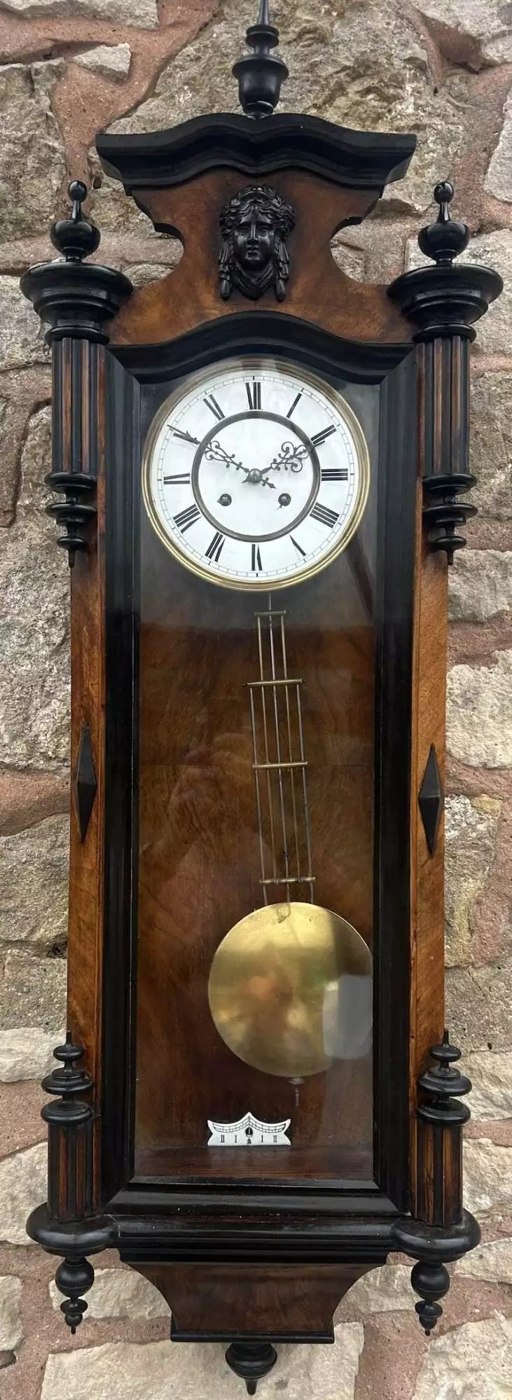
This wall-mounted regulator clock is described as being of English origin, dating to approximately 1900. The case is constructed with walnut veneer and features a dark finish, including an arched top adorned with a carved central head and turned finials. The facade incorporates side columns and a glazed hinged door, which provides a view of the dial and pendulum. The dial is white with black Roman numerals, decorative hands, and two winding apertures, encircled by a brass bezel. The clock is powered by an eight-day mechanical movement, described in the source as a twin fusee mechanism with a bell-striking system. The pendulum assembly includes a multi-rod structure with a brass lens and a beat scale located at the bottom of the case. The auction description notes that the exterior shows minor signs of age and wear.

Front view of the wall clock showing the wooden case, dial, and pendulum assembly.
Front view of the wall clock showing the wooden case, dial, and pendulum assembly. — Vintage Clocks UK via Zamanito. Rights pending — permission not yet requested. Original source

Catalogue identity

Source
zamanito.com
Category
Clock · Wall regulator clock
Maker / attribution
Not established
Reference
Not recorded
Catalogue / lot identifier
Source URL identifies the listing
Source-reported date
circa 1900
Source-reported place
England

Source-reported attribution and specifications are not independent authentication. A listing does not establish present ownership, current display, availability or permission to reproduce.

Object description

Case and Aesthetic Features

The clock is housed in an elongated case constructed from timber with a walnut veneer finish. The architectural form of the case includes an arched pediment, which is highlighted by a central carved human head decoration and turned finials at the summit and corners. The front of the clock is protected by a hinged glass panel, allowing for visibility of the pendulum and the dial.

Verticality is emphasized by the inclusion of side columns. The overall design utilizes a dark finish, consistent with the walnut veneering mentioned in the source material. The physical presence of the clock is marked by its regulator-style proportions, though the textual description from the source identifies it differently as a grandmother clock. The case is designed to be wall-mounted, as evidenced by the configuration of the lower case and the absence of a floor-standing base.

Evidence for this section
  • “قاب دارای روکش گردو (Walnut veneer) و ساختار چوب یکپارچه با طاق قوسی و ستون‌های کناری”
  • “تزیینات سرستون، فینال‌های تراش‌خورده و سردیس منبت‌کاری‌شده در تاج”

Dial and Timekeeping

The dial is finished in white and features black Roman numerals to denote the hours. Central to the dial are decorative, shaped hands. The dial is bordered by a brass bezel, providing a contrast to the lighter face and the dark case exterior.

The internal components visible through the glazed door include a brass lens pendulum attached to a multi-rod suspension system. A beat scale is mounted at the bottom of the interior case, which is a feature used for leveling and adjusting the rhythm of the escapement. While the movement is reported to be an eight-day twin fusee system, the visual evidence confirms the presence of the regulation mechanism.

Evidence for this section
  • “صفحه ساعت سفید با اعداد رومی مشکی، عقربه‌های تزیینی و دو سوراخ کوک است که دور آن یک زه برنجی قرار گرفته است”
  • “آونگ بلند با میله‌های چندگانه و وزنه عدسی‌شکل برنجی و همچنین صفحه درجه‌بندی نوسان (Beat scale) در پایین محفظه به وضوح دیده می‌شود”

Movement and Attribution

The movement is attributed in the source as an English eight-day mechanism featuring twin fusees and a bell-striking mechanism. The fusee system is designed to provide consistent power to the train as the mainspring unwinds.

The source provides a disclaimer regarding the classification of the clock, noting that while it is marketed as a grandmother clock—a miniature longcase clock—the photographs confirm a wall-mounted regulator form.

Evidence for this section
  • “مکانیزم این ساعت یک موتور انگلیسی ۸ روزه زنگ‌دار (با زنگ ناقوسی) و دارای فیوزی دوقلو (Twin fusee) معرفی شده است”
  • “متن آگهی مشخصات یک ساعت گرندمادر فیوزی انگلیسی را ذکر می‌کند، اما تصاویرِ بررسی‌شده یک ساعت دیواری رگولاتور با سیستم آونگی را نشان می‌دهند”

Open research questions

  • Is the movement an actual fusee-driven regulator as claimed, or a weight-driven regulator common to the period?
  • What are the precise dimensions of the clock case, given the lack of data in the source?

Source evidence

Recorded claims and source quotations for Wall Regulator Clock
FieldSource-reported valueSource quotation
Movement type8-day twin fusee“موتور انگلیسی ۸ روزه زنگ‌دار (با زنگ ناقوسی) و دارای فیوزی دوقلو (Twin fusee)”
Datecirca 1900“حدود سال ۱۹۰۰ میلادی”
OriginEngland“ساعت ایستاده سبک گرندمادر (Grandmother Clock) انگلیسی”
MaterialsWalnut veneer“قاب دارای روکش گردو (Walnut veneer) و ساختار چوب یکپارچه”
Case featuresArched top, finials, carved head, side columns“تزیینات سرستون، فینال‌های تراش‌خورده و سردیس منبت‌کاری‌شده در تاج”
ConditionMinor wear“وجود نشانه‌های جزیی کهنگی و سایش ظاهری روی بدنه و صفحه”

Visible details

  • Case features a carved head decoration on the arched pediment.
  • Movement includes a pendulum with a beat scale.
  • The dial possesses two winding apertures indicating a striking movement.
  • The case utilizes walnut veneer with dark stained accents.

Research qualifications

  • There is a noted contradiction between the 'Grandmother clock' text description and the wall-mounted regulator shown in the images.
  • The functionality of the movement and the presence of internal parts have not been verified.

Photograph identity and source facts were screened before import; rights clearance remains pending.

Consulted source

Incredible English Double fusee Grandmother Clock – Ca 1900

Reviewed 2026-11-02 · Record c80fc74121

Terms in this record

Glossary explanations for terms named in this object’s record.