
Skip to content
The Encyclopedia of Horology

Clock · Wall clock

Wall clock by Jan Koogies

Partially verified

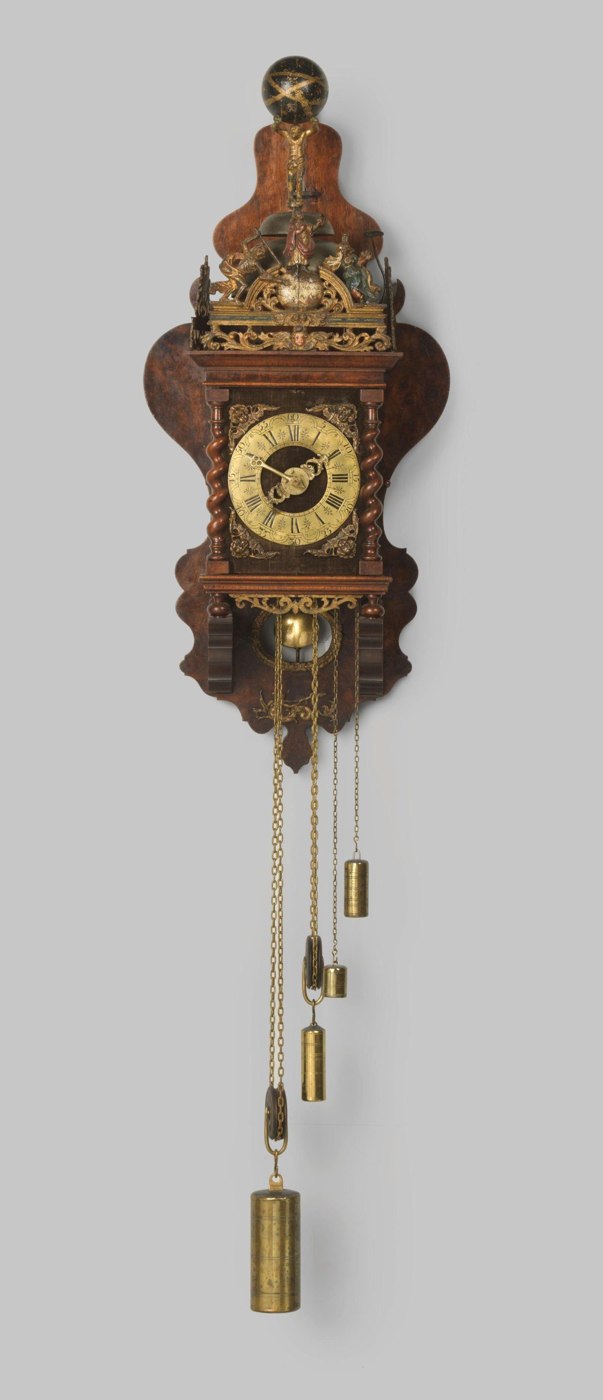
This Dutch wall clock, accessioned by the Rijksmuseum as BK-NM-4143, is attributed to the clockmaker Jan Koogies of Wormerveer, dating to circa 1700. The timepiece is constructed from an oak core veneered in walnut and mounted against a distinctive, cut-out vase-shaped backboard. The clock case features a profiled base and cornice, with twisted columns at the corners and glass-paned doors on the sides. The brass dial is adorned with gilded cast cherub spandrels placed against a black velvet ground. The movement includes a pendulum visible through an oval aperture in the backboard, which is shaped like a small equestrian figure. Below this, a sea nymph blowing a trumpet is mounted to the board. The clock is driven by two weights suspended on chains. The top of the case is decorated with a lead figure of Atlas carrying a globe, flanked by allegorical figures including Faith, Death, and a weeping woman.

Wall clock with walnut veneer and lead ornaments by Jan Koogies, circa 1700.
Wall clock with walnut veneer and lead ornaments by Jan Koogies, circa 1700. — Rijksmuseum. Rights pending — permission not yet requested. Original source

Catalogue identity

Source
www.rijksmuseum.nl
Category
Clock · Wall clock
Maker / attribution
Jan Koogies
Reference
Not recorded
Catalogue / lot identifier
BK-NM-4143
Source-reported date
ca. 1700
Source-reported place
Netherlands

Source-reported attribution and specifications are not independent authentication. A listing does not establish present ownership, current display, availability or permission to reproduce.

Object description

Case and Decorative Features

The wall clock is built upon an oak frame, which is completely covered in walnut veneer. The assembly is supported by an ornate, vase-shaped wooden backboard that serves as a mount for the central clock housing and the pendulum display. The housing is structured with molded cornices at the base and top, while the flanking corners are adorned with carved twisted columns.

The decorative program is extensive, particularly on the top and backboard. Above the clock cabinet, a lead figure of Atlas holds a celestial sphere. Additional lead ornaments are mounted to the front and sides of the clock, depicting allegorical figures such as 'Geloof' (Faith) represented by a woman with a book, alongside representations of Death and a weeping woman with an hourglass. The sides are decorated with lion figures bearing shields, accompanied by the inscription 'Nu elck zijn zin'.

Evidence for this section
  • “Hangklok belijmd met notenhout op eiken kern”
  • “geprofileerde voet- en kroonlijst, geslingerde hoekstijlen”
  • “het kastje heeft bovenop in het midden een bel met Atlas-figuur”

Dial and Timekeeping Mechanics

The dial is crafted from brass and features traditional Dutch-style corner pieces in the form of gilded, cast cherub figures set against a black velvet background. The time is displayed via a central chapter ring with Roman numerals. The clock is a weight-driven mechanism, utilizing two distinct weights suspended from chains.

The movement incorporates a pendulum that is visible through a specialized oval opening cut into the center of the wooden backboard. The pendulum itself is fashioned into the shape of a small horse and rider. Directly below this opening, a decorative element depicting a sea nymph playing a trumpet is fixed to the backboard, providing a cohesive aesthetic transition between the clock cabinet and the lower portion of the mounting structure.

Evidence for this section
  • “De wijzerplaat is van koper; vergulde gegoten cherubsen dienen als hoekstukken”
  • “De slinger verschijnt in een ovale opening van het blad en heeft de vorm van een ruitertje”
  • “De twee gewichten hangen aan kettingen”

Attribution and History

The clock is attributed to the horologist Jan Koogies, who operated in the town of Wormerveer. The signature is clearly visible on the dial, documenting both the maker and his location. This record is held within the collection of the Rijksmuseum, having been formally acquired by the institution in 1877.

The documentation identifies this piece as a mechanical wall clock ('wandklok'). It has been catalogued by the museum as item number BK-NM-4143. While the technical specifics of the escapement and movement internal components are not detailed, the object is documented as a complete assembly including its weight system and decorative backboard, preserving its characteristic Dutch form from the turn of the 18th century.

Evidence for this section
  • “Jan Koogies, Wormerveer”
  • “Gemerkt op de wijzerplaat: Jan Koogies, Wormerveer”
  • “aankoop 1877”

Open research questions

  • What is the specific type of escapement used within the movement?
  • Does the internal movement bear any additional stamps or marks consistent with Koogies' known output?

Source evidence

Recorded claims and source quotations for Wall clock by Jan Koogies
FieldSource-reported valueSource quotation
MakerJan Koogies“Jan Koogies, Wormerveer”
Dateca. 1700“ca. 1700”
MaterialWalnut veneer on oak core“Hangklok belijmd met notenhout op eiken kern.”
SignedOn the dial“Gemerkt op de wijzerplaat: Jan Koogies, Wormerveer.”
Dimensions78 cm x 34 cm x 22 cm“hoogte 78 cm x breedte 34 cm x diepte 22 cm”
Acquisition1877“aankoop 1877”

Visible details

  • Backboard features a cut-out aperture for the pendulum bob
  • Case sides are fitted with glass doors
  • Lead decorative pediments feature foliage and figures
  • Dial is signed at the bottom center

Research qualifications

  • The provenance is limited to a 1877 acquisition date
  • Originality of the allegorical lead figures and velvet backing is not explicitly assessed

Photograph identity and source facts were screened before import; rights clearance remains pending.

Terms in this record

Glossary explanations for terms named in this object’s record.