
Skip to content
The Encyclopedia of Horology

Tool · German vertical dial

Vertical Dial

Partially verified

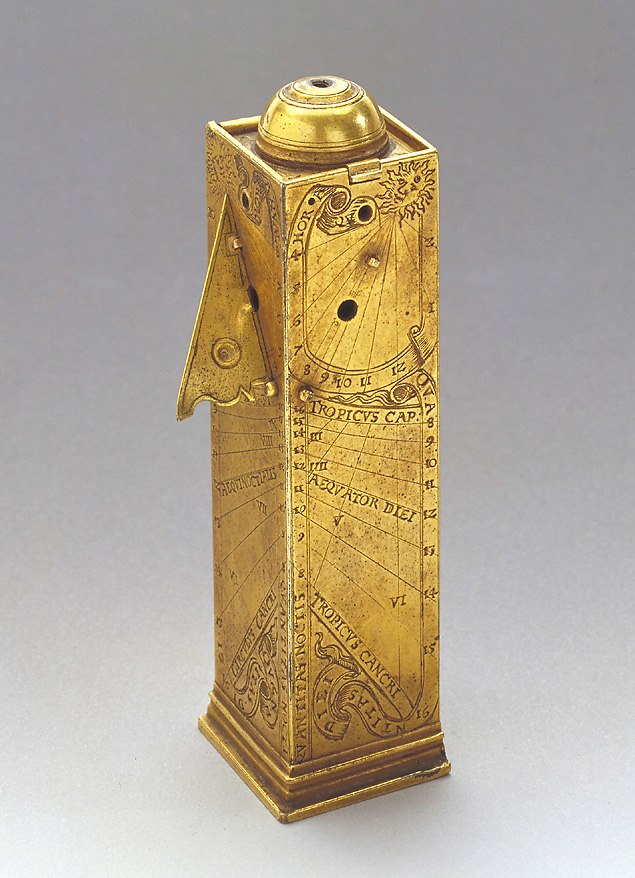
This 16th-century column sundial is composed of gilt brass and measures 100 mm in height. The instrument consists of a quadrilateral column featuring a hinged, domed lid that houses an integrated compass, which allows for proper orientation of the dial. Internally, the instrument incorporates a metal frame equipped with a counterweighted perpendicular rod attached to a double pivot; this plumb-line mechanism serves to ensure the dial is maintained in a strictly vertical position during use. The two front faces are engraved with hour dials calibrated for a 48° latitude, while the back faces feature a table of planetary rulers and decorative leaf motifs. All numerals and inscriptions on the instrument are executed using a punching technique, with Latin used for all textual components. The dial is unsigned and is currently held in the collection of the Istituto e Museo di Storia della Scienza in Florence.

Gilt brass column sundial with a hinged lid containing a compass and a plumb-line mechanism for leveling.
Gilt brass column sundial with a hinged lid containing a compass and a plumb-line mechanism for leveling. — Istituto e Museo di Storia della Scienza, Firenze. Rights pending — permission not yet requested. Original source

Catalogue identity

Source
www.mhs.ox.ac.uk
Category
Tool · German vertical dial
Maker / attribution
Not established
Reference
Not recorded
Catalogue / lot identifier
2534
Source-reported date
16th century
Source-reported place
Germany

Source-reported attribution and specifications are not independent authentication. A listing does not establish present ownership, current display, availability or permission to reproduce.

Object description

Construction and Orientation

The instrument is fashioned as a column with a quadrilateral cross-section, measuring 100 mm in height. It is crafted from gilt brass and features a hinged dome-shaped lid. When opened, the lid reveals an integrated compass, which provides the orientation required for the sundial to function correctly.

To ensure accuracy in time measurement, the column is equipped with a vertical leveling device located within the body of the instrument. This assembly consists of a metal frame and a counterweighted rod, attached by a double pivot. This configuration allows the rod to oscillate, functioning as a plumb-line to verify the vertical position of the dial.

Evidence for this section
  • “in the shape of a column with a quadrilateral cross-section.”
  • “dome-shaped lid which, when opened, can be seen to contain a small compass”
  • “metal frame carrying a counterweighted perpendicular rod attached at the bottom to the frame by a double pivot”

Dialling and Markings

The functionality of the dial is dictated by the latitude for which it was calibrated, specifically 48°. This calibration, which suggests a German origin, is applied to the two front faces of the canister, which recline at an angle of 45° when the dial is oriented.

These faces feature hour markings from 4 to 12 to 2 and 10 to 12 to 8. Beneath the hour dials, there is an hour diagram detailing the lengths of day and night, including specific arcs for the Tropics and the equinoxes. The back faces are decorated with a table of planetary rulers and formal leaf patterns within a double rule border. All text and numerals are applied via a punching process.

Evidence for this section
  • “calibrated for a latitude of 48?”
  • “engraved at the top with equal hour dials for 48?”
  • “All inscriptions are in Latin and they and the numerals are punched.”

Provenance and Documentation

The object is recorded as item number 2534 within the collection of the Istituto e Museo di Storia della Scienza in Florence. It is currently catalogued without a maker's mark.

The instrument has been examined and documented as part of the Epact archive regarding scientific instruments of Medieval and Renaissance Europe, with research notes provided by Anthony J. Turner.

Evidence for this section
  • “Inventory number: 2534”
  • “Istituto e Museo di Storia della Scienza, Firenze”
  • “Unsigned”

Open research questions

  • Can the absence of a maker's mark be corroborated by similar unmarked column sundials found in other European institutional collections?
  • Does the specific configuration of the planetary ruler table correspond to known almanacs or horological manuals from 16th-century Germany?

Source evidence

Recorded claims and source quotations for Vertical Dial
FieldSource-reported valueSource quotation
MaterialGilt brass“Gilt brass”
Dimensions100 mm in height“100 mm in height”
Date16th century“16th century”
Latitude Calibration48 degrees“calibrated for a latitude of 48?”
ConstructionQuadrilateral column with domed lid“in the shape of a column with a quadrilateral cross-section. It has a dome-shaped lid”
InscriptionsPunched Latin numerals and text“All inscriptions are in Latin and they and the numerals are punched.”
Leveling MechanismCounterweighted perpendicular rod“a metal frame carrying a counterweighted perpendicular rod”

Visible details

  • Quadrilateral column construction with a domed, hinged lid.
  • Integrated compass contained within the lid assembly.
  • Gnomons present on the column faces for shadow casting.
  • Engraved Latin inscriptions including Tropic of Cancer/Capricorn and Equinoxes.

Research qualifications

  • The maker of the instrument is currently unidentified.
  • The attribution to Germany is inferred from the latitude calibration of 48°.

Photograph identity and source facts were screened before import; rights clearance remains pending.

Consulted source

Vertical Dial

Reviewed 2026-10-26 · Record 341d6016c9

Terms in this record

Glossary explanations for terms named in this object’s record.

Other german vertical dial records