
Skip to content
The Encyclopedia of Horology

Tool · German vertical dial

Vertical Dial

Partially verified

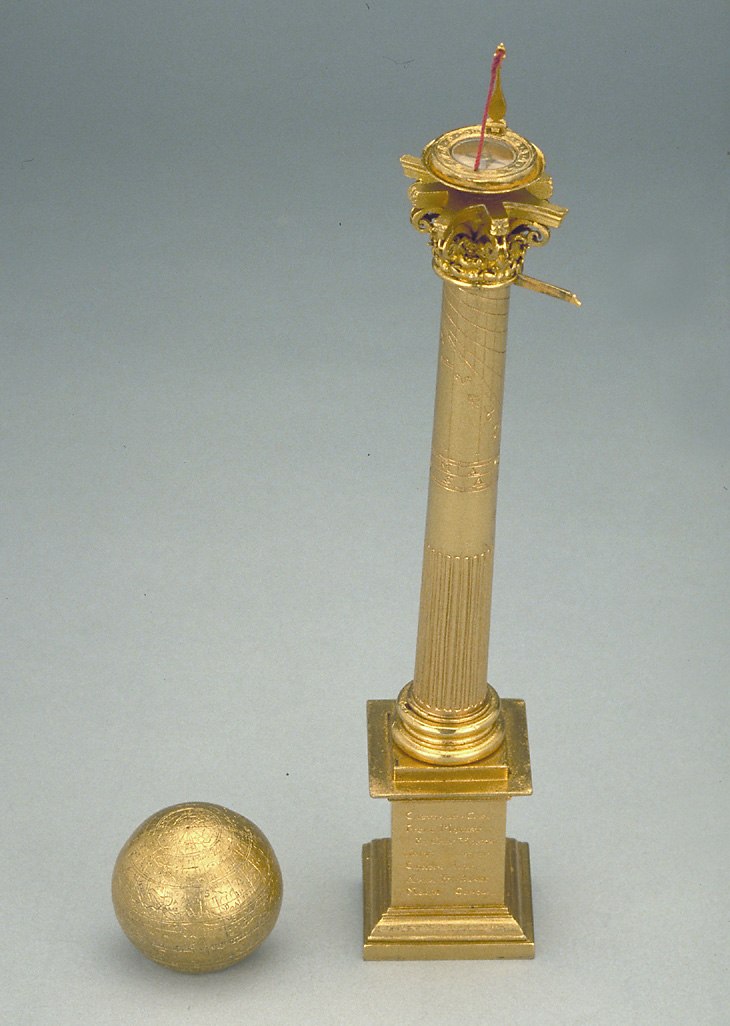
This gilt brass pillar sundial, dating to 1593, is designed in the form of a Corinthian column on a square moulded base. The instrument is surmounted by a terrestrial globe, which can be lifted to reveal a secondary small internal compass with a string gnomon dial. The main exterior column features fluted lower portions, while the upper section is engraved with hour lines from V to XII to VII and a calendar scale divided by month. A latitude scale is marked on the right side of the hours, with additional zodiacal symbols positioned in vertical zones corresponding to the months. The base of the pillar is inscribed on all four sides with Latin text. The object appears to have been re-gilded. This item was part of the Octavius Morgan bequest to the British Museum in 1888 and is referenced in the museum's published catalogue of European scientific instruments.

The pillar sundial with the terrestrial globe detached to reveal the compass.
The pillar sundial with the terrestrial globe detached to reveal the compass. — British Museum, London. Rights pending — permission not yet requested. Original source

Catalogue identity

Source
www.mhs.ox.ac.uk
Category
Tool · German vertical dial
Maker / attribution
Not established
Reference
MLA 1888, 12-1.282
Catalogue / lot identifier
MLA 1888, 12-1.282
Source-reported date
1593
Source-reported place
Germany

Source-reported attribution and specifications are not independent authentication. A listing does not establish present ownership, current display, availability or permission to reproduce.

Object description

Form and Construction

The instrument takes the form of a pillar dial resembling a Corinthian column. It stands on a square, moulded base that is inscribed with text on all four sides. The column itself is composed of distinct sections, including a fluted lower portion and an upper section containing the primary timekeeping scales.

A bayonet fitting allows the column to connect securely to the base. The capital of the column is finely rendered in the Corinthian style, and it supports a detachable terrestrial globe at its peak. This globe features engravings of the equator and the tropic of Capricorn, alongside geographic labels such as 'MARE OCEANO' and 'MER DEL CHINA'.

Evidence for this section
  • “This brass pillar dial has the form of a Corinthian column, on a square moulded base”
  • “The column, plugging into the base with a bayonet fitting, has a fluted lower portion”
  • “The gnomon is fixed to the detachable capitol, finely wrought in Corinthian style.”

Timekeeping Scales

The exterior of the column is engraved with hour lines ranging from V to XII to VII, positioned above a horizontal calendar scale. The months are divided into three parts each, with equinoxes indicated for late March and late September. Vertical zones corresponding to these months display zodiacal symbols.

A latitude scale is situated to the right of the hour lines, marked from 0 to 65. The dial also incorporates a hidden timekeeping feature: lifting the terrestrial globe reveals a smaller, internal dial centered on a compass, featuring hour lines from 5 to 12 to 7 with dots denoting half-hour increments.

Evidence for this section
  • “Horizontally is engraved a calendar scale, with the initials of the names of the months”
  • “On the right hand side of the hours is engraved a latitude scale from 0 to 65”
  • “The hour lines are engraved around the compass, from 5 to 12 to 7, with dots at the half hours.”

Provenance and Documentation

This object was acquired by the British Museum as part of the bequest of Octavius Morgan in 1888. It is catalogued as item MLA 1888, 12-1.282. The instrument is documented in the 1981 publication by F. A. B. Ward, which serves as the museum's catalogue for European scientific instruments of that period.

The piece appears to have undergone a re-gilding process at some point in its history. Despite its detailed inscriptions and engravings, the instrument remains unsigned by a specific maker.

Evidence for this section
  • “The instrument was bequeathed by Octavius Morgan in 1888”
  • “is described in F. A. B. Ward, A Catalogue of European Scientific Instruments”
  • “The instrument appears to have been re-gilded in recent times.”

Open research questions

  • What is the specific translation of the Latin inscription on the base?
  • What is the exact material of the terrestrial globe?

Source evidence

Recorded claims and source quotations for Vertical Dial
FieldSource-reported valueSource quotation
Date1593“Dated 1593”
MaterialGilt brass“Gilt brass”
Dimensions31 x 31 x 190 mm“31 x 31 x190 mm”
OriginGerman“German”
Accession NumberMLA 1888, 12-1.282“Registration no. MLA 1888, 12-1.282”
Inscription locationSquare base“The square base is inscribed on the four sides”
Secondary dialCompass and string gnomon“to reveal a small string gnomon dial with hour lines around a compass”

Visible details

  • Corinthian column capital detail
  • Detachable terrestrial globe
  • Square base with four-sided inscription
  • Latitude scale markings 0-65

Research qualifications

  • Terrestrial globe material is unverified
  • Re-gilding history is suggested but unconfirmed

Photograph identity and source facts were screened before import; rights clearance remains pending.

Consulted source

Vertical Dial

Reviewed 2026-10-26 · Record ae3abcd4a5

Terms in this record

Glossary explanations for terms named in this object’s record.

Other german vertical dial records