
Skip to content
The Encyclopedia of Horology

Clock · Vase clock

Vase with a clock

Partially verified

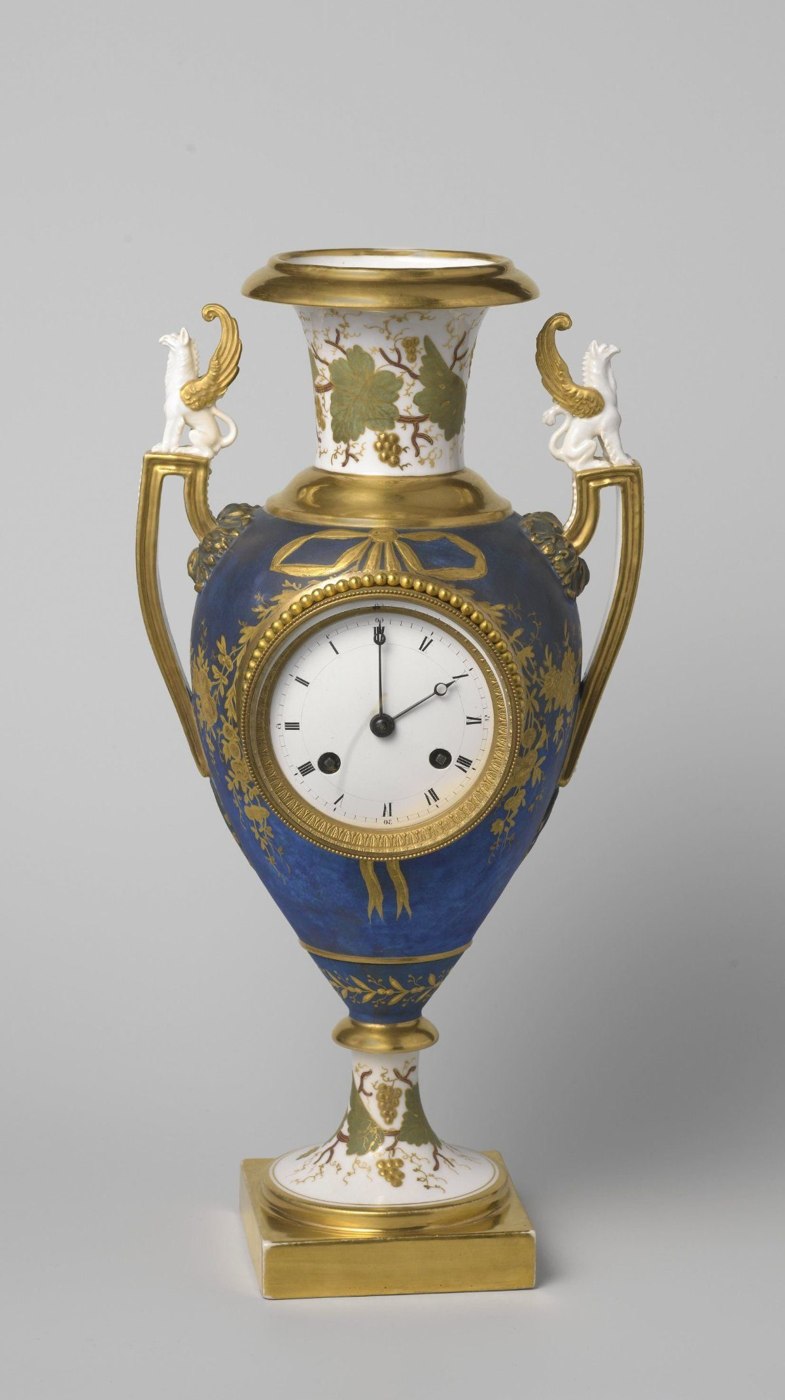
This vase clock, held by the Rijksmuseum as object BK-1962-63, is a porcelain vessel featuring integrated timekeeping components. Standing 41.5 cm tall, the object rests on a square pedestal base and incorporates a mechanical clock movement within the body of the vase. The exterior is decorated with painted motifs, specifically grapevines and bunches of grapes on the neck and foot, complemented by a trophy of musical instruments. The design features handles topped by winged griffins. Marked with the name "Amstel" in gold, the vase utilizes a blue and white color scheme with extensive gilding. The movement is mounted centrally in the vase body, framed by a beaded bezel, and features a white dial with Roman numerals. The object is catalogued as a mechanical clock and vase combination, dating to the period between circa 1809 and 1814, as established by the Rijksmuseum documentation.

Frontal view of the porcelain vase clock featuring winged griffin handles and a central dial.
Frontal view of the porcelain vase clock featuring winged griffin handles and a central dial. — Rijksmuseum, Amsterdam. Rights pending — permission not yet requested. Original source

Catalogue identity

Source
orbiscollectibles.com
Category
Clock · Vase clock
Maker / attribution
Not established
Reference
Not recorded
Catalogue / lot identifier
BK-1962-63
Source-reported date
c. 1809 - c. 1814
Source-reported place
Netherlands

Source-reported attribution and specifications are not independent authentication. A listing does not establish present ownership, current display, availability or permission to reproduce.

Object description

Design and Construction

The object is constructed from porcelain and stands upon a square pedestal base. Its form integrates a clock into the center of the vase body, which is finished in a deep blue tone. The neck and lower foot feature painted grapevine decorations, highlighting clusters of grapes against a white background.

The handles of the vase are distinctive, each adorned with a winged griffin figure. A gilded trophy of musical instruments is applied to the surface of the vase. The clock dial is circular and positioned centrally, secured by a metallic beaded bezel that serves as the frame for the timekeeping display.

Evidence for this section
  • “The vase stands on a square pedestal and is painted with a trophy of musical instruments.”
  • “On the neck and the foot are grapevines and bunches of grapes.”
  • “Winged griffins sit on the handles of the vase.”

Signatures and Identification

The object bears a specific mark which is applied in gold. The inscription reads 'Amstel', identifying its production or origin according to the markings on the piece. This mark is situated on the porcelain body, providing a point of identification for the piece.

The object is officially registered within the Rijksmuseum collection under the accession number BK-1962-63. This registration serves as the primary formal identification for the item and confirms its status as part of the museum's documented holdings.

Evidence for this section
  • “Marked: Amstel in gold.”
  • “The Rijksmuseum, Amsterdam, holds this object as BK-1962-63; its record gives material recorded as porcelain”

Museum Attribution and Documentation

The documentation for this object is provided by the Rijksmuseum in Amsterdam, which lists the item in its collection. The museum's records describe the piece as a mechanical clock and a vase. The dimensions and physical characteristics are verified through this museum record, which details the height as 41.5 cm.

The dating of the object is assigned to the period between approximately 1809 and 1814. These details are derived from the museum's catalogue, which serves as the formal source for the object's provenance and classification within the collection.

Evidence for this section
  • “The Rijksmuseum, Amsterdam, holds this object as BK-1962-63”
  • “The Rijksmuseum, Amsterdam, holds this object as BK-1962-63; its record gives material recorded as porcelain”
  • “c. 1809 - c. 1814”

Open research questions

  • What specific internal mechanism is used for the clock movement?
  • Is the 'Amstel' mark definitive proof of Amstel porcelain manufacture?

Source evidence

Recorded claims and source quotations for Vase with a clock
FieldSource-reported valueSource quotation
Materialporcelain“material recorded as porcelain”
Height41.5 cm“height 41.5 cm”
MarkingsAmstel“Marked: Amstel in gold.”
MotifsGrapevines, grapes, and musical instruments“painted with a trophy of musical instruments. On the neck and the foot are grapevines and bunches of grapes.”
InstitutionRijksmuseum“The Rijksmuseum, Amsterdam, holds this object as BK-1962-63”
Datec. 1809 - c. 1814“c. 1809 - c. 1814”

Visible details

  • Painted trophy of musical instruments on the body
  • Winged griffins surmounting the side handles
  • Beaded bezel surrounding the white circular clock dial
  • Grapevine motifs on the neck and foot

Research qualifications

  • Maker attribution beyond the 'Amstel' mark requires further validation
  • Specific mechanical details of the clockwork are not disclosed

Photograph identity and source facts were screened before import; rights clearance remains pending.

Consulted source

Vase with a clock

Reviewed 2026-11-02 · Record d02eddaf09

Terms in this record

Glossary explanations for terms named in this object’s record.