
Skip to content
The Encyclopedia of Horology

Clock · Vase clock

Sèvres porcelain oviform clock

Partially verified

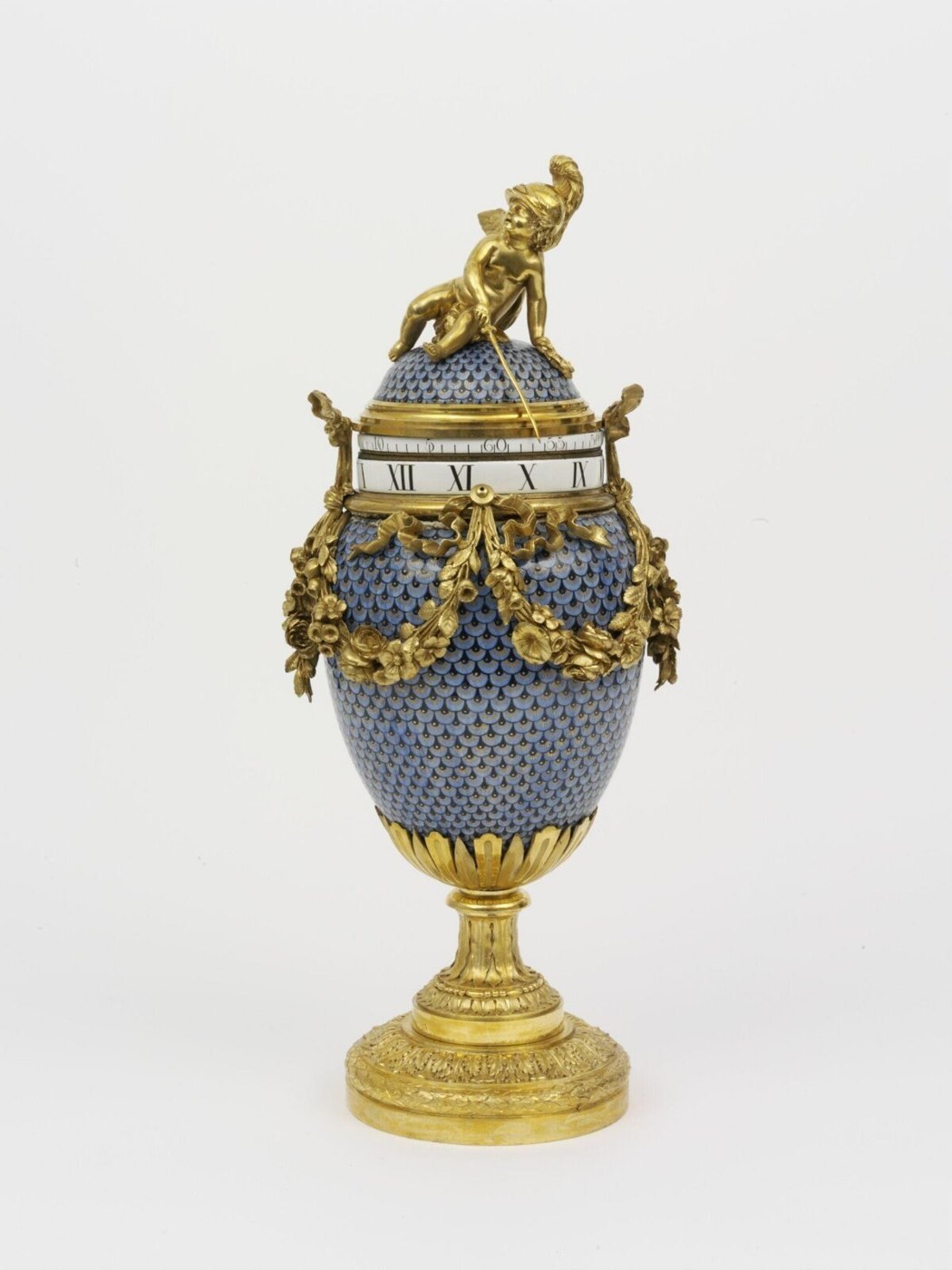
This Sèvres porcelain clock is shaped as an oviform or egg-shaped vase, standing 44 cm in height. It is decorated with an imbricated pattern in blue, black, and gold. The timekeeping mechanism is unconventional, featuring two moveable enamelled dial bands that rotate to indicate the time against a stationary pointer held by a gilt-bronze figure of a cupid positioned on the cover. The cupid wears a helmet. The body of the vase is embellished with gilt-bronze mounts, including floral festoons and handles on the shoulders. The clock is attributed to the designer Jean-Claude-Thomas Chambellan Duplessis (fils) and represents a production of the Sèvres Royal Manufactory. The clock movement is signed 'Martin AParis'. This object formed part of a larger garniture and was acquired from the collection of John Charles Robinson.

Sèvres porcelain oviform clock, 1770-1780, showing the rotating dial bands and the cupid pointer.
Sèvres porcelain oviform clock, 1770-1780, showing the rotating dial bands and the cupid pointer. — Victoria and Albert Museum. Rights pending — permission not yet requested. Original source

Catalogue identity

Source
collections.vam.ac.uk
Category
Clock · Vase clock
Maker / attribution
Sèvres
Reference
Not recorded
Catalogue / lot identifier
171-1879
Source-reported date
ca. 1770-1780
Source-reported place
France

Source-reported attribution and specifications are not independent authentication. A listing does not establish present ownership, current display, availability or permission to reproduce.

Object description

Form and Decoration

The clock is designed as an oviform, or egg-shaped, porcelain vase. The exterior surface is covered in an imbricated pattern rendered in blue, black, and gold. The vase is supported on a pedestal base and features gilt-bronze floral festoons and side handles mounted on the shoulders of the vase body.

The finial, mounted on the cover, depicts a gilt-bronze cupid wearing a helmet. This figure holds a pointer that remains stationary, acting as the indicator for the time displayed on the dial bands below it.

The vase is 44 cm high, 17.5 cm wide, and 17 cm deep.

Evidence for this section
  • “The vase-shaped clock is fitted with two enamelled dial bands that turn to indicate time against a pointer held by the gilt bronze helmetted cupid who forms the finial.”
  • “Clock with moveable dial bands set in an oviform vase decorated with an imbricated pattern in blue, black and gold.”
  • “On the cover a gilt-bronze figure of cupid armed, and on the shoulders are handles and floral festoons also of gilt bronze.”

Timekeeping Mechanism

Unlike standard clocks of the period which use hands moving across a fixed dial, this piece uses a system of moveable dial bands. Two separate enamel rings are positioned beneath the cover.

These bands rotate to indicate the time against the stationary pointer held by the bronze cupid finial. The movement itself is marked by the maker 'Martin AParis'.

Evidence for this section
  • “The vase-shaped clock is fitted with two enamelled dial bands that turn to indicate time against a pointer held by the gilt bronze helmetted cupid who forms the finial.”
  • “Clock movement signed 'Martin AParis'”

Attribution and History

The clock is attributed to Jean-Claude-Thomas Chambellan Duplessis (fils), who worked as a designer and bronze founder.

The clock was once part of a larger garniture, a common format for displaying ornamental vases and clocks on mantlepieces or commodes. The object was acquired by the museum from the collection of John Charles Robinson.

Evidence for this section
  • “This garniture was probably designed by Duplessis fils , and the porcelain components made at his request.”
  • “An oviform (egg-shaped) clock in Sèvres porcelain forming part of a garniture.”
  • “Bought from the collection of John Charles Robinson”

Open research questions

  • What is the specific horological mechanism used to rotate the dial bands?
  • Is the 'Martin AParis' signature associated with a specific clockmaker known to have collaborated with Sèvres?

Source evidence

Recorded claims and source quotations for Sèvres porcelain oviform clock
FieldSource-reported valueSource quotation
MakerSèvres“Sèvres, 1770-1780”
SignatureMartin AParis“Clock movement signed 'Martin AParis'”
DesignerJean-Claude-Thomas Chambellan Duplessis (fils)“This garniture was probably designed by Duplessis fils , and the porcelain components made at his request.”

Visible details

  • Helmetted cupid finial holds the time-indicating pointer
  • Two rotating enamel rings display Roman numerals and minutes
  • Vase body features blue, black, and gold imbricated surface decoration

Research qualifications

  • The designer is only possibly Jean-Claude-Thomas Chambellan Duplessis (fils)
  • The object is described as forming part of a larger garniture, though only the clock is catalogued here

Photograph identity and source facts were screened before import; rights clearance remains pending.

Consulted source

Clock, Sèvres porcelain, Sèvres, 1770-1780

Reviewed 2026-11-02 · Record da21845fff

Terms in this record

Glossary explanations for terms named in this object’s record.