
Skip to content
The Encyclopedia of Horology

Tool · Nuremberg diptych dial

Thomas Tucher Ivory Diptych Dial

Partially verified

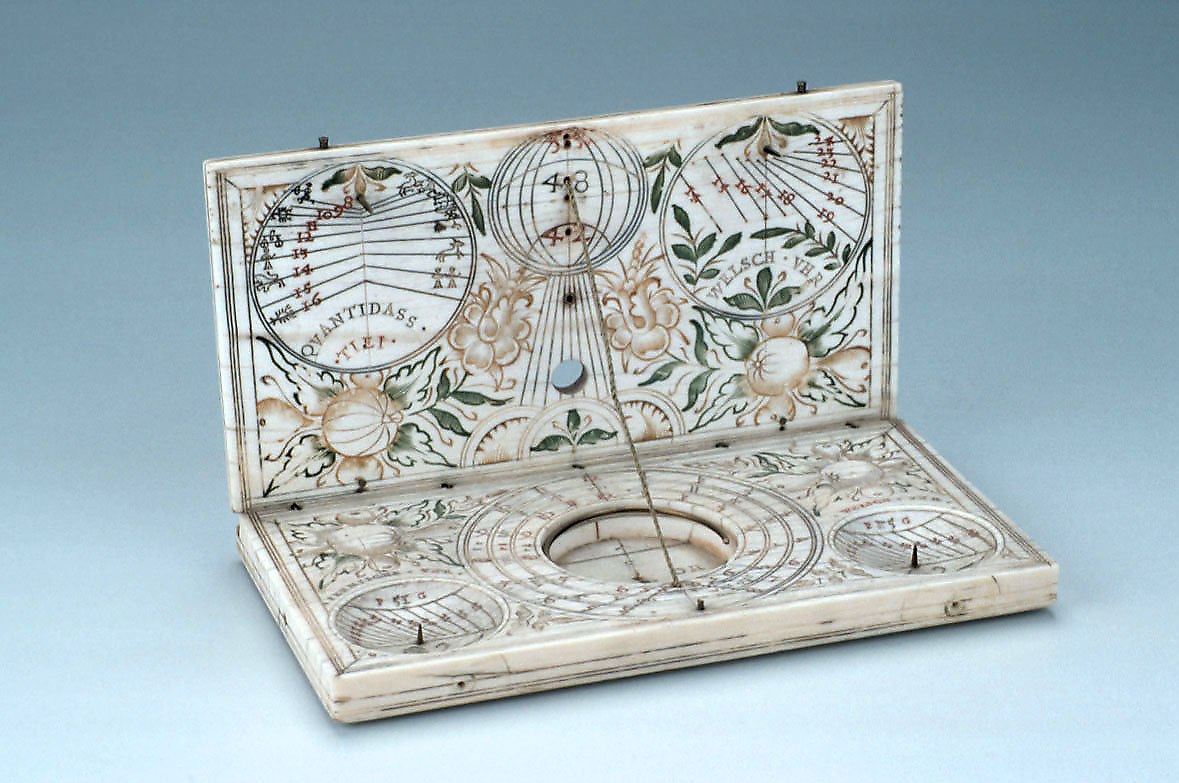
This ivory diptych dial is attributed to Thomas Tucher of Nuremberg, dated to circa 1600. Measuring 139 x 75 x 15 mm, the instrument is characterized by its wide proportions and intricate decoration featuring motifs of fruits and flowers in brown and green pigments. The dial is composed of two hinged leaves. The interior of the upper leaf contains latitude adjustment holes for 54°, 48°, and 42°, alongside two pin gnomon dials displaying 'Welsch' hours and 'Quantidass Diei' with zodiacal signs. The interior of the lower leaf includes a central compass compartment and a string gnomon dial. Additional scaphe dials for 'Welsch' and 'Penmische' hours are calibrated for specific latitudes.

Ivory diptych dial by Thomas Tucher, showing the interior leaves with multiple pin gnomon and scaphe dials, circa 1600.
Ivory diptych dial by Thomas Tucher, showing the interior leaves with multiple pin gnomon and scaphe dials, circa 1600. — Museum of the History of Science, Oxford. Rights pending — permission not yet requested. Original source

Catalogue identity

Source
www.mhs.ox.ac.uk
Category
Tool · Nuremberg diptych dial
Maker / attribution
Thomas Tucher
Reference
Not recorded
Catalogue / lot identifier
78766
Source-reported date
circa 1600
Source-reported place
Nuremberg

Source-reported attribution and specifications are not independent authentication. A listing does not establish present ownership, current display, availability or permission to reproduce.

Object description

Construction and Layout

The diptych dial is constructed from ivory with external dimensions of 139 by 75 by 15 mm. The instrument consists of two leaves hinged together, decorated with foliage, fruits, and flowers. The outer surfaces include a wind rose with 32 directions on the upper leaf and a lunar volvelle on the lower leaf, accompanied by figures.

The interior of the upper leaf houses latitude settings enclosed in ellipses. Below these are two pin gnomon dials: one for Welsch hours (14–24) and one for 'Quantidass Diei' (8–16) featuring zodiacal symbols. The lower leaf centers on a compass cavity, though the original glass is absent, surrounded by a string gnomon dial and two inset scaphe dials calibrated for specific latitudes.

Evidence for this section
  • “The outer part of the upper leaf of this dial has a wind rose with 32 directions”
  • “The inner side of the lower leaf has a compass (glass missing) in the centre”
  • “The remaining space of the leaf is filled with a decoration of fruits and flowers”

Horological Functions

The dial serves multiple timekeeping functions, including the indication of common hours, Italian hours (Welsch hours), and day duration hours. Latitude adjustment is facilitated by pin holes corresponding to 42°, 48°, and 54°, allowing the string gnomon to be positioned correctly for different geographical locations.

Specific scaphe dials on the lower leaf indicate Welsch hours for latitude 45° and 'Penmische' hours for latitude 51°, both numbered 9 to 23. These scales indicate that the dial was intended to function across several European regions, utilizing varying systems of hour measurement prevalent in the period.

Evidence for this section
  • “The small scaphe dials indicate Italian hours (or 'Welsch hour') and 'Penmische' hours”
  • “The inner part of the upper leaf has at the centre a set of holes for adjusting the latitude to 54?, 48? and 42?”
  • “On the right side of the dial is a scaphe dial 'WELSCH VHR' indicated from 9 to 23 for latitude 45”

Signatures and Provenance

The instrument bears the mark of a crowned snake, identified in the cataloging as the maker's mark. It is attributed to Thomas Tucher of Nuremberg, an attribution consistent with the style of ivory dial production associated with that center during the turn of the 17th century.

The piece is currently part of the collection at the Museum of the History of Science, Oxford, under the inventory number 78766. The documentation provided notes the absence of the compass glass, a detail preserved in the museum’s physical examination of the object.

Evidence for this section
  • “Attributed to a Thomas Tucher”
  • “engraved with the abbreviated names of the cardinal points and the maker's mark (a crowned snake)”
  • “The inner side of the lower leaf has a compass (glass missing) in the centre”

Open research questions

  • What is the specific historical definition of 'Penmische' hours in relation to Italian hours?
  • Are there known surviving works by Thomas Tucher that confirm the crowned snake as his hallmark?

Source evidence

Recorded claims and source quotations for Thomas Tucher Ivory Diptych Dial
FieldSource-reported valueSource quotation
MakerThomas Tucher“Attributed to a Thomas Tucher”
Datecirca 1600“circa 1600; Nuremberg”
MaterialIvory“Ivory; 139 x 75 x 15 mm”
Inventory Number78766“Inventory number 78766”
Dimensions139 x 75 x 15 mm“139 x 75 x 15 mm”
OriginNuremberg“Nuremberg”
Maker's MarkCrowned snake“the maker's mark (a crowned snake)”

Visible details

  • Internal compass glass is missing
  • Decoration includes colored fruit and floral motifs
  • Features three bun feet on the base
  • Latitude adjustments provided for 42, 48, and 54 degrees

Research qualifications

  • Attribution to Thomas Tucher is not definitive
  • Relationship between 'Welsch' and 'Penmische' hours remains speculative

Photograph identity and source facts were screened before import; rights clearance remains pending.

Consulted source

Diptych Dial

Reviewed 2026-10-26 · Record 69afa26896

Terms in this record

Glossary explanations for terms named in this object’s record.