
Skip to content
The Encyclopedia of Horology

Tool · Latin-inscribed astrolabe

The Painswick Astrolabe

Partially verified

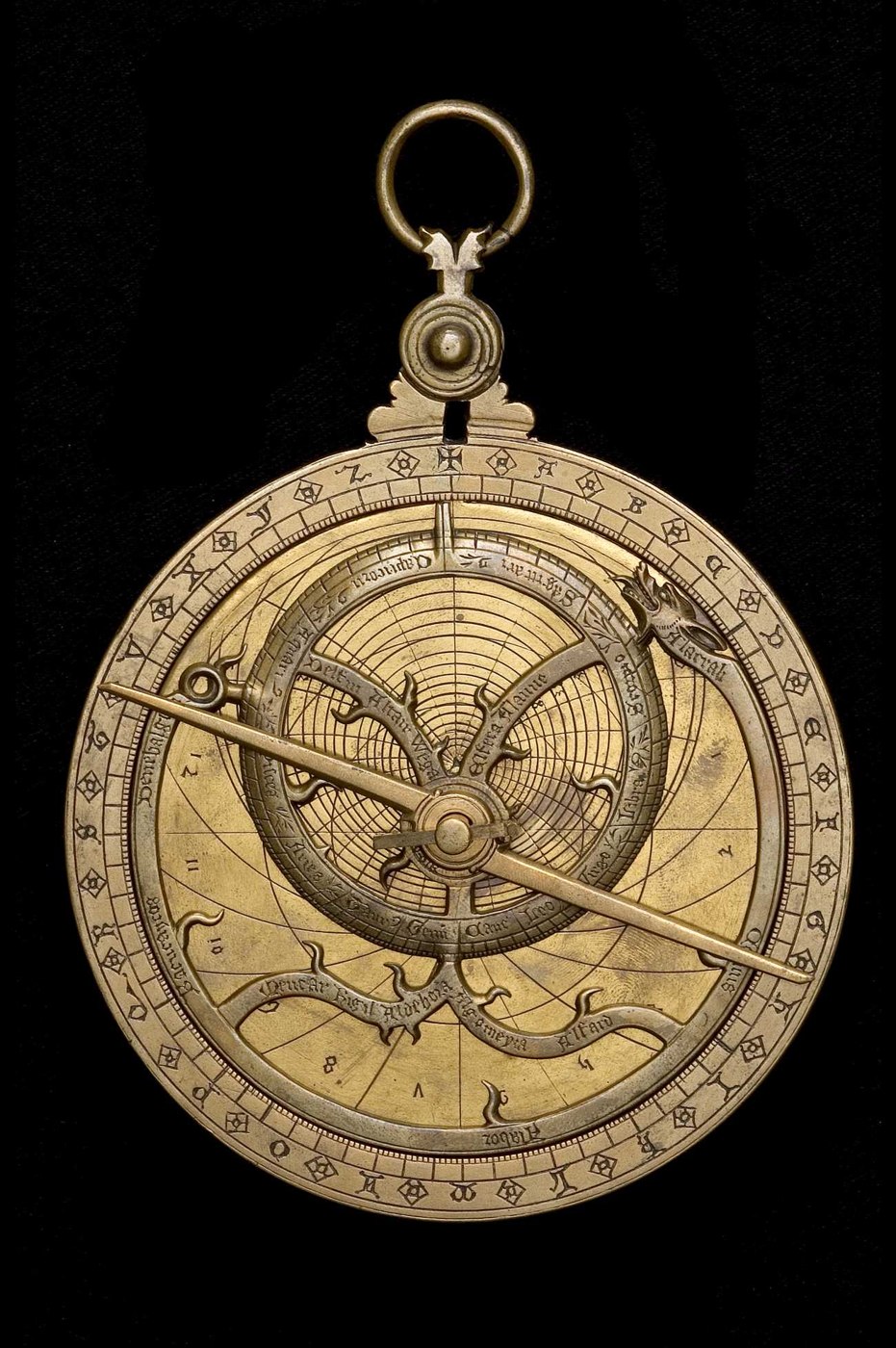
This brass astrolabe, identified as inventory number 47869 and historically known as the 'Painswick Astrolabe', dates to approximately 1370. The instrument features a Y-shaped rete with zoomorphic elements where the Tropic of Capricorn terminates in the head and tail of a dragon, with the head pointing at the star Antares and the tail at Deneb Algiedi. The rete displays 21 star positions indicated by flamant pointers and a labelled zodiac circle. The mater and limb consist of a one-piece construction, while the throne is of a simple, unusual pierced type with an integrated base. The back incorporates scales for degrees, zodiacal signs, a calendar, Saints' Days, and a shadow square. This instrument was presented to the History of Science Museum, University of Oxford, in 1955 by the Misses M. E. and L. C. Hyett and The Friends of the Old Ashmolean.

Full view of the Painswick Astrolabe, showing the rete and the dragon-head zoomorphic terminal.
Full view of the Painswick Astrolabe, showing the rete and the dragon-head zoomorphic terminal. — History of Science Museum, University of Oxford. Rights pending — permission not yet requested. Original source

Catalogue identity

Source
www.mhs.ox.ac.uk
Category
Tool · Latin-inscribed astrolabe
Maker / attribution
Not established
Reference
Not recorded
Catalogue / lot identifier
47869
Source-reported date
ca. 1370
Source-reported place
England (?)

Source-reported attribution and specifications are not independent authentication. A listing does not establish present ownership, current display, availability or permission to reproduce.

Object description

Structural Design and Components

The instrument features a one-piece mater and limb construction. The throne is of a simple, pierced type attached to an integrated base, a feature described as unusual for European astrolabes. The ring is a simple round cross-section rod, and the shackle is uniquely fashioned to resemble a comet with a fiery tail.

The rete is Y-shaped and carries 21 stars indicated by flamant pointers. A primary decorative feature is the zoomorphic treatment of the Tropic of Capricorn, which ends in the head and tail of a dragon or serpent.

Evidence for this section
  • “The throne is of the simple type made of brass attached with integrated base made of brass”
  • “The throne is unusual amongst the European astrolabes because it is pierced.”
  • “The rete is of the y-shaped (low) type. The Tropic of Capricorn ends in the head and tail of a dragon”

Scales and Back Markings

The back of the astrolabe is engraved with five circular, concentric scales providing various astronomical and calendrical data. These include a degree scale ranging from 0 to 90 degrees, zodiacal signs, a calendar of the year, a scale for Saints' Days, and a shadow square located in the lower two quadrants.

The limb of the instrument also contains scales, specifically for equal hours marked with letters instead of numbers, and a 360-degree scale. The instrument is accompanied by three plates covering a range of latitudes from 40 degrees to 59 degrees, supporting its functionality across various locations.

Evidence for this section
  • “The back contains 5 scales of the following types: Degree; Zodiacal signs; Calendar; Saints' Days; Shadow square.”
  • “The lower two quadrants of the back of the instrument”
  • “There are 3 plates with latitudes ranging from 40°0' to 59°0' .”

Provenance and History

The astrolabe, documented as the 'Painswick Astrolabe', was acquired by the History of Science Museum in Oxford in 1955. It was previously part of the collection of Sir Francis A. Hyett of Painswick House, Gloucestershire. The acquisition was made possible through a donation from the Misses M. E. and L. C. Hyett and the Museum's Friends organisation.

The item is associated with a related group of 14th-century English astrolabes, including the instrument catalogued under inventory number 49359. The documentation notes the inclusion of zoomorphic dragon features as a characteristic shared across this group of instruments.

Evidence for this section
  • “'The Painswick Astrolabe' was purchased by the Museum 'at a nominal price'”
  • “It had belonged to Sir Francis A. Hyett (1844-1941), of Painswick House, Gloucestershire.”
  • “Along with this instrument, the other 'Chaucerian' astrolabe (inventory no. 49359 ) and the related group of 14th-century English astrolabes all fashion the Tropic of Capricorn into a serpent.”

Open research questions

  • What is the specific astronomical function or symbolism behind the pierced throne design?
  • Are there extant primary records that confirm the manufacture of this specific instrument in 14th-century England?

Source evidence

Recorded claims and source quotations for The Painswick Astrolabe
FieldSource-reported valueSource quotation
Inventory number47869“Inventory no. 47869”
MaterialBrass“Material Brass”
Dateca. 1370“Date ca. 1370”
Place of originEngland (?)“Place England (?)”
Star count21“The rete contains 21 stars.”
Rete typeY-shaped (low)“The rete is of the y-shaped (low) type.”
Acquisition date1955“Presented by the Misses M. E. and L. C. Hyett and by The Friends of the Old Ashmolean in 1955”

Visible details

  • Rete includes dragon-head zoomorphic terminal
  • Three plates included with latitudes from 40° to 59°
  • Shadow square located in lower two back quadrants
  • Shackle design resembles a comet with a fiery tail

Research qualifications

  • The exact place of manufacture is uncertain and noted as England (?)
  • The attribution of the astrolabe to the 14th century is approximate as 'ca. 1370'

Photograph identity and source facts were screened before import; rights clearance remains pending.

Consulted source

Astrolabe, inventory 47869 (England (?), ca. 1370)

Reviewed 2026-10-26 · Record 7574dfcd13

Terms in this record

Glossary explanations for terms named in this object’s record.