
Skip to content
The Encyclopedia of Horology

Clock · Marine pendulum clock

The Bruce-Oosterwijck Longitude Pendulum Sea Clock Movement and Case

Partially verified

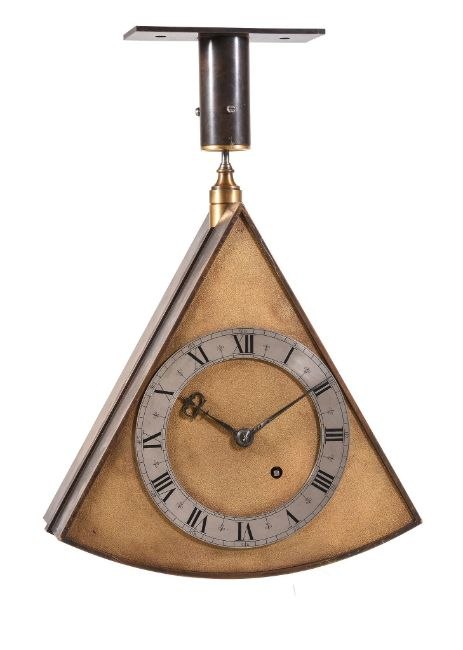
This spring-driven longitude pendulum sea clock movement was made by Severijn Oosterwijck in The Hague circa 1662 for Alexander Bruce, in collaboration with Christiaan Huygens and Robert Moray. The tapered-plate single-fusee movement is inscribed 'Severijn Oosterwijck Fecit Haghe' and fitted with an auxiliary sixty-division scale on the backplate. The assembly is housed within a modern conjectural brass reconstruction of the original cheese-wedge-shaped marine case, suspended from a Cardan-type ball and socket pivot with an upper mounting flange.

The Bruce-Oosterwijck longitude pendulum sea clock movement housed in a reconstructed cheese-wedge brass case
The Bruce-Oosterwijck longitude pendulum sea clock movement housed in a reconstructed cheese-wedge brass case — Dreweatts. Rights pending — permission not yet requested. Original source

Catalogue identity

Source
auctions.dreweatts.com
Category
Clock · Marine pendulum clock
Maker / attribution
Severijn Oosterwijck
Reference
Not recorded
Catalogue / lot identifier
108
Source-reported date
circa 1662
Country
Not established

Source-reported attribution and specifications are not independent authentication. A listing does not establish present ownership, current display, availability or permission to reproduce.

Object description

Movement Construction and Mechanism

The movement is a single fusee design with heavily tapered plates measuring a maximum of 5.375 inches wide by 6.675 inches high. It is held together by four finned column turned pillars pinned through the backplate and a fifth slender square-section pillar positioned at the lower margin between the fusee and the mainspring barrel.

The four-wheel train includes a re-cut fusee and a replaced great wheel to allow for an approximate one-week duration. The contrate wheel arbor passes through the backplate to a brass hand indicating against a ring of sixtieths engraved directly onto the backplate. The crown wheel features a long arbor to allow for the pendulum to be suspended from the apex of the plates.

Evidence for this section
  • “The single fusee movement with heavily tapered plates measuring a maximum of 5.375 inches wide by 6.675 inches high united by four finned column turned pillars pinned through the backplate and a fifth slender square-section pillar positioned to the centre of the lower margin between the fusee and mainspring barrel”
  • “the four-wheel train with re-cut fusee and replaced great wheel to increase the duration to around one week”
  • “the contrate wheel with arbor passing through the backplate fitted with a brass hand reading against a slender ring divided into sixtieths engraved directly into the backplate”
  • “the escapement crown wheel with long arbor to facilitate the pendulum to be suspended from the apex of the plates”

Dial and Signature

The movement is fitted with a cheese-wedge shaped matted gilt brass dial plate measuring 10.125 inches high by 10 inches wide. It features a silvered Roman numeral chapter ring, stylised trident half-hour markers, and Arabic five-minute notations within an outer track.

An engraved signature, 'Severijn Oosterwijck Fecit Haghe', is located on the lower margin. The pendulum has an effective length of approximately 7.125 inches, fitted with a suspension spring and a ring-turned lenticular bob with a central aperture and winged rating nut.

Evidence for this section
  • “the movement now fitted with a cheese-wedge shaped matted gilt brass dial plate measuring 10.125 inches high by 10 inches wide applied with slender silvered Roman numeral chapter ring with stylised Trident half hour markers and Arabic five minutes within the outer minute track”
  • “over exquisite engraved signature Severijn Oosterwijck Fecit Haghe to lower margin”
  • “the pendulum with effective length of approximately 7.125 inches now fitted with a suspension spring and with ring-turned lenticular bob with aperture to centre and winged rating nut”

Case and Suspension

The movement and dial are housed in a heavy cast brass conjectural reconstruction of the original cheese-wedge-shaped case, formed of two sections joined by a riveted band. The rear panel features a glazed hinged porthole to view the subsidiary dial.

The assembly is suspended via a Cardan-type ball and socket pivot from a drilled rectangular flange, measuring 41cm (16 ins) high overall.

Evidence for this section
  • “the movement and current dial now housed in a very well-made heavy cast brass conjectural reconstruction of the original case also of distinctive cheese-wedge shape formed as two sections joined via a riveted band”
  • “the rear with conforming cast panel centred with a glazed hinged circular porthole for viewing the subsidiary dial”
  • “the whole suspended via a substantial Cardan-type ball and socket pivot from a drilled rectangular flange 41cm (16 ins) high overall”

Open research questions

  • What defines the technical construction of a 'cheese-wedge' sea clock case?
  • What is the documentation regarding the 'old' olivewood veneered case referenced as available for purchase separately?

Source evidence

Recorded claims and source quotations for The Bruce-Oosterwijck Longitude Pendulum Sea Clock Movement and Case
FieldSource-reported valueSource quotation
MakerSeverijn Oosterwijck“The movement by Severijn Oosterwijck for Alexander Bruce in collaboration with Christiaan Huygens and Robert Moray, The Hague, circa 1662”
Engraved signatureSeverijn Oosterwijck Fecit Haghe“exquisite engraved signature Severijn Oosterwijck Fecit Haghe to lower margin”
Dial plate designCheese-wedge shaped matted gilt brass dial“cheese-wedge shaped matted gilt brass dial plate measuring 10.125 inches high by 10 inches wide applied with slender silvered Roman numeral chapter ring”
Movement dimensions5.375 inches wide by 6.675 inches high“measuring a maximum of 5.375 inches wide by 6.675 inches high united by four finned column turned pillars”
Suspension mountingCardan-type ball and socket pivot“the whole suspended via a substantial Cardan-type ball and socket pivot from a drilled rectangular flange”
MakerSeverijn Oosterwijck“The movement by Severijn Oosterwijck for Alexander Bruce in collaboration with Christiaan Huygens and Robert Moray, The Hague, circa 1662”

Visible details

  • Cheese-wedge triangular cast brass case suspended via a vertical cylindrical mount and flat drilled rectangular flange
  • Gilt matted dial plate bearing an applied circular silvered chapter ring with Roman numerals and outer Arabic five-minute markers
  • Two steel hands, including an hour hand with a pierced quatrefoil/heart motif
  • Winding aperture situated in the lower right portion of the chapter ring center

Research qualifications

  • The triangular brass sea case is a modern conjectural reconstruction of the original 17th-century housing
  • Lot also includes an auxiliary square dial and a walnut table clock case not visible in this primary photograph
  • Movement backplate and interior train are concealed within the case in this view

Photograph identity and source facts were screened before import; rights clearance remains pending.

Terms in this record

Glossary explanations for terms named in this object’s record.