
Skip to content
The Encyclopedia of Horology

Clock · Temple clock

Temple Clock by Pierre-Michel Barancourt

Partially verified

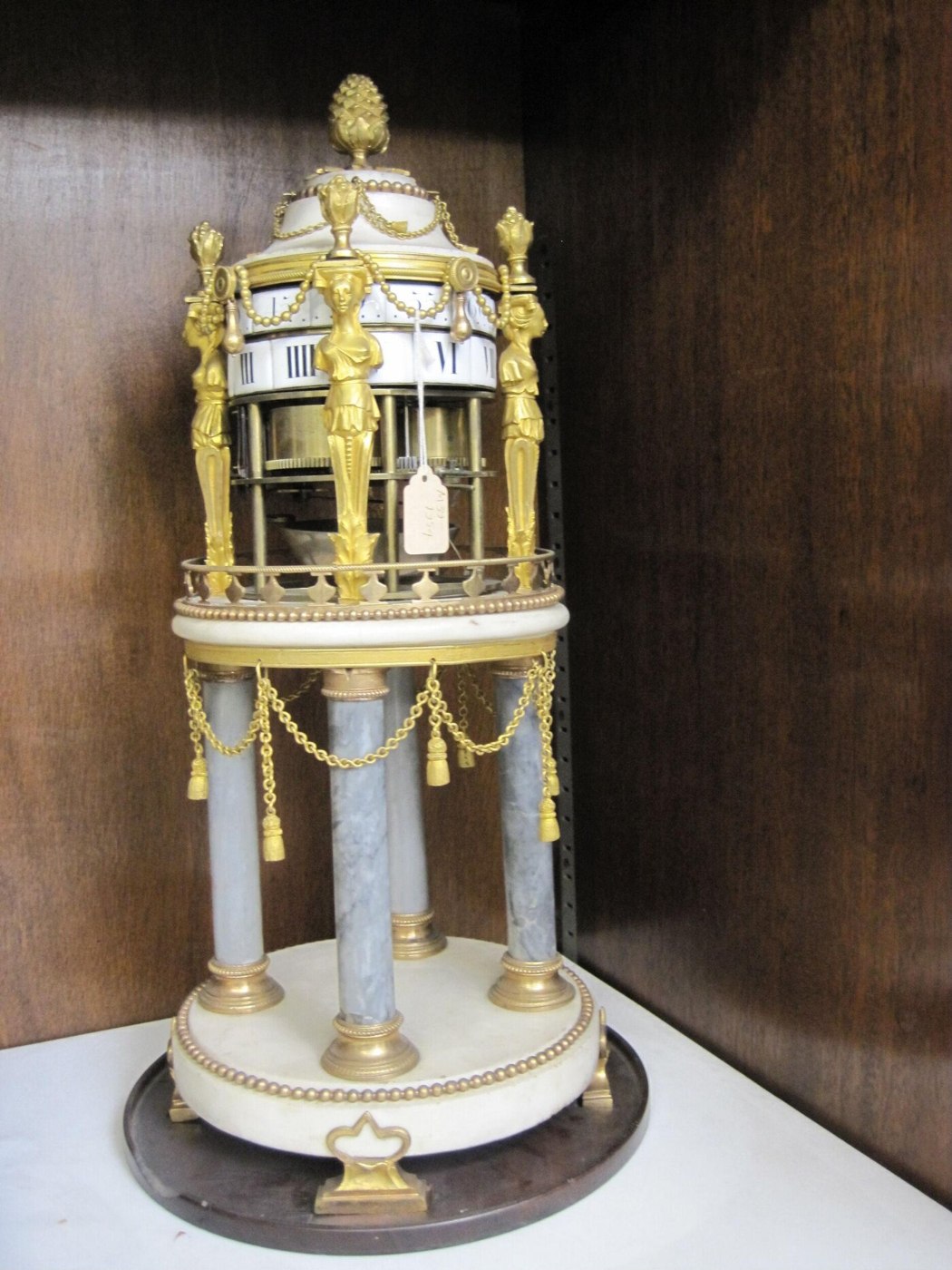
This table clock, designed as a two-storey classical temple, is attributed to the maker Pierre-Michel Barancourt (1745-1804). Standing 49.5 cm high, the base is constructed from white marble with ormolu bead embellishments, resting on four pedestal feet. The lower section features four grey marble columns with ormolu capitals, linked by festoons of ormolu cord and tassels. The movement is mounted on the upper level, framed by four female term figures cast in ormolu, which support a white marble dome topped with an ormolu pineapple finial. Time is displayed on two horizontally revolving white enamel bands. The hour dial features individual Roman numeral plates, while the minute dial displays numerals in five-minute increments. The movement, signed by Barancourt, includes an anchor escapement and a pendulum. The entire assembly was historically housed within a glass case.

Temple clock by Barancourt, Paris, showing the rotating dial drums and ormolu female term supports.
Temple clock by Barancourt, Paris, showing the rotating dial drums and ormolu female term supports. — Victoria and Albert Museum, London. Rights pending — permission not yet requested. Original source

Catalogue identity

Source
collections.vam.ac.uk
Category
Clock · Temple clock
Maker / attribution
Pierre-Michel Barancourt
Reference
Not recorded
Catalogue / lot identifier
M.39:1, 2-1954
Source-reported date
ca. 1790
Source-reported place
Paris

Source-reported attribution and specifications are not independent authentication. A listing does not establish present ownership, current display, availability or permission to reproduce.

Object description

Case and Dial Design

The clock is configured as a two-storey classical temple. The foundational structure comprises a white marble base supported on four pedestal feet, adorned with ormolu beadwork. Rising from this are four grey marble columns fitted with ormolu capitals and bases, which are interconnected by decorative festoons of cast ormolu cord and tassels.

The upper section houses the mechanism, which is enclosed within a frame of four ormolu female terms. These figures support a white marble dome, which is itself finished with an ormolu pineapple finial and hanging chain accents. Time is displayed via two horizontally rotating white enamel drums, with Roman numerals for the hours and five-minute numerical intervals for the minutes.

Evidence for this section
  • “The movement is supported on a peristyle of grey marble columns, resting on a white marble base.”
  • “The movement itself is enclosed within a framework supported by four female terms of ormolu.”
  • “The chapter rings are in the form of two rotating white enamel bands each mounted on the side of a drum 12.7cm diameter on a vertical arbor.”

Movement and Escapement

The timekeeping mechanism is mounted between two horizontal plates measuring 12.7 cm in diameter. The movement is configured with two distinct trains: one for timekeeping and one for striking. It utilizes an anchor escapement and a pendulum system, the latter being 18.4 cm long with a circular bob.

The going train utilizes a going barrel and a contrate drive, featuring a 33-tooth escape wheel and an inverted tic-tac escapement. The striking train employs a locking-plate mechanism and a count-wheel, specifically designed to produce a single strike each half-hour. The entire movement is signed by Barancourt, identifying the maker of the internal components.

Evidence for this section
  • “The movement is unscreened and mounted between two horizontal plates 12.7cm diameter.”
  • “The going train with going barrel and contrate drive carries a 33T escape wheel, with an inverted tic-tac escapement with pallets spanning 3T.”
  • “The locking-plate striking train, with going barrel has a count-wheel allowing a single stroke each half-hour.”

Provenance and Documentation

The object was acquired by the museum via a gift from Miss Rachel Rashleigh in 1954. It is catalogued under the accession number M.39:1, 2-1954. The documentation associates the clock with the Parisian maker Pierre-Michel Barancourt, active during the late 18th century.

The signatures found on the hour and minute plates, reading 'BARANCOURT' and 'A PARIS', serve as primary evidence of its origins.

Evidence for this section
  • “Given by Miss Rachel Rashleigh, 1954”
  • “The movement is signed Barancourt for Pierre-Michel Barancourt (1745-1804), Paris, late 18th century.”
  • “The '60'-plate is signed 'BARANCOURT' and the '30'-plate 'A PARIS'.”

Open research questions

  • Is the glass dome currently present, or is it missing from the documented item?
  • What was the precise function of the cord-regulated pendulum in this specific model's timekeeping accuracy?

Source evidence

Recorded claims and source quotations for Temple Clock by Pierre-Michel Barancourt
FieldSource-reported valueSource quotation
MakerPierre Michel Barancourt“Barancourt, Pierre Michel”
Dateca. 1780“ca. 1780”
MaterialsMarble, ormolu, glass“Marble and ormolu with a glass case”
Movement signedBarancourt“The movement is signed Barancourt.”
Dial signaturesBarancourt and A Paris“The '60'-plate is signed 'BARANCOURT' and the '30'-plate 'A PARIS'.”
Dimensions49.5 cm x 21.6 cm“Height: 49.5 cm; Diameter: 21.6 cm”
ProvenanceMiss Rachel Rashleigh“Given by Miss Rachel Rashleigh, 1954”

Visible details

  • Rotating enamel chapter rings for hours and minutes
  • Four ormolu female term figures support the upper dome
  • Use of grey marble columns and white marble base
  • Ormolu decorative festoons with tassels

Research qualifications

  • Date range differs between source summary (late 18th century) and data field (ca. 1780)
  • Specific technical condition is not provided beyond general descriptive physical summary

Photograph identity and source facts were screened before import; rights clearance remains pending.

Consulted source

Clock

Reviewed 2026-10-26 · Record 42364aa140

Terms in this record

Glossary explanations for terms named in this object’s record.

Other temple clock records