
Skip to content
The Encyclopedia of Horology

Clock · Temple clock

Silver and silver-gilt temple clock

Partially verified

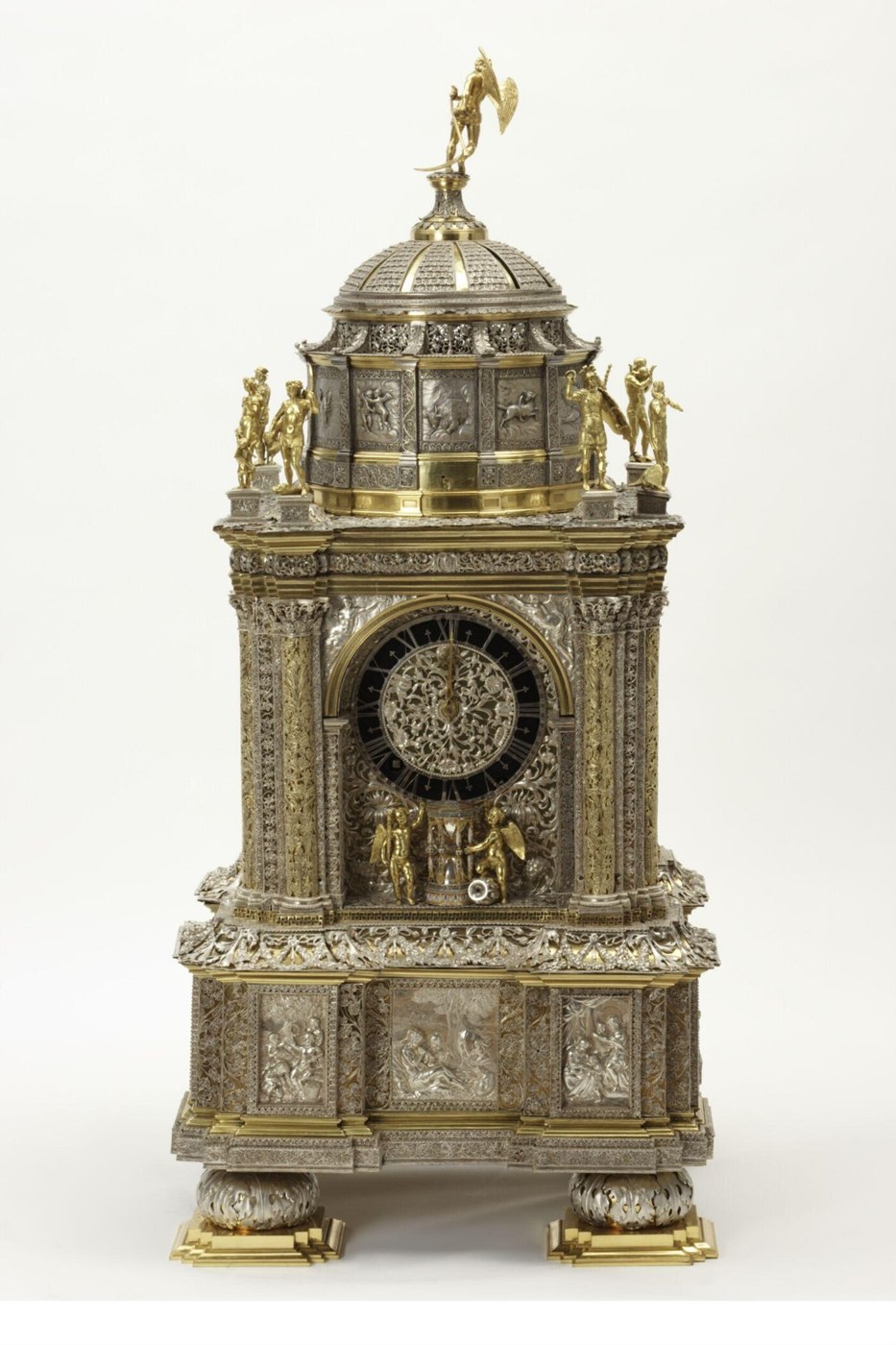
This silver and silver-gilt temple clock, measuring 91.6 cm in height, was made in The Hague between 1665 and 1670. The case, designed by silversmith Hans Conraedt Breghtel, features an architectural temple form with a cupola and Corinthian columns. It is decorated with pierced, embossed, and filigree silver, with gilding highlighting the vertical elements. The clock is surmounted by a statuette of Time and features figures of classical deities at the cornice level. The base is embellished with plaques depicting the ages of man and the seasons. The front dial shows hours and minutes, while the side dials display only the hour. Two gilded amorini support an hourglass beneath the front dial. The movement, signed by Adriaen van den Bergh, is an eight-day striking mechanism housed within the temple structure, accessed via a door on the back.

Temple clock in silver and silver-gilt by Hans Conraedt Breghtel, ca. 1665-1670.
Temple clock in silver and silver-gilt by Hans Conraedt Breghtel, ca. 1665-1670. — The Victoria and Albert Museum. Rights pending — permission not yet requested. Original source

Catalogue identity

Source
collections.vam.ac.uk
Category
Clock · Temple clock
Maker / attribution
Hans Coenraet Breghtel (designer and maker); Adriaen van den Bergh (movement maker)
Reference
Not recorded
Catalogue / lot identifier
92-1870
Source-reported date
ca. 1665-1670
Source-reported place
The Netherlands

Source-reported attribution and specifications are not independent authentication. A listing does not establish present ownership, current display, availability or permission to reproduce.

Object description

Architectural Design and Decoration

The clock is constructed in the form of a temple, with the case surface elaborately decorated in pierced, embossed, and filigree silver, partly gilt. The design incorporates scrolling foliage, cornucopia, and classical heads. The main body is designed as a series of triumphal arches, supported by Corinthian columns, and is surmounted by a cupola. The cupola is adorned with twelve relief panels depicting the Signs of the Zodiac, separated by pilasters.

The structure is punctuated with numerous statuettes, including classical deities such as Apollo, Venus, Cupid, Mercury, Janus, Saturn, Diana, Jupiter, and Mars, positioned at the corners. The top is surmounted by an allegorical figure of Time. Beneath the front dial, two gilded amorini in high relief stand on either side of an hourglass, which is further decorated with enamelled foliage. The pedestal base displays plaques representing the seasons and the ages of man in domestic and mythological settings. The entire assembly rests on four ball feet with acanthus leaf decoration on moulded square bases.

Evidence for this section
  • “The clock is in the form of a temple with a cupola surmounted by an allegorical figure representing Time.”
  • “The surface of the case is decorated with applied pierced embossed and filigree silver, partly gilt, representing scrolling foliage, swags of flowers, cornucopia and classical heads.”
  • “The pedestal of the clock is embellished with a series of plaques representing the seasons in pastoral settings; the ages of man in domestic contexts and appropriate mythological scenes.”

Movement and Functionality

The clock houses an eight-day movement, which is accessible via a door located on the back of the case. The movement is responsible for striking the hours on a bell positioned within the top of the cupola.

The clock features three distinct dials. The primary dial, located on the front, displays both hours and minutes. The two side dials are more limited in function, showing only the hours. The signature of the clockmaker, Adriaen van den Bergh, is found directly on the back of the movement, confirming his role in the fabrication of the internal mechanism within The Hague, the same city where Hans Conraedt Breghtel created the decorative case. The clock was probably made as a showpiece to attract patronage from The Hague's wealthy citizens. While the object functions as a timekeeper, the source indicates that the movement's technical design was secondary to the elaborate decorative scheme of the exterior.

Evidence for this section
  • “The eight-day movement strikes the hours on a bell in the top of the cupola.”
  • “Although the movement was not particularly significant, the elaborate decorative scheme and the clock's hourly bell would have proclaimed its significance as a showpiece to visitors to Breghtel's workshop”
  • “signed 'Adriaen van den Bergh Fecit Hagae' on the back of the movement.”

Provenance and Historical Context

This clock was crafted in The Hague during the mid-17th century, a period when the city served as the seat of the Statholders Court and the States General. The piece reflects the intersection of silversmithing and horology, with the decorative case taking precedence over the movement. The design and construction of the piece were significant enough that it inspired the creation of several copies during the period.

Historical records indicate that the clock was displayed in Breghtel’s own workshop prior to his death in 1675. Subsequent history includes its appearance at an auction in Amsterdam in 1715. The clock has also been included in exhibitions, such as the one held at the Gemeentesmuseum.

Evidence for this section
  • “The clock was displayed by the maker in his workshop in The Hague, prior to his death; it was auctioned in Amsterdam in 1715.”
  • “This clock is important for the decoration of its case as the time-keeping aspect is incidental.”
  • “It was probably made for display by Breghtel and inspired a number of copies.”

Open research questions

  • What is the internal construction mechanism of the hourly striking bell system?
  • Are there any remaining copies known to exist that were inspired by this specific temple clock design?

Source evidence

Recorded claims and source quotations for Silver and silver-gilt temple clock
FieldSource-reported valueSource quotation
Place of OriginThe Hague“Place of origin: Hague (made)”
Dateca. 1665-1670“Date: ca. 1665-1670”
Dimensions91.6 cm (H) x 42.2 cm (W) x 42.2 cm (D)“Height: 91.6 cm; Width: 42.2 cm; Width: 42.2 cm; Depth: 42.2 cm”
Movement TypeEight-day“The eight-day movement strikes the hours on a bell in the top of the cupola.”
Signature (Case)HC Breghtel Fecit Hagae“Signed 'HC Breghtel Fecit Hagae' on the back”
Signature (Movement)Adriaen van den Bergh Fecit Hagae“signed 'Adriaen van den Bergh Fecit Hagae' on the back of the movement.”

Visible details

  • Case features an allegorical figure of Time atop a cupola
  • Front dial incorporates an hourglass supported by two gilded amorini
  • Base incorporates relief plaques depicting pastoral settings and the ages of man
  • Construction utilizes pierced, embossed, and filigree silver with partial gilding

Research qualifications

  • The exact distribution of the movement's technical components is not fully visible in provided imagery
  • Relationship between the maker's workshop and the movement maker beyond the signed inscriptions is based on historical records

Photograph identity and source facts were screened before import; rights clearance remains pending.

Consulted source

Clock

Reviewed 2026-10-26 · Record 19f7c0187b

Terms in this record

Glossary explanations for terms named in this object’s record.