
Skip to content
The Encyclopedia of Horology

Clock · Tall clock

Tall Clock by Jacob Diehl

Partially verified

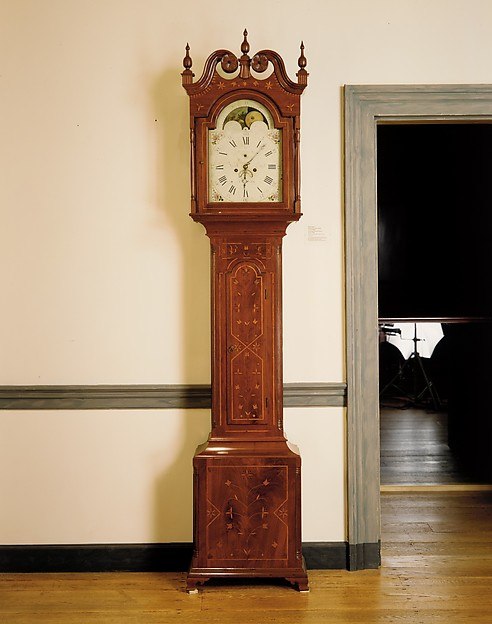
This tall clock is the work of American clockmaker Jacob Diehl (1776–1858), dating to circa 1800. Held by The Metropolitan Museum of Art (accession number 1976.279), the piece was manufactured in Reading, Pennsylvania. The case is constructed from walnut and pine, measuring 96 1/2 inches in height, 21 1/2 inches in width, and 12 1/2 inches in depth. The design is characterized by an integration of English and continental style influences, which was present in rural Pennsylvania furniture production during the turn of the nineteenth century. The dial features artistic details that are virtually identical to those found on another clock by the same maker, documented in the museum's collection as 1980.458. The object is currently housed within The American Wing of the museum and was acquired through the gifts of Douglas and Priscilla de Forest Williams, Mr. and Mrs. Eric M. Wunsch, and The Sack Foundation.

Tall clock by Jacob Diehl, ca. 1800, collection of The Metropolitan Museum of Art.
Tall clock by Jacob Diehl, ca. 1800, collection of The Metropolitan Museum of Art. — The Metropolitan Museum of Art. Rights pending — permission not yet requested. Original source

Catalogue identity

Source
orbiscollectibles.com
Category
Clock · Tall clock
Maker / attribution
Jacob Diehl
Reference
1976.279
Catalogue / lot identifier
1976.279
Source-reported date
ca. 1800
Source-reported place
United States

Source-reported attribution and specifications are not independent authentication. A listing does not establish present ownership, current display, availability or permission to reproduce.

Object description

Case and Dial Design

The clock case is constructed primarily from walnut and pine, standing at a height of 96 1/2 inches. The exterior surfaces of the case are adorned with inlay work, displaying intricate floral or geometric patterns that extend from the base to the waist section. The hood of the clock features an arched pediment crowned by finials, which frames the dial.

The dial layout and aesthetic treatment are described by the museum as nearly identical to those seen on another clock by the same maker, Jacob Diehl (accession number 1980.458).

Evidence for this section
  • “The Metropolitan Museum of Art holds this object as 1976.279.”
  • “the dial of this clock is virtually identical to that of another clock crafted by Jacob Diehl, designated as 1980.458.”

Historical Context and Attribution

Attributed to the clockmaker Jacob Diehl (1776–1858) of Reading, Pennsylvania, the clock dates to approximately 1800.

The Metropolitan Museum of Art identifies the object as a product of the cultural shift in rural Pennsylvania furniture production, where English and continental European design elements were synthesized.

Evidence for this section
  • “This clock serves as an example of the fusion of English and continental design elements that took place in rural Pennsylvania furniture at the turn of the nineteenth century.”
  • “Made in Reading, Pennsylvania, United States”

Provenance and Documentation

The clock is part of The American Wing collection at The Metropolitan Museum of Art, assigned accession number 1976.279. It entered the collection in 1976 through a purchase supported by the Douglas and Priscilla de Forest Williams gift, as well as contributions from Mr. and Mrs. Eric M. Wunsch and The Sack Foundation.

The museum maintains records confirming the clock's provenance and physical specifications. While the maker is identified, the museum notes that clocks of this type may have components—specifically cases and movements—that were produced by separate workshops or combined at a later time.

Evidence for this section
  • “Purchase, Douglas and Priscilla de Forest Williams, Mr. and Mrs. Eric M. Wunsch and The Sack Foundation Gifts, 1976.”
  • “movements and cases were frequently made by different workshops and were sometimes married later.”

Open research questions

  • Are there records of the movement's maker beyond the attribution to Jacob Diehl?
  • Can the specific workshop in Reading, Pennsylvania, where the case was produced be verified through archival furniture records?

Source evidence

Recorded claims and source quotations for Tall Clock by Jacob Diehl
FieldSource-reported valueSource quotation
MakerJacob Diehl (1776–1858)“Jacob Diehl (1776–1858)”
Dateca. 1800“ca. 1800”
MaterialsWalnut, pine“Walnut, pine”
Dimensions96 1/2 x 21 1/2 x 12 1/2 in. (245.1 x 54.6 x 31.8 cm)“96 1/2 x 21 1/2 x 12 1/2 in. (245.1 x 54.6 x 31.8 cm)”
GeographyReading, Pennsylvania, United States“Made in Reading, Pennsylvania, United States”
Accession Number1976.279“1976.279”
DepartmentThe American Wing“Department: The American Wing.”

Visible details

  • Case features extensive floral or geometric inlay decoration
  • Hood displays an arched pediment with finials
  • Clock face includes an arched moon phase or calendar indicator

Research qualifications

  • Museum notes suggest stylistic similarities to other works but do not explicitly confirm mechanical consistency
  • Source notes that movements and cases in such clocks were sometimes married later, though this is not specified for this particular object

Photograph identity and source facts were screened before import; rights clearance remains pending.

Terms in this record

Glossary explanations for terms named in this object’s record.