
Skip to content
The Encyclopedia of Horology

Clock · Tall clock

Tall Clock by Benjamin Willard

Partially verified

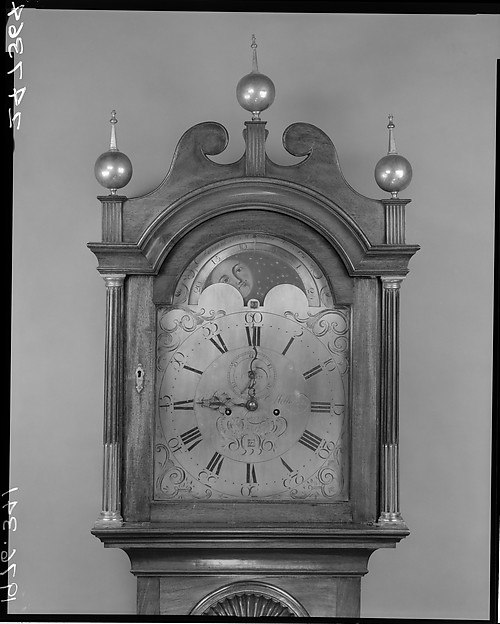
This tall clock, produced in 1772 in Roxbury, Massachusetts, is a collaborative work by clockmakers Benjamin Willard (1743–1803) and Simon Willard (1753–1848). Held by The Metropolitan Museum of Art (accession 1976.341), the clock is constructed from mahogany, cherry, and white pine. It measures 95 1/4 by 21 7/8 by 10 3/8 inches. The object is documented by inscriptions on its components, which identify the original owner, Mr. James Mears, and provide specific production information. The dial is signed "Benja.n Willard" and includes the "Roxbury" location. Inscriptions indicate that this was the 131st clock produced by Benjamin Willard, while the movement is identified as the ninth produced by Simon Willard. The clock features a moon phase indicator in the arch of the dial. The piece reflects the collaborative clockmaking endeavours of the Willard brothers during the period of approximately 1771 to 1775.

View of the tall clock dial showing the moon phase indicator, maker signature, and location.
View of the tall clock dial showing the moon phase indicator, maker signature, and location. — The Metropolitan Museum of Art. Rights pending — permission not yet requested. Original source

Catalogue identity

Source
orbiscollectibles.com
Category
Clock · Tall clock
Maker / attribution
Benjamin Willard and Simon Willard
Reference
Not recorded
Catalogue / lot identifier
1976.341
Source-reported date
1772
Source-reported place
United States
Source-reported serial
131 (Benjamin Willard), 9 (Simon Willard)

Source-reported attribution and specifications are not independent authentication. A listing does not establish present ownership, current display, availability or permission to reproduce.

Object description

Case and Dial Construction

The tall clock is constructed from a combination of mahogany, cherry, and white pine. Its physical dimensions are recorded at 95 1/4 inches in height, 21 7/8 inches in width, and 10 3/8 inches in depth.

The dial features a moon phase mechanism located in the arch, displaying a moon face design. The dial face is inscribed with the maker's name, "Benja.n Willard," and the location, "Roxbury." Further text on the dial identifies the warrantee and date of manufacture.

Evidence for this section
  • “The museum records its materials as: Mahogany, cherry, white pine.”
  • “these inscriptions clearly note that it was Benjamin Willard’s 131st clock”

Movement and Inscriptions

The movement of this clock is identified as the ninth produced by Simon Willard. The back plate of the movement carries specific inscriptions that detail its intended recipient and its provenance.

These inscriptions include the number "No 9" and the name of the original owner, Mr. James Mears. The documentation on the movement confirms the collaborative nature of the clockmaking, distinguishing between the work of the two brothers.

Evidence for this section
  • “that its movement was the ninth made by Simon Willard.”
  • “upon the clock itself, which reveal the name of the original owner”

Provenance and Historical Context

The clock is part of The Metropolitan Museum of Art's collection in The American Wing, having entered the museum as a gift of Dr. and Mrs. Brooks H. Marsh in 1976.

Museum records categorize the piece as a collaborative effort between Benjamin and Simon Willard, dating the object to 1772, within a broader production window of 1771 to 1775. The object is cited as being well-documented by the inscriptions present on its surfaces.

Evidence for this section
  • “Credit line: Gift of Dr. and Mrs. Brooks H. Marsh, 1976.”
  • “Dating from about 1771–75, this clock represents a characteristic example of the collaborative work undertaken by the Willard brothers.”
  • “The piece is well documented”

Open research questions

  • What specific workshop records exist to detail the division of labor between Benjamin and Simon Willard for this serial number?
  • Has any independent forensic analysis been conducted to verify the timber composition mentioned in the museum records?

Source evidence

Recorded claims and source quotations for Tall Clock by Benjamin Willard
FieldSource-reported valueSource quotation
MakerBenjamin Willard and Simon Willard“Tall Clock made by Benjamin Willard (1743–1803), dated 1772, from American.”
Museum Number1976.341“The Metropolitan Museum of Art holds this object as 1976.341.”
Dimensions95 1/4 x 21 7/8 x 10 3/8 in. (241.9 x 55.6 x 26.4 cm)“95 1/4 x 21 7/8 x 10 3/8 in. (241.9 x 55.6 x 26.4 cm).”
MaterialsMahogany, cherry, white pine“Mahogany, cherry, white pine.”
Production NumberBenjamin Willard 131, Simon Willard 9“these inscriptions clearly note that it was Benjamin Willard’s 131st clock, and that its movement was the ninth made by Simon Willard.”
Original OwnerMr. James Mears“reveal the name of the original owner”
Location of ManufactureRoxbury, Massachusetts“Made in Roxbury, Massachusetts, United States”

Visible details

  • Moon phase disc features a human face.
  • Dial is inscribed "Warranted for Mr. James Mears 1772".
  • Movement back plate is inscribed "No 9" and "for Mr. Jam.s Mears Roxbury".
  • Case includes reeded column details.

Research qualifications

  • Historical collaboration dynamics between the Willard brothers remain subject to ongoing scholarship.
  • The dating of the piece is provided as 1772, with a wider range of 1771–75 noted in museum records.

Photograph identity and source facts were screened before import; rights clearance remains pending.

Consulted source

Tall Clock by Benjamin Willard, American, 1772

Reviewed 2026-11-02 · Record 2745c821da

Terms in this record

Glossary explanations for terms named in this object’s record.