
Skip to content
The Encyclopedia of Horology

Clock · Table clock

Table Clock with Figure of Fame

Partially verified

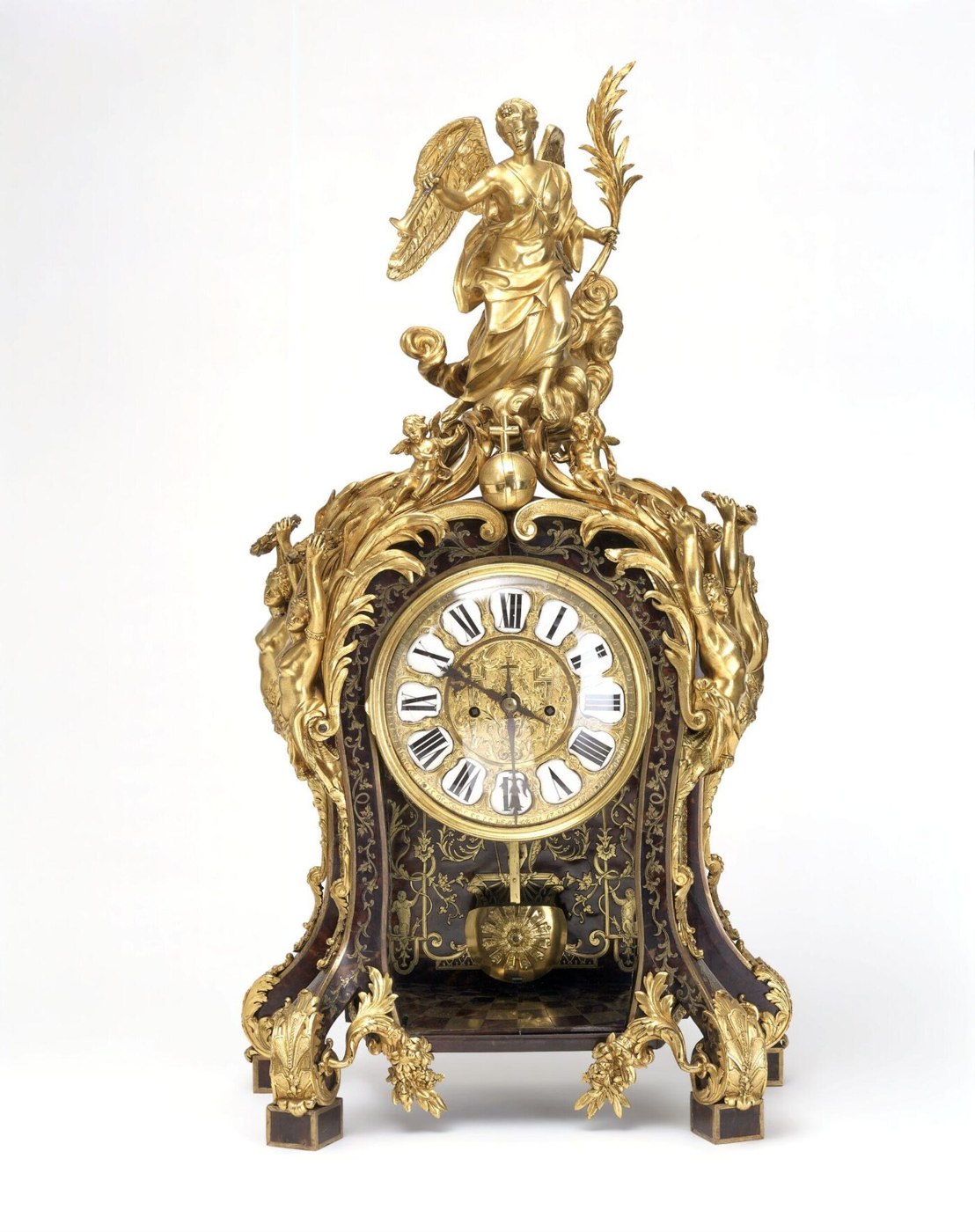
This table clock, measuring 78 cm in height, 40 cm in width, and 20 cm in depth, is a reproduction of an original timepiece created circa 1715 for Maximilian II Emmanuel, Elector of Bavaria. The clock features a mahogany case veneered with tortoiseshell, inlaid with brass in the style of Boulle work. It is surmounted by a bronze figure of Fame. The provenance of the object includes the collection of John Jones, who bequeathed it to the South Kensington Museum in 1882. While the identity of the maker of this specific copy remains unrecorded, it is known to be one of two extant versions, with the other held in the Wallace Collection. The design lacks the armorials present at the base of the Wallace Collection example. The object is a component of a larger collection of furniture and decorative arts transferred to the museum following Jones's death.

Front view of the table clock featuring the decorative marquetry and the figure of Fame.
Front view of the table clock featuring the decorative marquetry and the figure of Fame. — Victoria and Albert Museum. Rights pending — permission not yet requested. Original source

Catalogue identity

Source
collections.vam.ac.uk
Category
Clock · Table clock
Maker / attribution
Not established
Reference
Not recorded
Catalogue / lot identifier
1002-1882
Source-reported date
18th century
Source-reported place
England

Source-reported attribution and specifications are not independent authentication. A listing does not establish present ownership, current display, availability or permission to reproduce.

Object description

Case Construction and Materials

The table clock is constructed with a mahogany carcass, which serves as the base for decorative surface treatment. The exterior surfaces are adorned with a marquetry veneer composed of tortoiseshell and brass inlay. This technique follows the 18th-century Boulle work tradition.

The decorative scheme is complemented by ormolu mounts integrated into the structure. A prominent feature of the clock is the bronze figure of Fame, which is mounted on the top of the case, contributing to the overall height of 78 cm.

Evidence for this section
  • “A table clock, with a mahogany case veneered with turtleshell inlaid with brass surmounted by a bronze figure of Fame”
  • “Marquetry of brass and tortoiseshell, mounted in ormolu, in the style of 18th c Boulle work.”

Historical Context and Attribution

This clock is documented as a copy of a 1715 original originally owned by Maximilian II Emmanuel, Elector of Bavaria. The source notes that while the maker of this piece is not recorded, it belongs to a group of two known copies of the original.

Unlike the version held in the Wallace Collection, which includes armorials at the centre of the base, this specific clock lacks such ornamentation. It is noted that the piece may have been supplied by the London dealer John Webb, though this remains an association rather than a verified record of origin.

Evidence for this section
  • “This clock is a close copy of that made circa 1715 for Maximilian II Emanuel, Elector of Bavaria”
  • “This clock differs from the copy in the Wallace Collection in that there are no armorials at the centre of the bottom of the case.”

Provenance and Museum Entry

The clock was part of the collection of John Jones, a tailor and businessman who resided at 95 Piccadilly, London. The collection consisted of a wide range of furniture, paintings, and decorative arts kept within his residence.

Upon his death in 1882, the clock was transferred to the South Kensington Museum following his will and a subsequent codicil. The clock was one of sixteen timepieces bequeathed to the institution by Jones, where it became part of the permanent collection under the accession number 1002-1882.

Evidence for this section
  • “This clock was among a large collection of furniture, porcelain, metalwork, paintings and books owned by the tailor and businessman John Jones”
  • “In his will of 4 December 1879 and in a codicil of 22 January 1880, Jones bequeathed the objects to the South Kensington Museum”

Open research questions

  • What is the specific movement mechanism type housed within the clock?
  • Are there internal maker marks on the movement plates that could clarify its origin?

Source evidence

Recorded claims and source quotations for Table Clock with Figure of Fame
FieldSource-reported valueSource quotation
Accession number1002-1882“1002-1882”
Date18th century“18th century”
Place of originEngland“England”
DimensionsHeight: 78 cm; Width: 40 cm; Depth: 20 cm“Height: 78 cm; Width: 40 cm; Depth: 20 cm”
MaterialsMarquetry of brass and tortoiseshell, mounted in ormolu“Marquetry of brass and tortoiseshell, mounted in ormolu.”
ProvenanceBequeathed by John Jones“Bequeathed by John Jones”
Historical contextClose copy of an original clock from 1715“This clock is a close copy of that made circa 1715 for Maximilian II Emanuel”

Visible details

  • Case features brass and tortoiseshell marquetry
  • Surmounted by a metallic figure of Fame
  • Dial includes Roman numerals
  • Movement back plate shows a central bell

Research qualifications

  • Maker of this copy is unrecorded
  • Specific dating beyond 18th century is not provided by source

Photograph identity and source facts were screened before import; rights clearance remains pending.

Consulted source

Clock

Reviewed 2026-10-26 · Record c9881cf73b

Terms in this record

Glossary explanations for terms named in this object’s record.