
Skip to content
The Encyclopedia of Horology

Clock · Table clock

Table clock with calendar

Partially verified

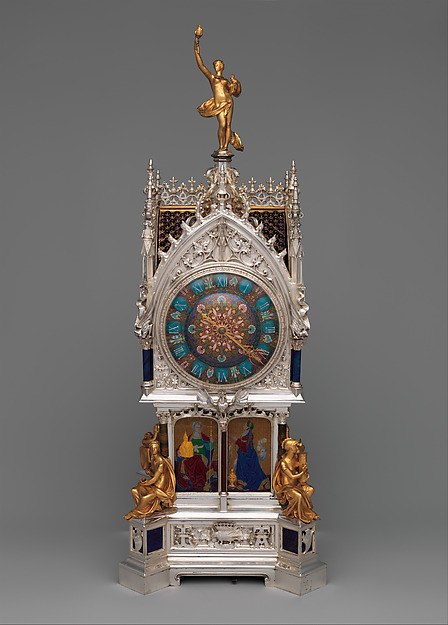
Designed by Lucien Falize in 1881 for Alfred Morrison, this miniature late-Gothic-style tower clock is constructed from cast silver, gold, and various hardstones including rock crystal, amethysts, carnelian, jasper, and lapis lazuli. The movement was produced by the firm Le Roy et Fils. The case is arranged in three tiers with winged gargoyles, crockets, and Gothic pointed arches. It incorporates elaborate decorative elements including basse-taille enameled plaques depicting allegorical figures, heraldic reliefs, and seated gold Cardinal Virtue figures modeled by Léon Chédeville. The clock features dual primary functions: one side presents time-telling via an engraved rock crystal lens, while the reverse displays three circular calendrical dials registering days of the week, days of the month, and months of the year. The movement, housed within, is spring-driven and features a rack-and-snail striking train.

Table clock with calendar, designed by Lucien Falize, 1881. Front view.
Table clock with calendar, designed by Lucien Falize, 1881. Front view. — The Metropolitan Museum of Art. Rights pending — permission not yet requested. Original source

Catalogue identity

Source
www.metmuseum.org
Category
Clock · Table clock
Maker / attribution
Lucien Falize
Reference
Not recorded
Catalogue / lot identifier
1991.113a–f
Source-reported date
1881
Source-reported place
France

Source-reported attribution and specifications are not independent authentication. A listing does not establish present ownership, current display, availability or permission to reproduce.

Object description

Construction and Design

The clock is conceived as a miniature tower in a late-Gothic style, standing approximately 18 1/2 inches tall. The primary structure consists of three distinct tiers: a base of cast silver with heraldic reliefs and seated gold figures, a midsection incorporating window-like frames with enameled plaques and hardstone colonettes, and an upper section containing the dials.

Ornamentation is extensive, utilizing a palette of lapis lazuli, carnelian, and jasper. The uppermost reaches are decorated with silver crockets, finials, and winged gargoyles. The architectural inspiration appears to have been sourced from Gothic church structures, with the entire piece topped by a svelte figure of Truth.

Evidence for this section
  • “The case is divided into three tiers.”
  • “The top carries two more plaques on the sides and time and calendar dials on the front and back sides. These are within Gothic pointed arches complete with silver crockets and finials and with winged gargoyles at the corners.”

Timekeeping and Calendar Functions

The clock operates with two primary display sides. The front indicates time via a convex rock crystal lens engraved with numerals I–XII on the interior. The minute scale is set into the silver bezel, marked in five-minute increments with circular punchmarks. Sculptured gold hands, set with tiny diamonds, sweep across a center decorated with cloisonné and painted floral ornaments.

The reverse side houses the calendrical functions, consisting of three circular dials representing the days of the week, the days of the month, and the months of the year. These are set within gold openwork branches, each utilizing a diamond-set gold hand. Beneath these dials, an owl figure presides over the calendar side.

Evidence for this section
  • “The principal dial registers the time (I–XII for the hours) engraved on the interior of a convex lens of rock crystal.”
  • “The reverse side carries a comparable lens-covered circle encompassing three smaller circular dials that register calendrical information.”

Movement and Maker Details

The clock’s movement was provided by the firm Le Roy et Fils, which held a royal warrant from Queen Victoria. The spring-driven mechanism is constructed from two rectangular brass and steel plates separated by four cylindrical pillars.

The going and striking trains are wound together by a single square located beneath the top figure of Truth.

Evidence for this section
  • “The spring-driven movement of the clock consists of two rectangular plates held apart by four cylindrical pillars.”
  • “It has a going and a striking train wound in tandem by means of a single winding square concealed under the figure of Truth at the top of the clock.”
  • “A lever in the base of the clock activates a repeating mechanism.”

Open research questions

  • What is the current mechanical condition of the repeating mechanism?
  • Does the serial number of the movement, if present, correlate with internal records of Le Roy et Fils from 1881?

Source evidence

Recorded claims and source quotations for Table clock with calendar
FieldSource-reported valueSource quotation
MakerLucien Falize“The Museum’s clock is the design of a nineteenth-century Frenchman, Lucien Falize (1839–1897)”
Dimensions18 1/2 × 7 × 7 in.“Overall: 18 1/2 × 7 × 7 in. (47 × 17.8 × 17.8 cm)”
Movement makerLe Roy et Fils“On the underside of the base, the maker’s name appears: “LE ROY ET FILS / Horlogers / fournisseurs brevétas / de S. M. la Reine à Londres.””
SculptorLéon Chédeville“They were modeled by Léon Chédeville (died 1883)”
ProvenanceAlfred Morrison“it was inherited by his second son, Alfred, for whom the Museum’s clock was created.”
MediumSilver, gold, hardstones, enamels“Case: silver, partly enameled gold, hardstones, rock crystal, amethysts, and diamonds; movement: brass and steel”

Visible details

  • The clock is surmounted by a gold figure of Truth.
  • The time dial features a rock crystal lens with engraved numerals.
  • Basse-taille enamel plaques are set into the midsection and upper tower.
  • The clock incorporates lapis lazuli panels and colonettes.

Research qualifications

  • The original arrangement of the enameled plaques may have been altered at least twice.
  • The precise inspiration for the tower structure remains uncertain, potentially church-housed clockwork.

Photograph identity and source facts were screened before import; rights clearance remains pending.

Consulted source

Table clock with calendar

Reviewed 2026-10-26 · Record 54caf3b36e

Terms in this record

Glossary explanations for terms named in this object’s record.