
Skip to content
The Encyclopedia of Horology

Clock · Table clock

Table clock by Jan van Ceulen

Partially verified

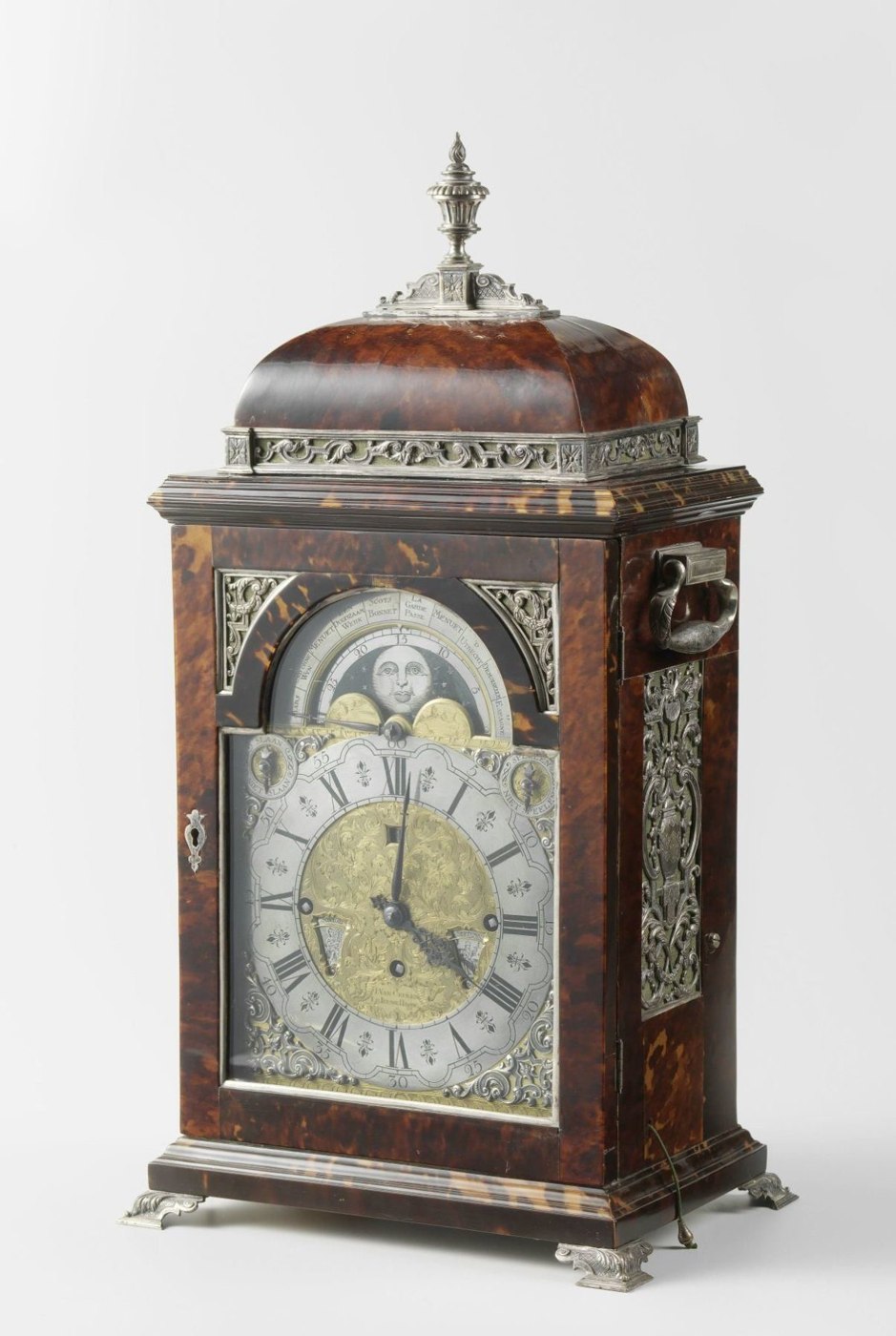
Housed in an oak case veneered with tortoiseshell and featuring silver accents, the clock measures 50 cm in height. It possesses multiple functions beyond timekeeping, including a full calendar indication and a display for the moon phase. Internally, the movement incorporates a musical mechanism equipped with nine bells capable of playing ten different melodies. The bronze dial is finely engraved in the center and includes silver corner ornaments and a silver chapter ring. The backplate is also described as being decorated with engraving, and the pendulum is directly connected to a verge escapement.

Frontal view of the table clock by Jan van Ceulen, displaying the dial with moon phase, calendar indicators, and control levers.
Frontal view of the table clock by Jan van Ceulen, displaying the dial with moon phase, calendar indicators, and control levers. — Rijksmuseum. Rights pending — permission not yet requested. Original source

Catalogue identity

Source
www.rijksmuseum.nl
Category
Clock · Table clock
Maker / attribution
Jan van Ceulen
Reference
Not recorded
Catalogue / lot identifier
BK-15991
Source-reported date
ca. 1700 - ca. 1725
Source-reported place
Netherlands

Source-reported attribution and specifications are not independent authentication. A listing does not establish present ownership, current display, availability or permission to reproduce.

Object description

Case and Aesthetic Features

The clock is constructed with an oak carcase, which is finished with a veneer of brown tortoiseshell. This primary material is complemented by extensive silver ornamentation applied to the structure, including decorative silver mounts at the corners and along the sides of the housing. The top of the case features a dome, surmounted by a silver-finished final.

The dial assembly consists of a bronze plate that has been finely engraved in the central portion, surrounded by silver corner mounts. The chapter ring is also formed of silver.

Evidence for this section
  • “Tafelklok, bruin schildpad met zilveren versieringen, ook op de zijkanten”
  • “bronzen wijzerplaat, in 't midden fijn gegraveerd, in de benedenhoeken zilveren versieringen, cijferring van zilver”

Movement and Functional Complications

The clock is designed as a multi-functional instrument. Beyond the indication of time, it features a full calendar complication and a moon-phase display positioned at the upper section of the dial. The movement is driven by a mechanism that includes a musical system; this component utilizes nine bells to produce ten distinct musical melodies or arias.

The horological mechanism is built with a verge escapement, to which the pendulum is directly connected. The movement's backplate features ornamental engraving. To manage the auxiliary functions, the dial includes controls for the striking train and the musical train, inscribed with the options to 'strike/not strike' and 'play/not play' respectively.

Evidence for this section
  • “Deze klok geeft niet alleen de tijd aan, maar ook de datum en de stand van de zon en de maan.”
  • “speelwerk met negen bellen, speelt tien aria's.”
  • “slinger rechtstreeks verbonden met de lepelgang”

Signatures and Identifiers

The timepiece is identified by the signature 'I. van Ceulen Le Jeune Hague', which is applied as a cartouche on both the dial and the movement's backplate. This attribution links the clock to the Hague-based maker Jan van Ceulen.

The object is catalogued under the accession number BK-15991. Additionally, the dial contains specific instructional text regarding the operational controls, including 'speelen / niet speelen' located at the upper right and 'slaan / niet slaan' at the upper left, providing user interaction points for the musical and striking functions.

Evidence for this section
  • “signatuur, cartouche op wijzerplaat en achterplatine: ‘I. van Ceulen Le Jeune Hague’”
  • “Objectnummer BK-15991”

Open research questions

  • What is the specific provenance of this clock before it entered the Rijksmuseum collection?
  • How does the internal musical mechanism interact with the striking train to execute the ten melodies?

Source evidence

Recorded claims and source quotations for Table clock by Jan van Ceulen
FieldSource-reported valueSource quotation
MakerJan van Ceulen“Jan van Ceulen, Den Haag”
Dateca. 1700 - ca. 1725“ca. 1700 - ca. 1725”
Dimensions50 cm x 26.3 cm x 28.8 cm“hoogte 50 cm x breedte 26,3 cm x diepte 28,8 cm”
MaterialsOak, tortoiseshell, silver, brass, textile“eikenhout, gefineerd met schildpad, zilver, messing, textiel”
SignatureI. van Ceulen Le Jeune Hague“signatuur, cartouche op wijzerplaat en achterplatine: ‘I. van Ceulen Le Jeune Hague’”
Musical functionPlays ten melodies on nine bells“speelwerk met negen bellen, speelt tien aria's.”
Dial inscriptionsControls for striking and music“opschrift, wijzerplaat rechtsboven: ‘speelen / niet speelen’”
EscapementVerge escapement“slinger rechtstreeks verbonden met de lepelgang”

Visible details

  • Case finished with brown tortoiseshell veneer
  • Silver mounts on corners and sides
  • Musical selection controls for 'slaan' and 'speelen'
  • Engraved bronze dial center with Roman numerals

Research qualifications

  • The internal state of the movement is not detailed beyond the description of the escapement and musical work
  • The exact extent of the original silver and tortoiseshell preservation is not explicitly qualified

Photograph identity and source facts were screened before import; rights clearance remains pending.

Consulted source

Table clock, c. 1700 - c. 1725

Reviewed 2026-11-02 · Record 8c57341092

Terms in this record

Glossary explanations for terms named in this object’s record.