
Skip to content
The Encyclopedia of Horology

Clock · Table clock

Table clock by Jan Janse Boekelts

Partially verified

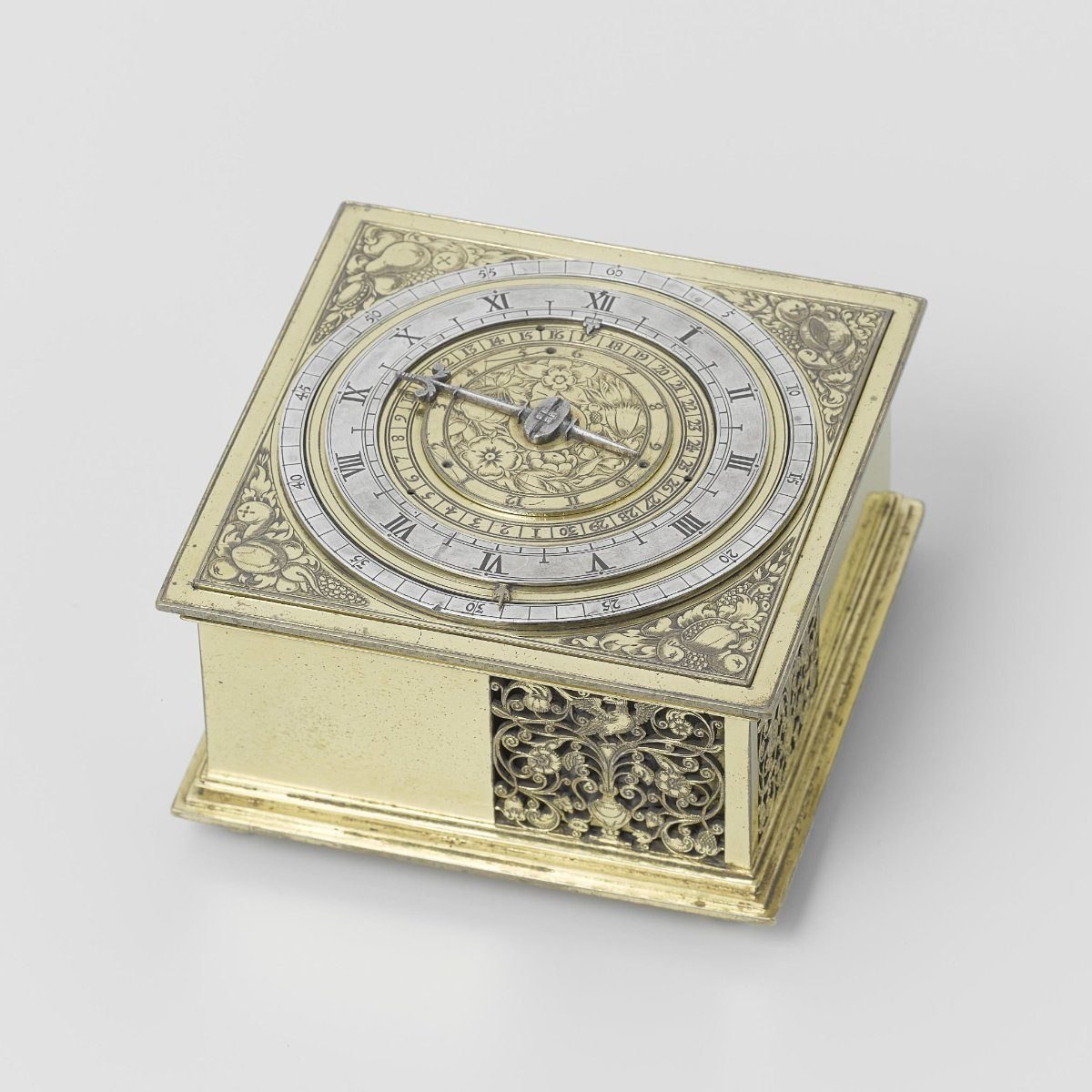
This square table clock is attributed to the maker Jan Janse Boekelts of Haarlem, dating between 1600 and 1625. The object is composed of a gilded copper clock movement housed within an oak case faced with tortoiseshell. The construction features a profiled base and top molding, with the walls of the case being openwork. The clock is supported by spherical feet and includes a hinged flap at the base and a glass top panel. The dial is decorated with engraved floral motifs and features a silver ring indicating hours and minutes, accompanied by a small hand. Additional decorative elements include openwork corner panels depicting vases, leaf tendrils, and a bird.

Table clock in an oak case veneered with tortoiseshell, by Jan Janse Boekelts, ca. 1600-1625.
Table clock in an oak case veneered with tortoiseshell, by Jan Janse Boekelts, ca. 1600-1625. — Rijksmuseum. Rights pending — permission not yet requested. Original source

Catalogue identity

Source
www.rijksmuseum.nl
Category
Clock · Table clock
Maker / attribution
Jan Janse Boekelts
Reference
Not recorded
Catalogue / lot identifier
BK-1957-7
Source-reported date
ca. 1600 - ca. 1625
Source-reported place
Netherlands

Source-reported attribution and specifications are not independent authentication. A listing does not establish present ownership, current display, availability or permission to reproduce.

Object description

Case and Dial Construction

The table clock is constructed from gilded copper and enclosed within an oak frame veneered with tortoiseshell. The design utilizes a square footprint supported by spherical feet, which elevate the base. The case features a profiled plinth and decorative top molding, with specialized openwork walls that provide visual depth to the exterior.

The dial is a prominent feature, displaying intricate engraved floral patterns across its surface. It incorporates a silver ring calibrated for both hours and minutes, allowing for precise time reading. The presence of a small hand facilitates this function. Furthermore, the top of the casing includes a glass panel, while the base contains a hinged flap, suggesting a design intended for both protected utility and handheld appreciation.

Evidence for this section
  • “Tafelklok van verguld koper, gevat in een eiken met schildpad belijmde kast met geprofileerde plint- en deklijst”
  • “wijzerplaat vertoont gegraveerde bloemen, een zilveren uren- en minutenring met kleine handwijzer”
  • “een klep aan de onderkant en een glasplaat bovenop”

Signatures and Decoration

The horological components are identified by the maker's signature located on the movement plate, explicitly naming Jan Janse Boekelts of Haarlem. This indicates the production originated from his workshop during the early 17th century.

Ornamentation is applied consistently across the object. Beyond the floral engravings on the dial, the clock case includes elaborate openwork corner panels. These panels represent artistic motifs including vases, intertwined leaf tendrils, and a bird, which enhance the aesthetic appeal of the gilded copper housing.

Evidence for this section
  • “signatuur, platine: ‘Jan Janse Boekelts Haerlem’”
  • “op twee hoeken zijn galmgaten aangebracht met opengewerkte versieringen met een vaas, bladranken en een vogel”

Acquisition and Provenance

The object is currently held within the Rijksmuseum collection, having been acquired by the institution in 1957. It is catalogued under the accession number BK-1957-7 and is designated as being in the public domain.

The description emphasizes that while the clock was often housed in a cabinet to prevent dirt accumulation, its refinement becomes apparent when removed from this protective environment.

Evidence for this section
  • “aankoop 1957”
  • “Gewoonlijk wordt een tafelklok opgeborgen in een kast, om het uurwerk tegen vuil en stof te beschermen. Haalt men hem uit zijn omhulsel, dan wordt duidelijk dat het een uiterst verfijnd kleinood is.”

Open research questions

  • What is the mechanical layout of the movement housed within the gilded copper frame?
  • Are there records in Haarlem archives that detail the specific production volume or client history of Jan Janse Boekelts during this period?

Source evidence

Recorded claims and source quotations for Table clock by Jan Janse Boekelts
FieldSource-reported valueSource quotation
MakerJan Janse Boekelts“uurwerkmaker: Jan Janse Boekelts, Haarlem”
Dateca. 1600 - ca. 1625“ca. 1600 - ca. 1625”
Dimensions6.8 cm x 12 cm x 12 cm“hoogte 6,8 cm x breedte 12 cm x diepte 12 cm”
Case materialsOak, tortoiseshell, gilded copper“Tafelklok van verguld koper, gevat in een eiken met schildpad belijmde kast”
Dial featuresSilver hour and minute rings with floral engraving“Wijzerplaat met bloemen en met minuten- en urenring van zilver.”
Signature locationMovement plate“signatuur, platine: ‘Jan Janse Boekelts Haerlem’”
Accession numberBK-1957-7“Objectnummer BK-1957-7”

Visible details

  • Square gilded copper top plate with engraved floral decoration.
  • Silver chapter ring marked with Roman numerals for hours and Arabic numerals for minutes.
  • Openwork side panels featuring stylized bird and plant motifs.
  • Small hand present on the dial assembly.

Research qualifications

  • Specific mechanical details beyond the movement plate signature are not provided.
  • The exact extent of original versus later components within the oak and tortoiseshell case is not specified.

Photograph identity and source facts were screened before import; rights clearance remains pending.

Consulted source

Table clock, c. 1600 - c. 1625

Reviewed 2026-11-02 · Record 26376b10ce

Terms in this record

Glossary explanations for terms named in this object’s record.