
Skip to content
The Encyclopedia of Horology

Tool · Sundial

Sundial on obelisk-shaped sandstone pedestal

Partially verified

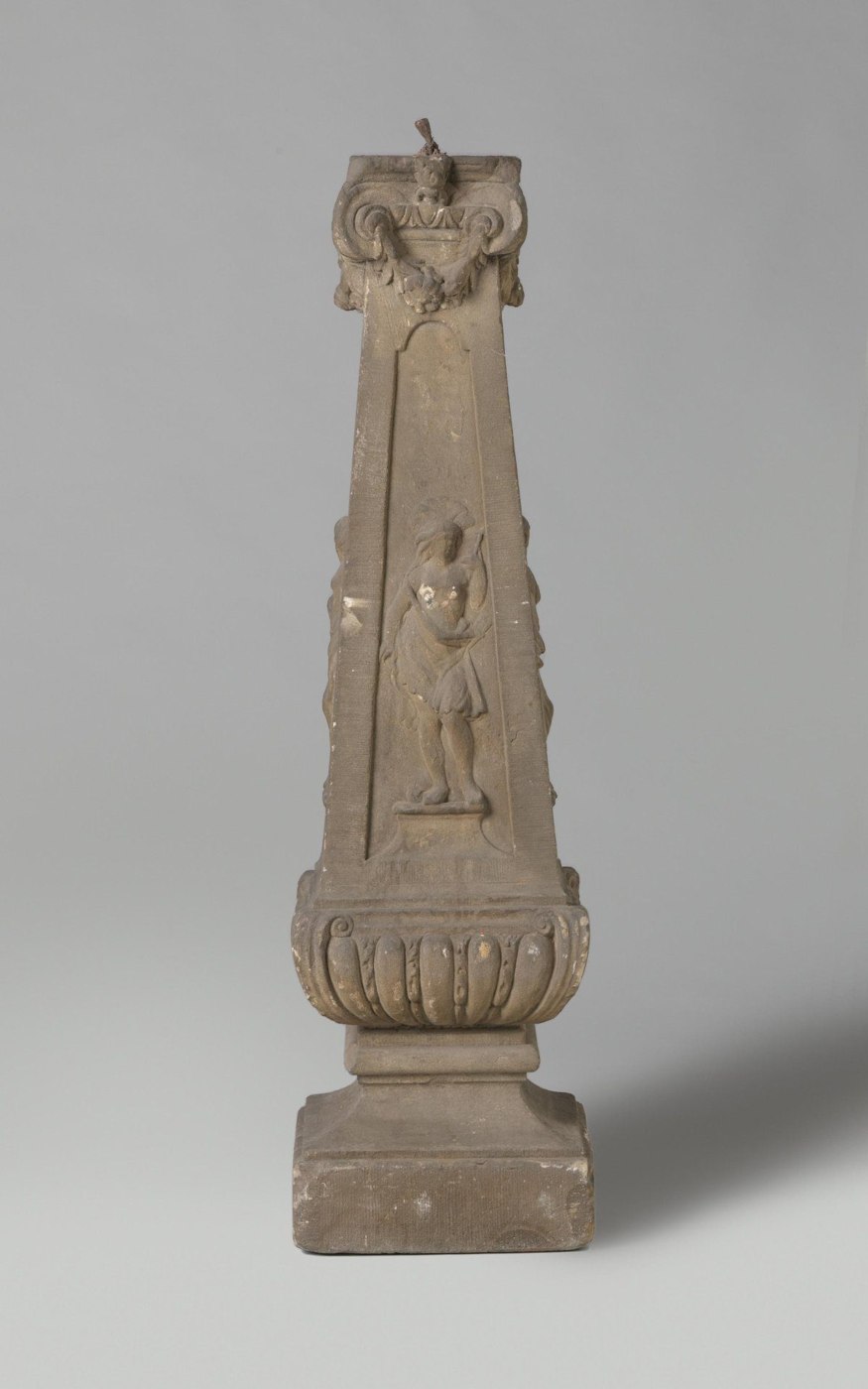
This sandstone pedestal, created between circa 1650 and 1660, functioned as a support for a sundial. It is constructed in the shape of an obelisk with a square base, featuring an upper plate decorated with garlands and a central iron pin protruding 4.1 centimeters. The design incorporates sections of gadrooning, or angled folds, which create transitions between the narrowing and broadening parts of the structure. The central section displays four female figures, each representing one of the four continents. The base of the object includes a concave section that widens towards the bottom. While the pedestal remains intact, the original copper sundial element is no longer present. The object was acquired by the Rijksmuseum in 1914 with support from the Vereniging Rembrandt and was formerly located in Uithoorn and Waverveen. It is currently held in the public domain.

Sandstone sundial pedestal with figurative reliefs of the continents.
Sandstone sundial pedestal with figurative reliefs of the continents. — Rijksmuseum. Rights pending — permission not yet requested. Original source

Catalogue identity

Source
www.rijksmuseum.nl
Category
Tool · Sundial
Maker / attribution
Not established
Reference
BK-BFR-338
Catalogue / lot identifier
BK-BFR-338
Source-reported date
ca. 1650 - ca. 1660
Source-reported place
Not established

Source-reported attribution and specifications are not independent authentication. A listing does not establish present ownership, current display, availability or permission to reproduce.

Object description

Structural Design and Ornamentation

The sundial pedestal is carved from sandstone and stands as an obelisk-shaped monument. The top section is enclosed by carved garlands and supports an iron pin, measuring 4.1 centimeters in length, which functioned as the gnomon for the missing horizontal dial. The overall form utilizes multiple architectural transitions, including decorative bands of gadrooning—represented as angled, folded carvings—that manage the tapering of the column as it rises.

Below the upper decorative zone, the structure broadens, providing a display space on its four sides. Each of these four faces features a relief sculpture depicting a female figure, intended to symbolize one of the four continents. The lower portion of the pedestal is characterized by a concave widening section, which sits upon a square-shaped base, providing stability and visual balance to the taller obelisk above.

Evidence for this section
  • “Voetstuk van zandsteen in de vorm van een obelisk”
  • “Het bovenblad is omsloten door guirlandes en bevat een ijzeren pin”
  • “schuine plooiingen, oftewel gadrooning, ervoor dat de sokkel versmalt”

Provenance and Historical Documentation

The object is of Dutch origin, historically documented in the municipalities of Uithoorn and Waverveen before its acquisition by the museum. Records indicate it was purchased in May 1914 with the financial support of the Vereniging Rembrandt. It has been documented in early museum reports, including the 1914 Annual Report of the Rijksmuseum, where it appears under two distinct internal inventory numbers, 1826 and 338.

The physical object includes an annotation on its side in white chalk, consisting of a simple cross mark, though its specific purpose in relation to the object's history remains undocumented. The current museum classification places the object under its collection of historic architectural and scientific support structures, maintaining its status as a public domain piece.

Evidence for this section
  • “De zonnewijzer is afkomstig uit Uithoorn en bevond zich eerder in Waverveen”
  • “aankoop 1914-05”
  • “Jaarverslag Rijksmuseum 1914, afb. op p. 9 en p. 4. Zowel onder inventarisnummer 1826 als 338”
  • “annotatie, zijkant van de sokkel, wit krijt: ‘een kruis’”

Condition and Completeness

The current state of the object is described as a pedestal without its functional horological instrument. The documentation explicitly confirms that the copper portion of the sundial is lost. Despite this missing element, the sandstone pedestal retains its integrity, including the fragile relief carvings and the original iron gnomon pin fixed to the upper plate.

Visible surface conditions are consistent with historical sandstone structures, with the object remaining largely preserved in its mid-17th-century configuration. No further structural damage is reported in the museum’s administrative records, and the object is treated as a complete sculptural unit for display purposes, even in the absence of the mechanical timekeeping attachment.

Evidence for this section
  • “De bijbehorende koperen zonnewijzer ontbreekt”
  • “bevat een ijzeren pin die 4,1 centimeter boven het bovenblad uitsteekt”

Open research questions

  • What was the original configuration or material composition of the missing copper sundial?
  • Is the white chalk cross a provenance mark from a specific estate in Waverveen or Uithoorn?

Source evidence

Recorded claims and source quotations for Sundial on obelisk-shaped sandstone pedestal
FieldSource-reported valueSource quotation
MaterialSandstone“Voetstuk van zandsteen”
Dateca. 1650 - ca. 1660“ca. 1650 - ca. 1660”
Object numberBK-BFR-338“BK-BFR-338”
Iron pinProtrudes 4.1 cm above top“ijzeren pin die 4,1 centimeter boven het bovenblad uitsteekt”
Missing elementOriginal copper sundial is missing“De bijbehorende koperen zonnewijzer ontbreekt”
MarkWhite chalk mark of a cross“annotatie, zijkant van de sokkel, wit krijt: ‘een kruis’”
AcquisitionAcquired 1914 via Vereniging Rembrandt“Aankoop met steun van de Vereniging Rembrandt”

Visible details

  • Iron pin at top measuring 4.1 cm
  • Four female personifications of continents carved in relief
  • Concave base section
  • Square ground surface

Research qualifications

  • The copper sundial component is missing
  • Maker is unknown/anonymous

Photograph identity and source facts were screened before import; rights clearance remains pending.

Terms in this record

Glossary explanations for terms named in this object’s record.