
Skip to content
The Encyclopedia of Horology

Pocket watch · Pair-cased pocket watch with 6-hour dial

Silver watch with '6-hour dial' by William Bartram

Partially verified

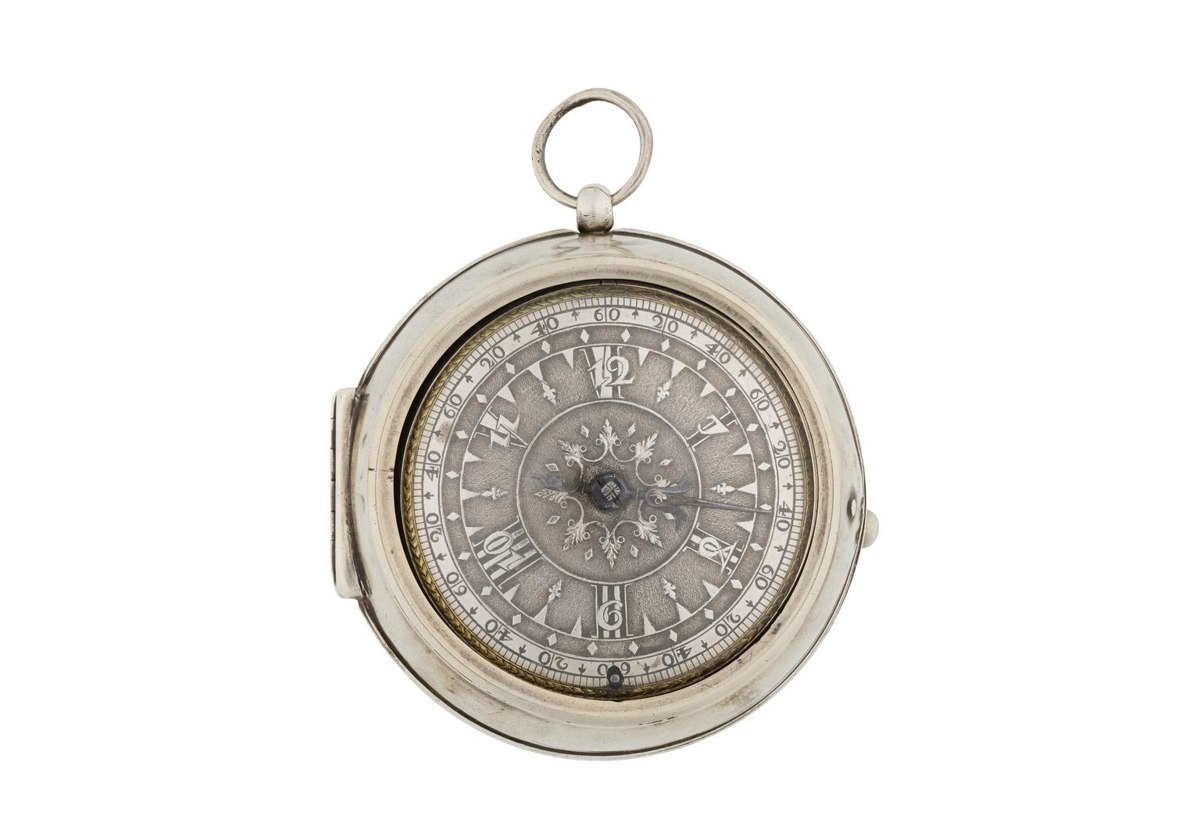
This silver pair-cased pocket watch was made in London around 1680 by William Bartram. The dial uses an experimental six-hour layout where the single steel hand completes one revolution every six hours rather than twelve. To represent twelve hours across each half of the day, Arabic numerals 7 through 12 are positioned over Roman numerals I through VI, and minute graduations from 1 to 60 appear between each hour. The museum notes the watch features a verge escapement signed 'Will Bertram, London' on the movement backplate, an outer calendar ring, an inner case engraved 'J. Smith', and an outer case marked 'J.S.'.

Front view of the silver pair-cased pocket watch by William Bartram with a six-hour dial
Front view of the silver pair-cased pocket watch by William Bartram with a six-hour dial — Science Museum Group / The Clockmakers' Museum © The Board of Trustees of the Science Museum. Rights pending — permission not yet requested. Original source

Catalogue identity

Source
collection.sciencemuseumgroup.org.uk
Category
Pocket watch · Pair-cased pocket watch with 6-hour dial
Maker / attribution
William Bartram
Reference
Not recorded
Catalogue / lot identifier
L2015-3123
Source-reported date
c.1680
Country
United Kingdom

Source-reported attribution and specifications are not independent authentication. A listing does not establish present ownership, current display, availability or permission to reproduce.

Object description

Case and External Markings

The timepiece is a silver pair-cased watch. The inner case is engraved with the name 'J. Smith', while the outer case is marked 'J.S.', which the source suggests may refer to the original owner.

The watch is constructed from materials including brass, silver alloy, steel, and glass, with overall dimensions of 55 mm x 47 mm x 28 mm.

Evidence for this section
  • “Silver pair cased watch with '6-hour dial' by William Bartram, London c.1680.”
  • “The inner silver case is engraved ‘J. Smith’ and the outer ‘J.S.’ This may refer to the original owner.”
  • “Materials: brass (copper, zinc alloy) , silver (alloy) , steel (metal) and glass”
  • “overall: 55 mm x 47 mm x 28 mm”

Dial Configuration

The watch features a silver champlevé dial with a single steel hand that completes one rotation every 6 hours. To represent the 12 hours of the day, Arabic numerals 7 through 12 are placed over Roman numerals I through VI.

The dial includes an outer calendar ring and minute graduations numbered 1 to 60 between each hour marker.

Evidence for this section
  • “Silver champlevé dial with steel hour hand and outer calendar ring.”
  • “The hour hand makes a complete rotation once every 6 hours, rather than the usual 12 hours.”
  • “The dial indicate the 12 hours for each half of the day by placing the numbers 7-12 (in Arabic numerals) over the top of the numbers 1-6 (in Roman numerals).”
  • “The minutes are listed from 1-60 between each hour marker.”

Movement and Attribution

The movement features a verge escapement. The backplate is signed 'Will Bertram, London'. The object is attributed to William Bartram and dated to approximately 1680.

The variation in name spelling between the source's title and the signed backplate is noted in the provided documentation.

Evidence for this section
  • “Movement with verge escapement and signed ‘Will Bertram, London’ on the backplate.”
  • “Silver pair cased watch with '6-hour dial' by William Bartram, London c.1680.”

Open research questions

  • What is the mechanical relationship between the 6-hour dial rotation and the calendar ring?
  • Are there further archival records detailing the transition or naming conventions between 'Will Bertram' and 'William Bartram'?

Source evidence

Recorded claims and source quotations for Silver watch with '6-hour dial' by William Bartram
FieldSource-reported valueSource quotation
MakerWilliam Bartram“Silver pair cased watch with '6-hour dial' by William Bartram, London c.1680.”
Datec.1680“Made: 1680 in London”
Object numberL2015-3123“Object Number: L2015-3123”
Movement signatureWill Bertram, London“Movement with verge escapement and signed ‘Will Bertram, London’ on the backplate.”
Dial featuresSilver champlevé dial with 6-hour rotation and outer calendar ring“Silver champlevé dial with steel hour hand and outer calendar ring.”
Dimensions55 mm x 47 mm x 28 mm“overall: 55 mm x 47 mm x 28 mm”
Object NumberL2015-3123“Object Number: L2015-3123”
Clockmakers' Museum ReferenceNo. 50“Clockmakers' Museum No. 50”

Visible details

  • Silver pair case with a rounded bow and suspension ring at top and an external hinge on the left.
  • Silver champlevé dial featuring an intricately engraved floral and foliate center rosette.
  • Dual hour chapter ring displaying Roman numerals I through VI beneath Arabic numerals 7 through 12.
  • Divisions between hour markers calibrated with numerals 20, 40, and 60.
  • Single dark steel hand pointing toward the right quadrant.

Research qualifications

  • The movement backplate, escapement, and case back engravings are not visible in the front photograph.
  • The museum notes the backplate signature spells the maker's name 'Will Bertram'.

Photograph identity and source facts were screened before import; rights clearance remains pending.

Consulted source

Silver watch with '6-hour dial' by William Bartram | Science Museum Group Collection

Reviewed 2026-10-25 · Record 07dba50326

Terms in this record

Glossary explanations for terms named in this object’s record.