
Skip to content
The Encyclopedia of Horology

Pocket watch · Pocket watch

Silver Pocket Watch

Partially verified

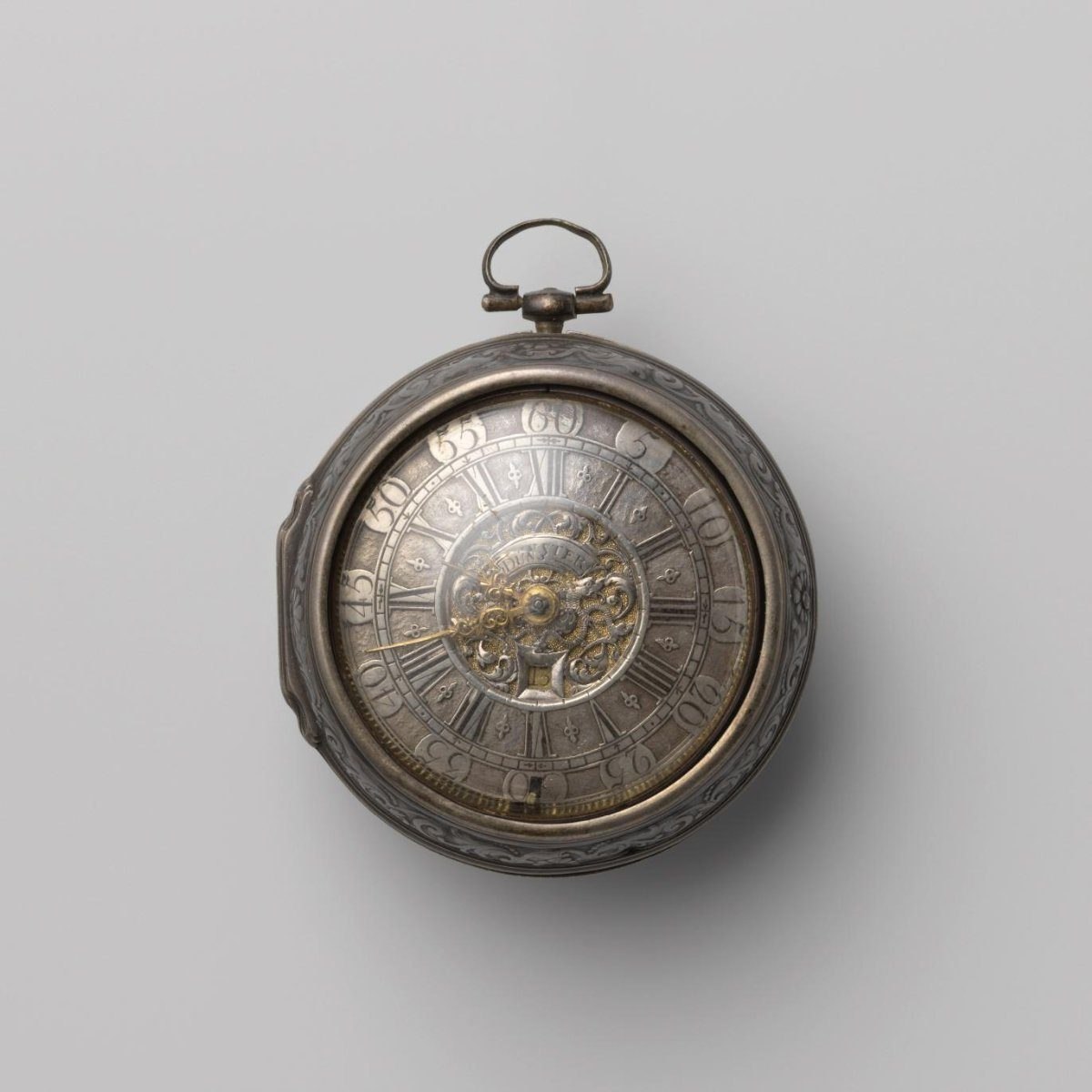
This object is a silver watch, currently held in the collection of the Rijksmuseum in Amsterdam under the accession number BK-NM-12815. Attributed to a period between circa 1700 and 1725, the timepiece is constructed from silver and features detailed decoration. The watch includes a chased dial that is equipped with a date display function. The exterior case of the watch is also decorated with a chased scene. No specific maker or place of origin has been formally identified or recorded in the museum documentation. The physical dimensions of the object are recorded as a height of 6.9 cm, a width of 5.6 cm, and a depth of 3.2 cm, with the watch itself having a diameter of 5.2 cm. The museum classification for the object includes both jewellery and a watch. The documentation relies upon translations from the original Dutch catalogue text of the holding institution.

The silver watch, displaying its chased dial with central date display and the manufacturer's name 'DUNSTER' visible on the dial, and external case decoration.
The silver watch, displaying its chased dial with central date display and the manufacturer's name 'DUNSTER' visible on the dial, and external case decoration. — Rijksmuseum, Amsterdam. Rights pending — permission not yet requested. Original source

Catalogue identity

Source
orbiscollectibles.com
Category
Pocket watch · Pocket watch
Maker / attribution
Not established
Reference
Not recorded
Catalogue / lot identifier
BK-NM-12815
Source-reported date
c. 1700 - c. 1725
Source-reported place
Not established

Source-reported attribution and specifications are not independent authentication. A listing does not establish present ownership, current display, availability or permission to reproduce.

Object description

Case and Dial Design

The watch is manufactured primarily from silver, utilizing chasing techniques for decorative effect. The dial is characterized by its chased surface, which serves as a foundation for the hour markers and the integrated date display window. This display provides a functional layer to the aesthetic design of the watch face.

The exterior of the case is similarly ornamented. It features a chased scene that encompasses the outer surfaces, The watch is suspended by a circular pendant loop at the top, allowing for attachment to a chain or fob.

Evidence for this section
  • “The piece features a chased dial equipped with a date display.”
  • “A scene is chased into the outer case of the watch.”
  • “The watch is recorded as being made of silver (metal) and executed with chasing.”

Dimensions and Documentation

The physical proportions of the timepiece are documented as follows: the object has a total height of 6.9 cm, a width of 5.6 cm, and a depth of 3.2 cm. The diameter of the watch itself is 5.2 cm. These measurements suggest an object intended for portability, despite the discrepancy in the museum classification records.

The object is held within the Rijksmuseum collection in Amsterdam. The documentation notes that no specific maker or geographical place of manufacture has been established for this specimen, leaving the origin attributed solely to the period window of 1700 to 1725.

Evidence for this section
  • “Its recorded measurements are a height of 6.9 cm, a width of 5.6 cm, and a depth of 3.2 cm, with a watch diameter of 5.2 cm.”
  • “The object is held in the collection of the Rijksmuseum in Amsterdam under the museum object number BK-NM-12815.”
  • “with no maker or place of manufacture specified in the documentation.”

Classification and Identification

The museum records identify the object under the headings of jewellery and a wrist watch. While the visual evidence strongly suggests a pocket-sized design, the formal classification reflects the museum's internal inventory system. The term 'wrist watch' appearing in the museum record is a point of note, given the chronological dating to the early 18th century.

No inscriptions or legends were identified on the object that would aid in identifying a manufacturer or a workshop. The lack of such markers remains a consistent feature in the available catalogue descriptions, requiring further research to determine if similar models can be linked to a known horological source.

Evidence for this section
  • “This object is a silver watch, classified in the collection records as jewellery and as a wrist watch.”
  • “No inscriptions or legends are recorded in the catalogue description.”

Open research questions

  • Does the 'wrist watch' classification in the Rijksmuseum database refer to a later conversion or an internal archival convention?
  • Can the chased scenes on the case and dial be attributed to a specific region or artisan based on stylistic motifs common between 1700 and 1725?

Source evidence

Recorded claims and source quotations for Silver Pocket Watch
FieldSource-reported valueSource quotation
Materialsilver“Watch of silver”
Datingc. 1700 - c. 1725“c. 1700 - c. 1725”
Museum NumberBK-NM-12815“BK-NM-12815”
Height6.9 cm“height of 6.9 cm”
Width5.6 cm“width of 5.6 cm”
Depth3.2 cm“depth of 3.2 cm”
Diameter5.2 cm“watch diameter of 5.2 cm”

Visible details

  • The dial features a central chased metal section with a visible date aperture.
  • The outer case surface is embellished with chased decorative work.
  • A single primary hand is visible at the center of the dial.
  • The dial includes an outer chapter ring displaying minute numerals.

Research qualifications

  • The museum classifies the object as a 'wrist watch', which may be an artifact of archival terminology rather than a functional description.
  • The maker and place of manufacture remain unknown and are not cited in the provided records.

Photograph identity and source facts were screened before import; rights clearance remains pending.

Consulted source

Watch of silver, c. 1700 - c. 1725

Reviewed 2026-11-02 · Record ad82786ba5

Terms in this record

Glossary explanations for terms named in this object’s record.