
Skip to content
The Encyclopedia of Horology

Pocket watch · Calendar pocket watch

Silver Calendar Pocket Watch by Gerrit Bramer

Partially verified

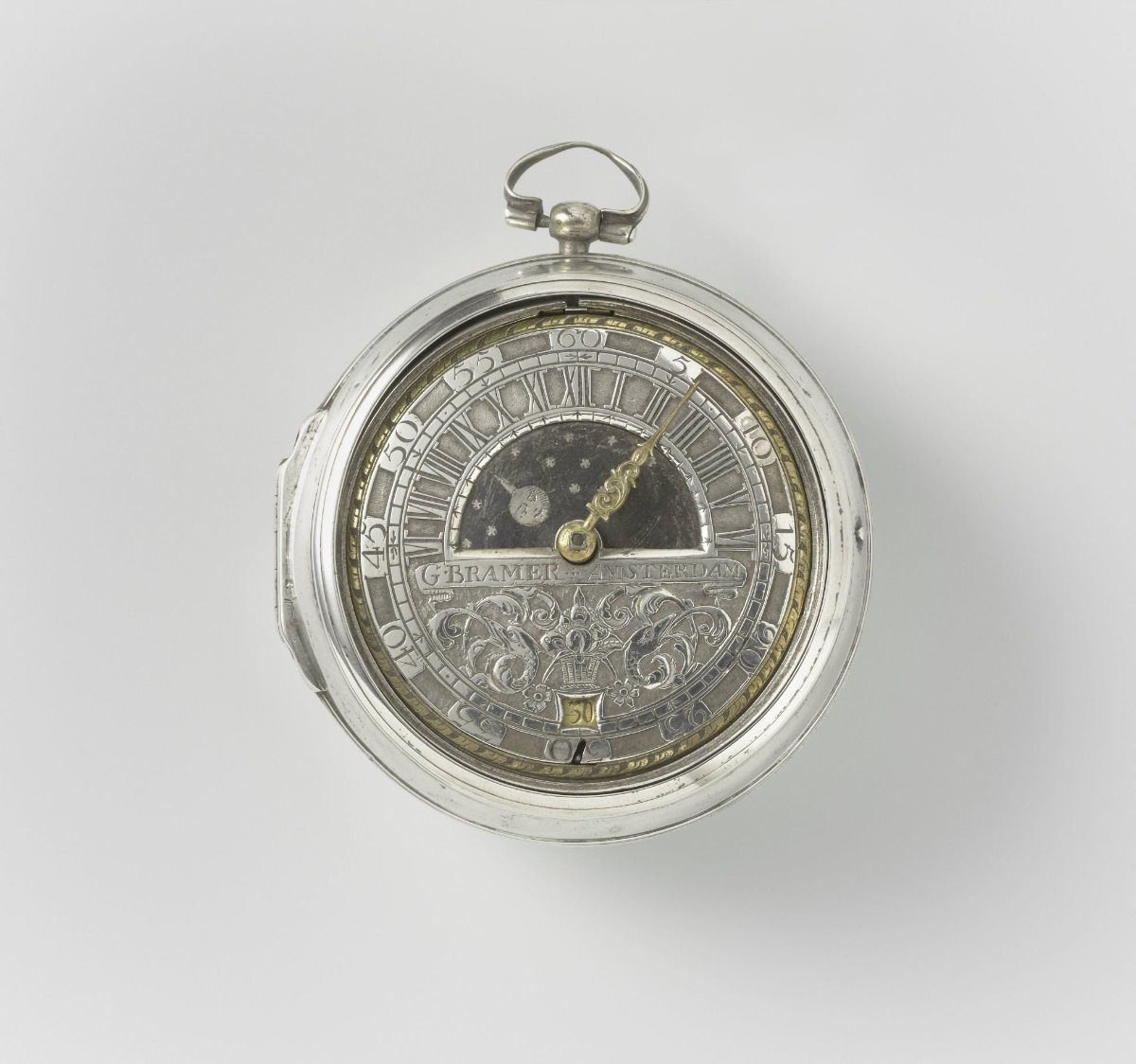
This calendar pocket watch, attributed to the Amsterdam-based watchmaker Gerrit Bramer, dates to approximately 1725. Housed in a plain silver case, the timepiece features a complex dial configuration split into two distinct semicircular zones. The upper section displays Roman hour numerals and incorporates a rotating disc depicting celestial elements, specifically the sun, moon, and stars. The lower dial section is decorated with engraved foliage patterns on a granulated surface and features a jumping date indicator. Arabic minute numerals are engraved upon silver plates set into the outermost ring of the dial. The single-handed watch utilizes a movement with a richly decorated cock, and the movement plate bears the signature of Gerrit Bramer. The object is part of the Maurits Elzas collection, having been bequeathed to the museum in 1937, and the silver case is attributed to the Amsterdam silversmith Thauvet Beslay.

The dial of the Bramer calendar watch, showing the single hand, celestial display, and date window.
The dial of the Bramer calendar watch, showing the single hand, celestial display, and date window. — Rijksmuseum. Rights pending — permission not yet requested. Original source

Catalogue identity

Source
www.rijksmuseum.nl
Category
Pocket watch · Calendar pocket watch
Maker / attribution
Gerrit Bramer
Reference
Not recorded
Catalogue / lot identifier
BK-15028
Source-reported date
ca. 1725
Source-reported place
Netherlands

Source-reported attribution and specifications are not independent authentication. A listing does not establish present ownership, current display, availability or permission to reproduce.

Object description

Dial and Timekeeping

The watch displays time and calendar information on a split-level dial face divided into two semicircular areas. The upper section is dominated by Roman numerals for the hours and contains a rotating disc that visualizes celestial cycles through depictions of the sun, moon, and stars. The perimeter of the dial features a fixed ring inset with silver plates, which carry engraved Arabic numerals for the minutes.

The lower part of the dial surface exhibits a textured, granulated finish, upon which scrolling engraved foliage is applied. Centrally integrated into this section is a jumping date mechanism. The watch uses a single hand to indicate the time. The dial is signed with the watchmaker's name across the mid-section, indicating the origins of the work in the city of Amsterdam.

Evidence for this section
  • “De wijzerplaat is in twee halve cirkels verdeeld; de bovenste wordt ingenomen door de Romeinse uurcijfers en een draaibare plaat met afbeelding van de zon, maan en sterren”
  • “De Arabische minuutcijfers zijn gegraveerd op zilveren platen op de buitenste ring”
  • “gemerkt: G. Bramer Amsterdam”

Movement and Case

The timepiece is protected by a plain, undecorated silver case. The physical construction of the movement includes a balance bridge or 'kloof' which is described as being richly decorated. This decorative treatment of the internal components is accompanied by the signature of the watchmaker inscribed directly onto the main plate.

The silversmith work responsible for the creation of the plain silver case is attributed to Thauvet Beslay, an artisan working in Amsterdam during the same period as the watchmaker.

Evidence for this section
  • “Zilveren horloge met losse onversierde kast”
  • “De platine met rijkbewerkte kloof is eveneens gesigneerd: Gerrit Bramer, Amsterdam”
  • “edelsmid: toegeschreven aan Thauvet Beslay, Amsterdam”

Provenance and Acquisition

The watch reached the museum as part of a significant legacy left by Maurits Elzas, a collector based in Arnhem. The collection, which included over one hundred other timepieces, was transferred to the institution in 1937. Prior to this, the watch's history can be traced back to 1921 when it was acquired by Elzas from an anonymous seller in Nijmegen for the price of 30 florins.

The acquisition history is documented within the inventory records of the museum, confirming its long-term preservation within the Maurits Elzas collection. , where it remains cataloged as item number BK-15028.

Evidence for this section
  • “from an anonymous seller, Nijmegen, fl. 30, to Maurits Elzas (1868-1937), Arnhem, 1921”
  • “by whom bequeathed with 106 other watches, as part of the 'Maurits Elzas Collection', to the museum, 1937”

Open research questions

  • What specific mechanical arrangement allows for the synchronization of the celestial disc and the jumping date?
  • Are there specific hallmark stamps present on the silver case to further verify the attribution to Thauvet Beslay?

Source evidence

Recorded claims and source quotations for Silver Calendar Pocket Watch by Gerrit Bramer
FieldSource-reported valueSource quotation
MakerGerrit Bramer“uurwerkmaker: Gerrit Bramer, Amsterdam”
Dateca. 1725“ca. 1725”
Case materialSilver“Zilveren horloge met losse onversierde kast”
Dial signatureG. Bramer Amsterdam“gemerkt: G. Bramer Amsterdam”
Movement signatureGerrit Bramer, Amsterdam“De platine met rijkbewerkte kloof is eveneens gesigneerd: Gerrit Bramer, Amsterdam”
Case attributionThauvet Beslay“edelsmid: toegeschreven aan Thauvet Beslay, Amsterdam”
ProvenanceMaurits Elzas Collection“by whom bequeathed with 106 other watches, as part of the 'Maurits Elzas Collection', to the museum, 1937”

Visible details

  • Single central hand
  • Dial split into upper and lower zones
  • Engraved foliage on granulated ground
  • Celestial rotating disc

Research qualifications

  • Attribution of the silver case to Thauvet Beslay
  • Functionality of the celestial rotating disc mechanism

Photograph identity and source facts were screened before import; rights clearance remains pending.

Consulted source

Watch with a Plain Silver Case

Reviewed 2026-11-02 · Record c236711124

Terms in this record

Glossary explanations for terms named in this object’s record.