
Skip to content
The Encyclopedia of Horology

Clock · Shelf clock

Shelf Clock by Seth Thomas

Partially verified

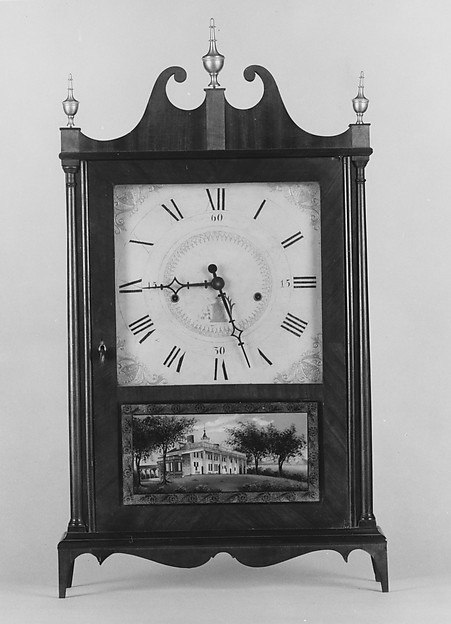
This shelf clock was produced by Seth Thomas (1785–1859), a clockmaker based in Connecticut, around 1820. The object is held by The Metropolitan Museum of Art (accession number 62.195). Its construction incorporates mahogany, maple, and white pine. The clock measures 27 7/8 by 15 3/4 by 3 3/4 inches (70.8 by 40 by 9.5 cm). The movement contained within the clock is derived from designs for wooden clockworks developed by Eli Terry (1772–1852). In October 1818, Thomas entered into an agreement with Terry to manufacture this shelf clock mechanism in exchange for the payment of royalty fees. Thomas went on to produce nearly five thousand movements of this type. The lower door panel of the clock features a painted scene of Mount Vernon. The clock is part of The American Wing collection at the museum.

A front-facing view of the Seth Thomas shelf clock showing the dial, the Mount Vernon lower panel, and the case architecture.
A front-facing view of the Seth Thomas shelf clock showing the dial, the Mount Vernon lower panel, and the case architecture. — The Metropolitan Museum of Art, New York. Rights pending — permission not yet requested. Original source

Catalogue identity

Source
orbiscollectibles.com
Category
Clock · Shelf clock
Maker / attribution
Seth Thomas
Reference
Not recorded
Catalogue / lot identifier
62.195
Source-reported date
ca. 1820
Source-reported place
American

Source-reported attribution and specifications are not independent authentication. A listing does not establish present ownership, current display, availability or permission to reproduce.

Object description

Construction and Design

The clock is constructed primarily from mahogany, maple, and white pine. It stands approximately 27 7/8 inches tall. The exterior architecture features a decorative top pediment surmounted by three finials and framed by vertical side columns. A rectangular panel on the lower portion of the front door is decorated with a painting of Mount Vernon.

The internal mechanism is a wooden movement designed by Eli Terry. These movements were developed by Terry around 1815 for use in shelf clocks. Seth Thomas began manufacturing these specific movements following an agreement reached with Terry in October 1818, which stipulated the payment of royalty fees for the production of the clockworks.

Evidence for this section
  • “Mahogany, maple, white pine”
  • “In October 1818, Terry agreed to let Seth Thomas produce his shelf clock in return for the payment of a royalty fee.”
  • “painted on the lower section of the door is a scene of Mount Vernon.”

Historical Context and Attribution

The clock is attributed to the maker Seth Thomas, an American clockmaker active during the early 19th century. The Metropolitan Museum of Art, which maintains the object under accession number 62.195, dates the production to circa 1820. The movement technology stems from developments by Eli Terry, who is credited with introducing mass production techniques and interchangeable parts to the creation of clock mechanisms.

Seth Thomas operated within this framework, producing a significant volume of these shelf clock movements. The production was contingent on a royalty agreement between Thomas and Terry. This specific specimen represents the resulting collaboration between the two clockmakers during the era of early industrial clock production in the United States.

Evidence for this section
  • “Seth Thomas (1785–1859), dated ca. 1820”
  • “Thomas subsequently produced nearly five thousand movements, which are exemplified by the movements housed in this shelf clock.”
  • “In October 1818, Terry agreed to let Connecticut clockmaker Seth Thomas produce his shelf clock in exchange for royalty fees.”

Museum Provenance and Documentation

The object is currently held within the American Wing of The Metropolitan Museum of Art. It was acquired as part of the Rogers Fund in 1962. The museum record provides the technical specifications and identification details for the piece.

While the record identifies the maker and provides technical details, it also notes the importance of verifying that the case and movement are original to one another, as components were occasionally combined from different sources during later periods.

Evidence for this section
  • “The Metropolitan Museum of Art holds this object as 62.195.”
  • “Department: The American Wing. Credit line: Rogers Fund, 1962.”
  • “movements and cases were frequently made by different workshops and were sometimes married later.”

Open research questions

  • Does the movement contain any specific internal manufacturer marks or serial numbers beyond the general attribution?
  • Can the specific artist responsible for the Mount Vernon painting on the door be identified?

Source evidence

Recorded claims and source quotations for Shelf Clock by Seth Thomas
FieldSource-reported valueSource quotation
MakerSeth Thomas (1785–1859)“Seth Thomas (1785–1859)”
MaterialsMahogany, maple, white pine“Mahogany, maple, white pine”
Dimensions27 7/8 x 15 3/4 x 3 3/4 in. (70.8 x 40 x 9.5 cm)“27 7/8 x 15 3/4 x 3 3/4 in. (70.8 x 40 x 9.5 cm)”
Holding InstitutionThe Metropolitan Museum of Art“The Metropolitan Museum of Art”
Museum Number62.195“62.195”
Door DecorationPainted scene of Mount Vernon“painted on the lower section of the door is a scene of Mount Vernon.”
Movement ProductionNearly 5,000 movements produced“Thomas subsequently produced nearly five thousand movements”
Agreement DateOctober 1818“In October 1818, Terry agreed to let Seth Thomas produce his shelf clock”

Visible details

  • Painted lower door panel depicting Mount Vernon
  • Dial with Roman numerals and central ornamentation
  • Pediment with three brass-colored finials
  • Case constructed with vertical columns

Research qualifications

  • The source notes that movements and cases were sometimes married later, requiring verification of components.
  • The source states that Eli Terry probably invented the pillar-and-scroll case form.

Photograph identity and source facts were screened before import; rights clearance remains pending.

Consulted source

Shelf Clock by Seth Thomas, American, ca. 1820

Reviewed 2026-11-02 · Record cab46194f0

Terms in this record

Glossary explanations for terms named in this object’s record.