
Skip to content
The Encyclopedia of Horology

Clock · Shelf clock

William L. Gilbert Clock Company 'The Amphion' Shelf Clock

Partially verified

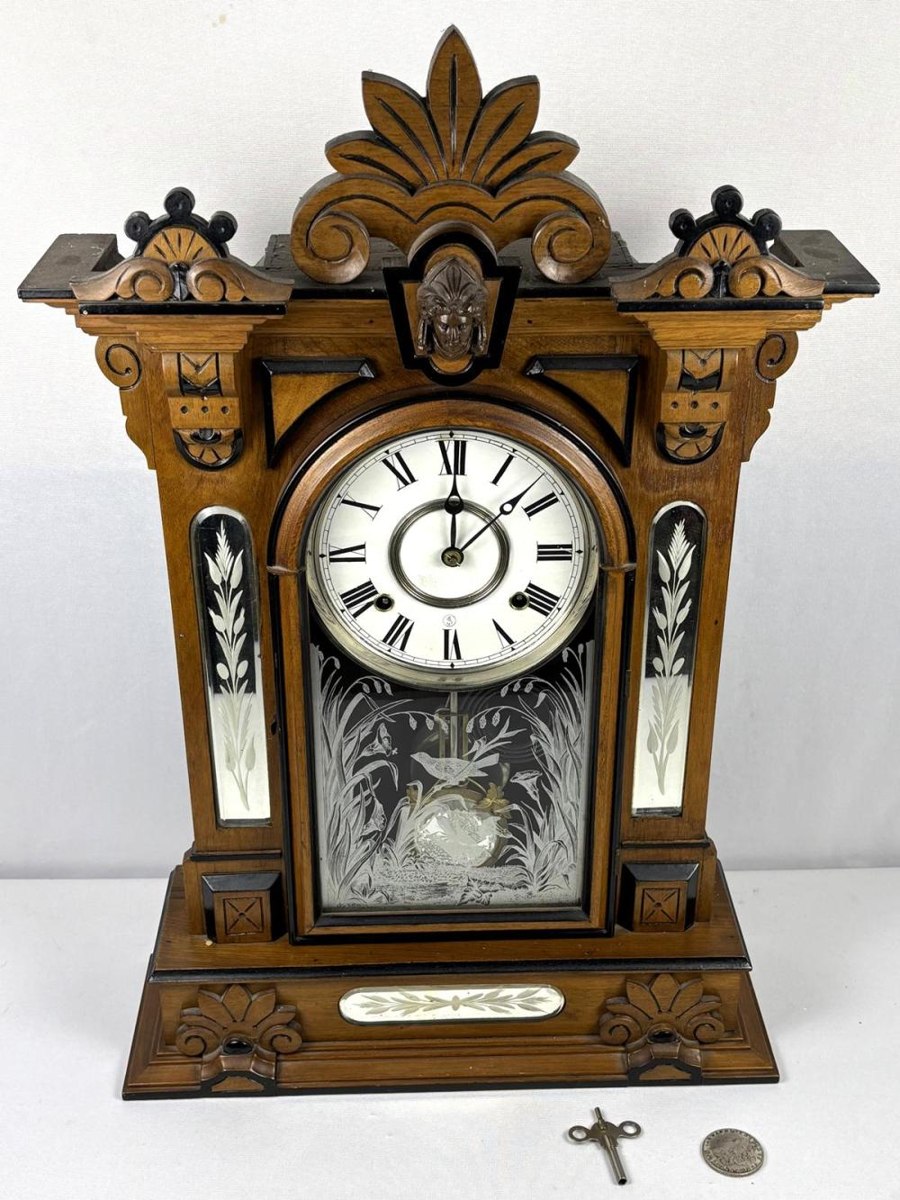
This antique 'Amphion' model shelf clock, produced circa 1884 by the William L. Gilbert Clock Company of Winsted, Connecticut, features an elaborate walnut case. The architectural design includes ebonized highlights, beveled mirrors with wheat motifs, and a pediment centered with a carved crest featuring a bust of Jenny Lind. The dome-topped door displays reverse-painted bird and grass imagery, allowing visibility of the pendulum and dial. Internally, the clock houses a rectilinear skeletonized brass eight-day movement that strikes on a patent-dated George B. Owen 'Cathedral' gong. The original manufacturer's paper label remains on the backboard. This distinctive Eastlake-style timepiece demonstrates significant craftsmanship through its numerous moldings and applied carvings.

Antique William L. Gilbert Clock Co. 'Amphion' shelf clock, c. 1884, featuring an elaborate walnut case with Jenny Lind crest and reverse-painted door.
Antique William L. Gilbert Clock Co. 'Amphion' shelf clock, c. 1884, featuring an elaborate walnut case with Jenny Lind crest and reverse-painted door. — One Source Auctions. Rights pending — permission not yet requested. Original source

Catalogue identity

Source
www.invaluable.com
Category
Clock · Shelf clock
Maker / attribution
William L. Gilbert Clock Company
Reference
Not recorded
Catalogue / lot identifier
4b40f20c94
Source-reported date
c. 1884
Country
United States

Source-reported attribution and specifications are not independent authentication. A listing does not establish present ownership, current display, availability or permission to reproduce.

Object description

Walnut case and carved crest

The auction description identifies this shelf clock as the Amphion by the William L. Gilbert Clock Company of Winsted, Connecticut, with an approximate date of 1884 in the lot title. Its walnut case is described with shaped mouldings, applied carving, Eastlake designs and ebonized highlighting. These are features of the particular case recorded by the seller, rather than independent proof of its date or originality.

The pediment has a central fleur-de-lys and shield-shaped carved crest. The source identifies the bust within the shield as Jenny Lind. Scrolled side crests with wooden rondels stand on either side, above an overhanging stepped architectural pediment. Triangular walnut spandrels appear above the door arch.

Evidence for this section
  • “The walnut case is decorated with numerous shaped moldings, applied carvings, Eastlake designs, ebonized highlighting, and beveled mirrors.”
  • “A bust of Jenny Lind is located in the center of the shield.”

Door glass and mirrored panels

The dome-topped door is described as carrying glass decorated from the reverse with a delicate silver transfer showing two birds in grass. The source says the design permits a view of both the dial and swinging pendulum. This description distinguishes the door decoration from the separate mirrored panels.

Bevelled mirrors stand on either side of the door and carry a wheat decoration. Below them are square ebony-edged blocks. A third cut-glass mirrored panel occupies the architectural base, flanked by cut foliate walnut forms. The repeated glass elements and carved framing are recorded features, not an assessment of restoration history.

Evidence for this section
  • “The artwork depicts two birds in the grass.”
  • “A wheat decoration is featured in the mirrors.”
  • “The architectural base centers a third cut-glass mirrored panel.”

Source-reported movement and surviving label

Behind the dial, the seller records a rectilinear skeletonized brass eight-day movement, with the front plate die-stamped by the maker. Hour and half-hour striking is described on a wire Cathedral gong mounted at the case back. The quoted gong patent is attributed to George B. Owen, number 256,727, dated April 18, 1882; this dates the cited patent rather than independently dating assembly of this clock.

The pendulum is described with multiple rods and a brass-bezel bob supporting decorative reverse-cut glass. A paper label remains on the backboard, naming Amphion and the Wm. L. Gilbert Clock Co. of Winsted, Connecticut. These internal features and label readings are source-reported: the held front photograph does not independently establish the movement markings or current mechanical condition.

Evidence for this section
  • “Behind the dial, one will find a rectilinear skeletonized brass eight-day movement.”
  • “No. 256,727. Patented Apr. 18, 1882.”
  • “The Clockmaker's paper label remains on the on the backboard.”

Open research questions

  • Can a clear backboard photograph verify the surviving Amphion label?
  • Do movement and case inspection reveal replaced components or repairs?

Source evidence

Recorded claims and source quotations for William L. Gilbert Clock Company 'The Amphion' Shelf Clock
FieldSource-reported valueSource quotation
MakerWilliam L. Gilbert Clock Company“MANUFACTURED BY / Wm. L. Gilbert Clock Co., / Winsted, Conn.”
Datec. 1884“Antique c. 1884 William L. Gilbert Clock Company”
Gong PatentApril 18, 1882“Patented Apr. 18, 1882.”
Movement TypeEight-day“rectilinear skeletonized brass eight-day movement”

Visible details

  • Walnut case with ebonized highlights and applied carvings
  • Reverse-painted glass panel depicting birds in grass
  • Includes winding key and a small circular object for scale
  • Beveled mirror panels with wheat decorations

Research qualifications

  • Internal movement condition is not visually verified
  • Functional state of the striking mechanism is not confirmed beyond the item title
  • Sold 'as is'

Photograph identity and source facts were screened before import; rights clearance remains pending.

Terms in this record

Glossary explanations for terms named in this object’s record.